Imagining Artist Methods
BonheurThe Horse Fair · 1852–55All 16

A studio guide · Paris, 1851–55

The Horse Fair, from the market to the frieze

Imagine you are Rosa Bonheur, thirty years old and already a first-class medallist at the Salon, with the horse market of Paris to paint on a canvas five metres wide. This guide follows what your process would have been, from studies made among the dealers to a canvas shown unfinished at the Salon of 1853 and reworked before it was sold, and on to London and New York.

The Met's 2016 catalogue entry, the 1853 reviews and the early biographies, two of them written with your family and one in your voice, tell how the picture was made and shown. No technical study of the canvas has been published, so the stages before the last are imagined from what those sources say. Each chapter opens with a note on what its evidence is. The slider steps through six stages; stages 1 to 5 are reconstructions.

1855, and today

Stage 6 of 6

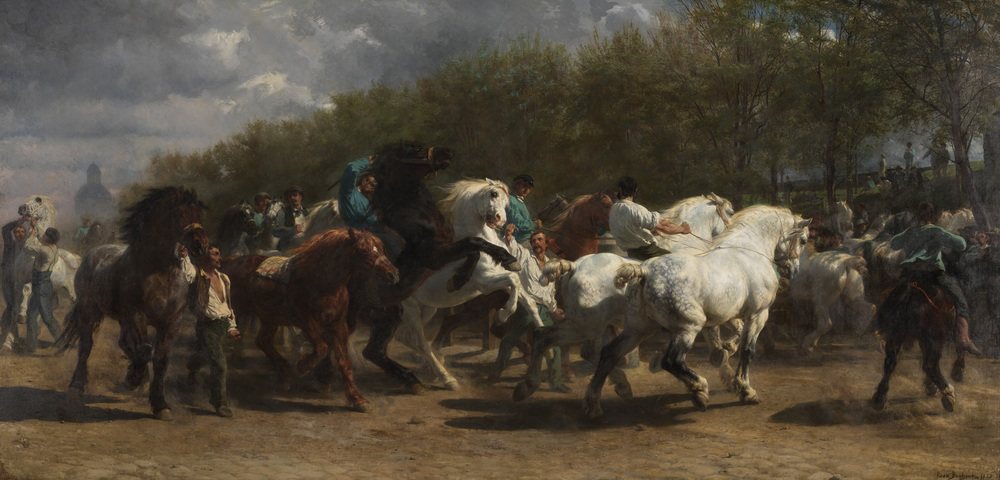
Reworked before the sale, probably in 1855, when you added a 5 to the date: “Rosa Bonheur 1853.5”. This is the painting today.

Rosa Bonheur, The Horse Fair (Le Marché aux chevaux), 1852–55. Oil on canvas, 244.5 × 506.7 cm. The Metropolitan Museum of Art, New York, gift of Cornelius Vanderbilt, 1887 (87.25). AI-generated Stage 2 is drawn with Prodia from this painting; stages 1 and 3 to 5 are made from the painting by simplifying, thinning and dulling it. None is based on technical evidence.

Your training

EvidenceLéon Roger-Milès's biography (1900), Anna Klumpke's book of 1908, written in your voice from conversations in 1898–99, and Theodore Stanton's collection of recollections (1910). The Salon records of your medals are given as Klumpke prints them.

You are Rosa Bonheur, born in Bordeaux on 16 March 1822. Your father, the painter Raymond Bonheur, is your only teacher; he sets you to copy in the Louvre. You study animals wherever you can find them: you spend whole days at the slaughterhouse of the Roule, and learn the anatomy of the horse from Richard du Cantal's study of it.

You first show at the Salon in 1841. A third-class medal follows in 1845 and a first-class medal in 1848. In 1849 the State acquires Ploughing in the Nivernais, a team of oxen breaking a field, 2.6 metres wide. That spring your father dies, and you succeed him as director of the free drawing school for girls in Paris, which you run for about ten years with your sister Juliette.

You live and work with Nathalie Micas. She looks after your business and, at times, helps with the painting.

Go to the horse market

EvidenceThe Met's catalogue entry, which cites Eugène de Mirecourt (1867) for the eighteen months; family recollections in Stanton (1910); Klumpke (1908); the police permit of 1857. No document from 1850–53 records how you dressed at the market.

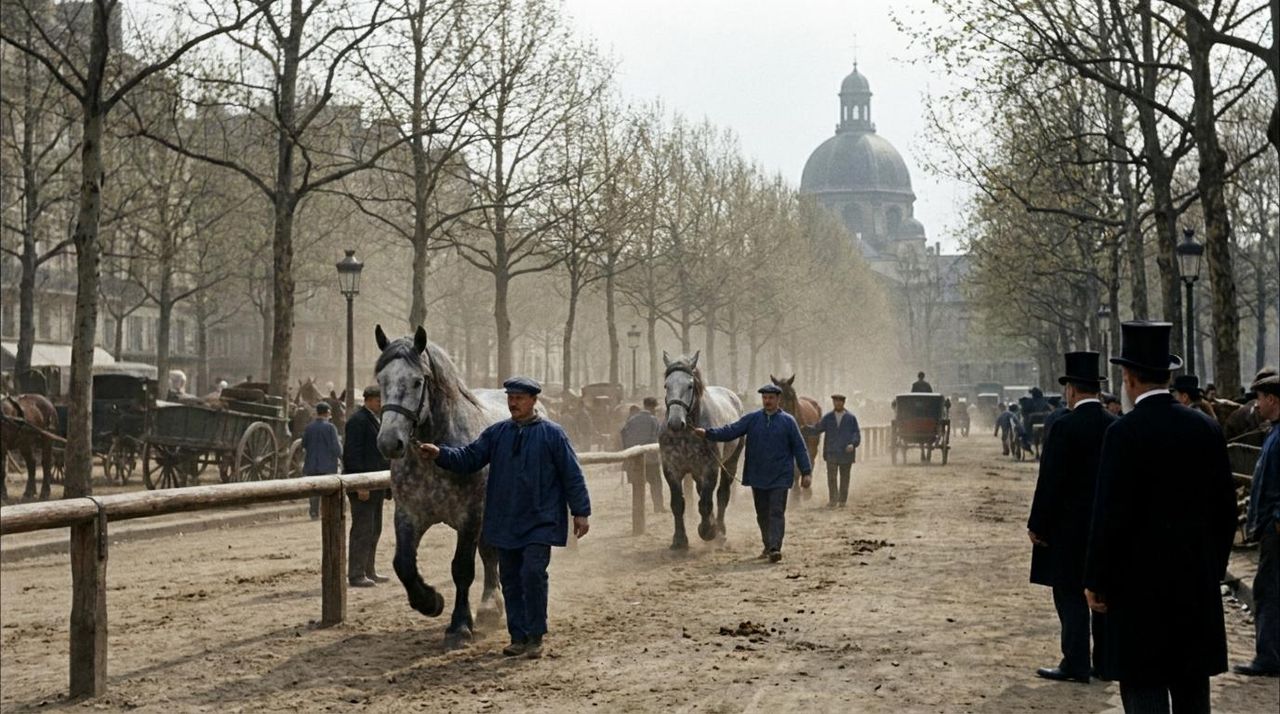
AI-generated reconstruction: a long dusty avenue lined with plane trees where dealers in blue smocks trot heavy dapple-grey horses past buyers in top hats, a grey dome above the trees in the distance.
AI-generatedThe horse market on the boulevard de l'Hôpital, as it might have looked in the early 1850s.

Paris has a horse market on the boulevard de l'Hôpital, a tree-lined avenue on the left bank, next to the Salpêtrière, the great hospice whose chapel dome rises over it. Dealers trot their horses up and down the avenue for buyers.

For a year and a half, according to the earliest account, you go there twice a week to draw. Your family remembered other sources too: the stables of the Paris omnibus company, whose director let you use their horses, and a stable built onto your own studio.

Among the dealers a woman's dress is, in the words Klumpke gives you, a constant hindrance. So, by every account from 1867 on, you go in men's clothes, and are taken for a young man. Dressing as a man in public needs a permit from the Prefecture of Police, valid for six months at a time.

The permit

The permit that survives is a renewal dated 12 May 1857, two years after the picture was finished. It gives your address as the rue d'Assas and your reason as health, and forbids you to appear so dressed at theatres, balls and other public gatherings. No permit from the years you spent at the market has been found, so it is not known when you first had one.

Draw, and draw again

EvidenceThe Met's three drawings and its catalogue entry; the Buffalo AKG Art Museum's oil sketch; Klumpke (1908). Many more studies are known from the 2022 exhibition catalogue, which was not read for this guide.

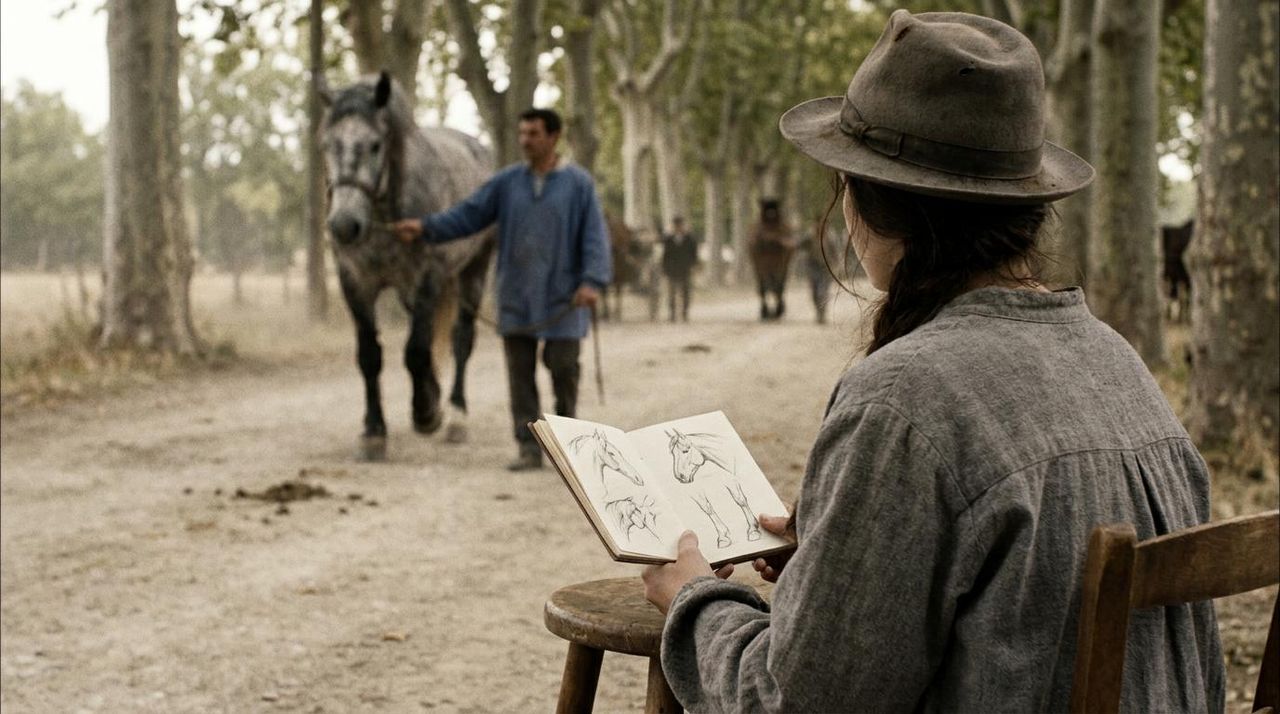
AI-generated reconstruction: over the shoulder of a young woman in a felt hat and grey smock, a sketchbook of quick horse drawings in her hands, a dealer leading a grey horse along a dusty avenue beyond.
AI-generatedDrawing at the market. Whether you drew there in a sketchbook or on loose sheets is not recorded.

You make, as Klumpke has you say, countless compositions and studies. The Met's curator notes that the number of preparatory drawings for this picture is unusually large. Draw the horses again and again, in pencil and black chalk: their legs in motion, their heads thrown up, the whole procession in a long strip.

A small oil sketch, about a quarter of a metre high, tries the composition in colour (chapter V). It differs from the final picture in several motifs: a wall closes the right side, and the horses are grouped differently.

Draw some of the men separately too, on bigger sheets, such as a bearded groom stripped to the waist, his arm raised. Which figure in the painting he became is not certain.

A frieze of horses

EvidenceKlumpke (1908) for the Parthenon; the 1853 critics and later scholars, as the Met's entry summarises them, for Géricault. No document of yours names the prints you used.

Watching the dealers try out their horses, you find yourself thinking of the Parthenon frieze, the procession of riders carved for the temple of Athena, which you could know from casts. The aim, in Klumpke's version of your words, is to interpret, not to imitate. The Met's gallery label calls the picture your own Parthenon frieze.

A procession
The horses move across the picture from left to right, in a band, as on a frieze, with the trees as a backdrop behind them.
Working horses
Not thoroughbreds but heavy draught horses, many of them Percherons, at the moment they turn.
A real place
The avenue, its trees and the Salpêtrière's dome far left, under a sky of moving cloud.
The size of history
A canvas of about 2.5 by 5 metres, the scale of a history painting; it has been called the largest picture any animal painter had made.

Critics in 1853 saw Théodore Géricault in it, and later scholars point to his lithograph of horses being taken to a fair. A study of horses by Géricault is said to have been in your studio while you worked.

A canvas five metres wide

EvidenceKlumpke (1908) on the size; Hippolyte Peyrol's recollections in Stanton (1910) on the studio. No technical examination of the canvas, its ground or its drawing has been published.

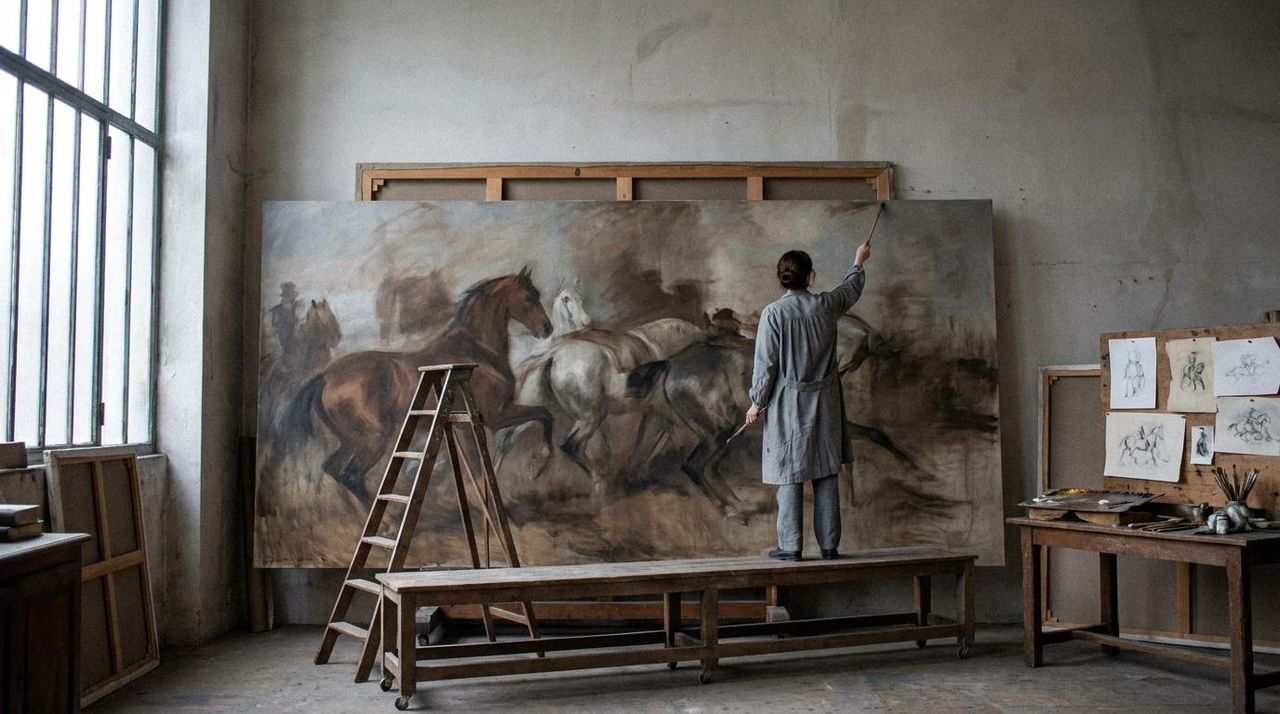
AI-generated reconstruction: a high studio with a tall window, a huge unfinished canvas of horses against the wall, a stepladder and a long wooden platform in front, a small painter in a grey smock and trousers on the platform reaching up with a brush, seen from behind.
AI-generatedImagined: the canvas in your studio. Its arrangement is not recorded.

You plan the picture, in Klumpke's account, on a canvas of no less than 2.5 by 5 metres, much bigger than Ploughing in the Nivernais. Your brother-in-law remembered that in 1851 you took a new studio, built for you in the same house as your old one, near the Luxembourg, with a sort of stable attached; there the picture “grew into being”. He gave the address as the rue d'Assas; in the 1850s the street was probably still called the rue de l'Ouest, which was joined to the rue d'Assas in 1868.

A canvas this size needs a ladder or a platform, and he recalled that men's clothes were convenient when you were perched on a ladder at one of your large canvases.

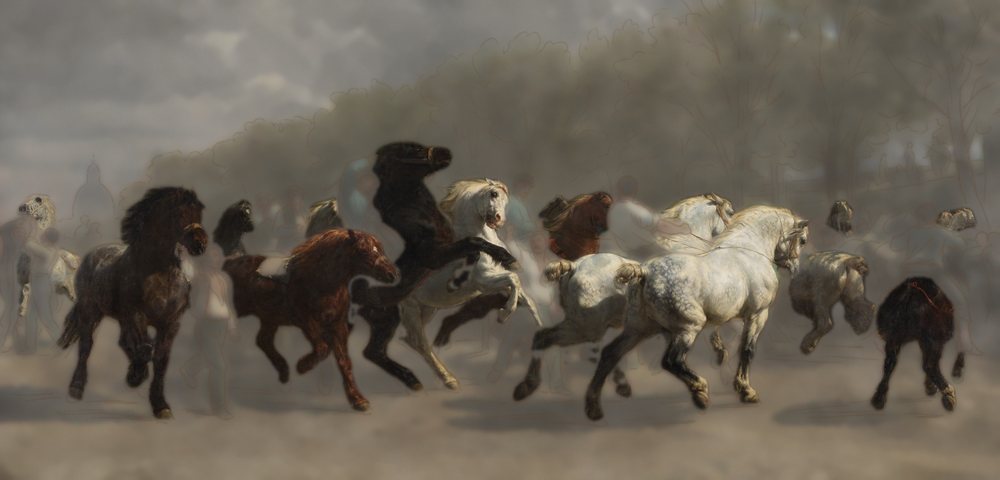
AI reconstruction: A bare canvas with an even pale ground.
The canvasGround colour unknown. AI-generated
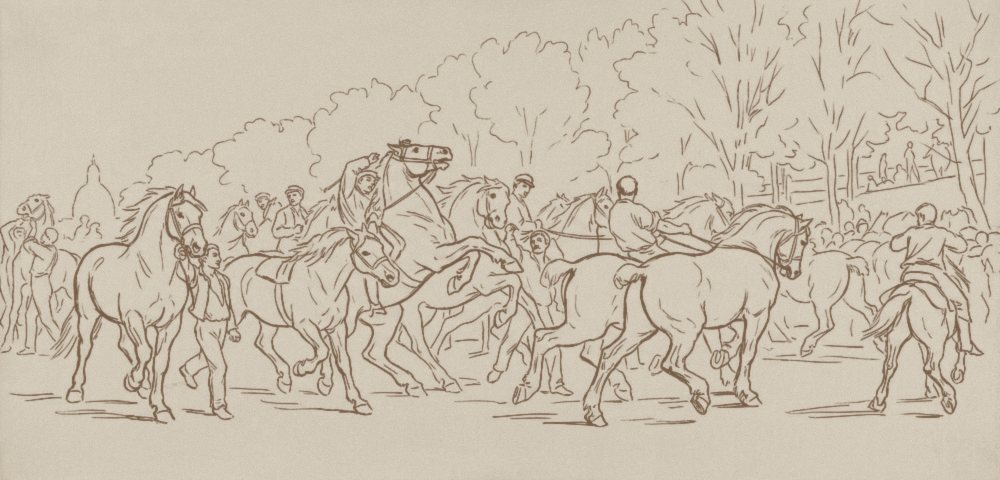
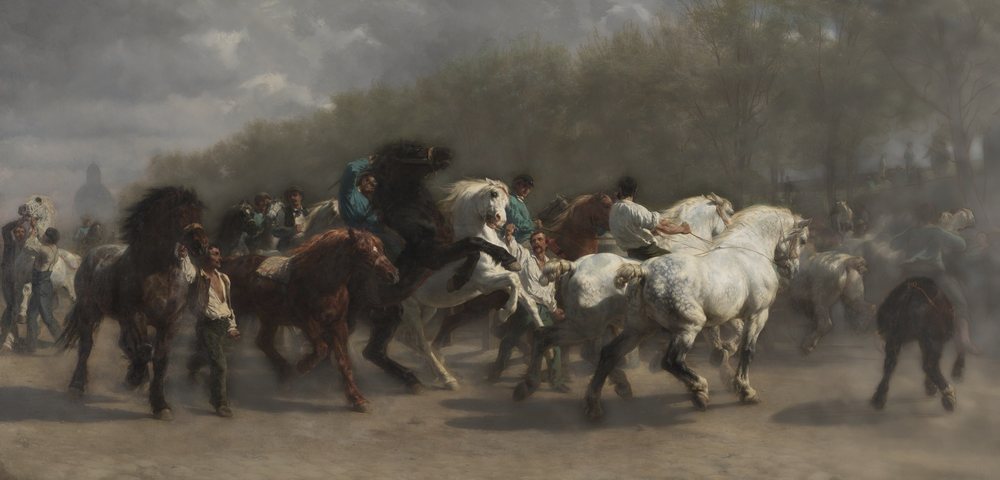
AI reconstruction: The horses, men, trees and dome drawn in thin brown lines on the pale canvas.
DrawingLines invented. AI-generated
AI reconstruction: The whole scene brushed in broadly and thinly, the drawing showing through.
Lay-inBroad and thin. AI-generated
Stage 2 was drawn with Prodia from the finished painting, so it stays in register; stages 1 and 3 are made from the painting. They show plausible stages, not evidence of the real layers.
  1. Prepare the canvas

    A single canvas or several widths sewn together, primed with a ground of unknown colour. Stage 1 assumes a pale one.

  2. Draw the procession

    Carry the composition over from your studies, at about eight times the size of the oil sketch. How is not recorded.

  3. Lay it in

    Brush in the whole scene broadly and thinly, to judge it as a whole. A visitor saw you at this stage about 1851.

Horses first, then the men

EvidenceThe painting itself; Tighe (1981) on the studies, and the 1853 reviews, as the Met summarises them. The order of the three steps here is inferred.

Corot, who saw the picture in progress in 1852–53, thought it looked disjointed in places compared with the preparatory drawing. Here is one way the work could have gone, from a thin lay-in to the state the Salon saw.

1 2 3

AI-generatedAfter step 3: the grooms and riders

  1. 1Lay in the whole scene
  2. 2Work up the horses
  3. 3The grooms and riders

Lay in the whole scene
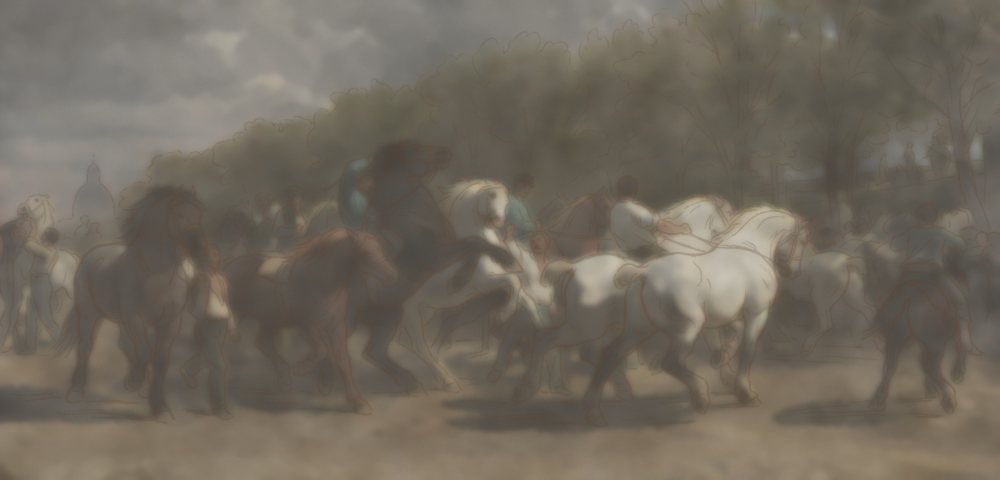
AI reconstruction after step 1: The whole scene brushed in broadly and thinly. A visitor recalled you at work on the first rough sketches on the canvas about 1851. The order of stages 3 to 5 is inferred.
After step 1 AI-generated
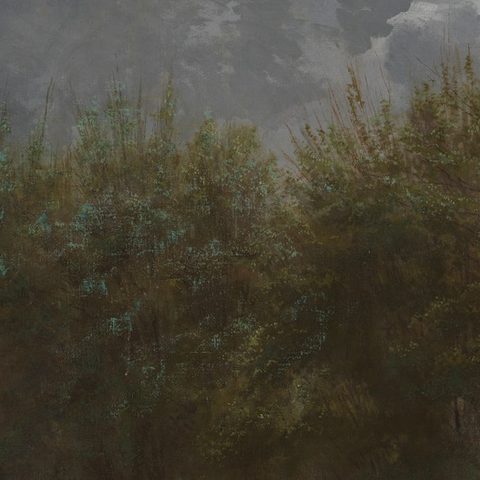
Close-up of the trees at the top of the painting: a loose mass of greens and greys against a cloudy sky.
The trees: the critics of 1853 thought them too heavy.

Brush in the whole crowd, the trees and the sky broadly and thinly, so that the composition can be judged across five metres at once. The dark horses are dark from the start and the greys pale; the ground of the avenue is a thin ochre.

A writer who visited you about 1851 remembered you at work on the first rough sketches of the picture in oil on canvas. Nothing else records this stage.
Work up the horses

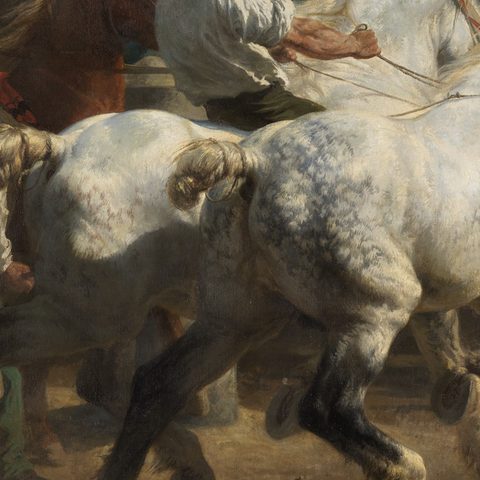
AI reconstruction after step 2: The horses worked up first, the men and the setting still rough. Your studies concentrate on the horses; that you painted them first is an inference.
After step 2 AI-generated
Close-up of two dapple-grey draught horses trotting, their tails tied up, a man in a white shirt riding behind them.
The dapple-greys at the centre.

Now the horses, which are the subject: heavy draught horses, many of them Percherons, the breed critics named in 1853, caught at the moment they turn. Model the dapples of the greys, the plaited and tied-up tails, the hooves kicking up dust.

Your studies concentrate on the horses; one scholar observed that you fitted the men in wherever there was room. That you also painted the horses first is an inference from that, not a finding.

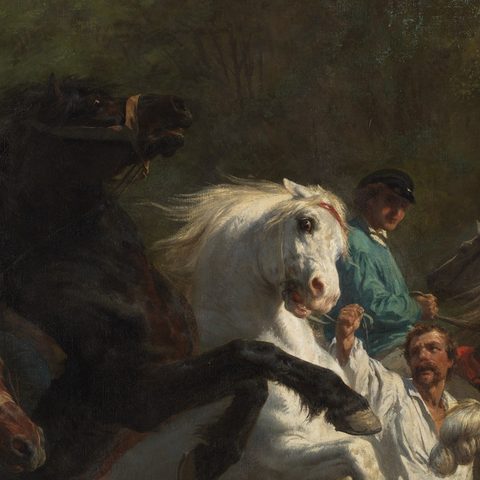
Close-up of a white horse rearing, a dark horse behind it, a groom in a blue smock with a cap and a bearded man grabbing the halter.
A white horse rears; the men hold on.
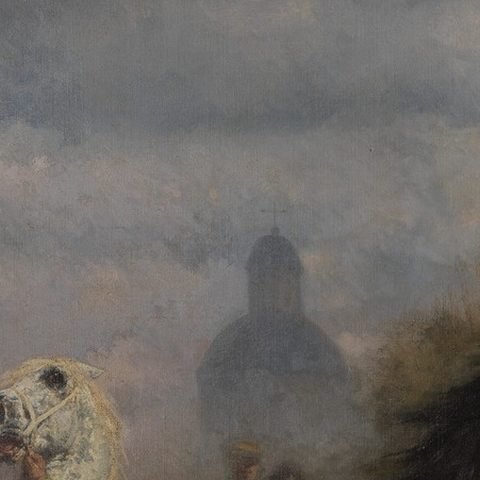
Close-up of the hazy dome of a chapel behind trees and dust at the far left.
The dome of the Salpêtrière in the dust, far left.

The grooms and riders

AI reconstruction after step 3: As critics described it in 1853: unvarnished, unfinished in parts, the right side still a sketch. Which areas you finished later is not documented.
After step 3 AI-generated
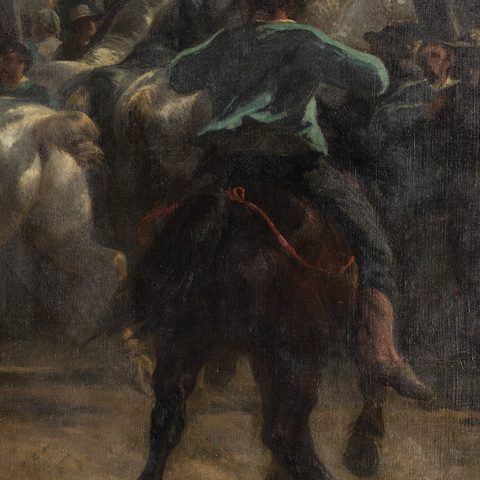
Close-up of a rider in a green-blue smock seen from behind on a dark horse, in a dusty crowd, more broadly painted.
The right side: still sketchy in 1853, according to a critic in Ghent.

Then the dealers and grooms: men in blue smocks and white shirts hauling on halters and riding bareback, one half-stripped. Draw them separately as well; some sheets of figure studies survive.

Send it to the Salon before it is finished. Critics in 1853 found parts of it unfinished and the whole in need of varnish, and a critic in Ghent that autumn described the right side as no more than a sketch.

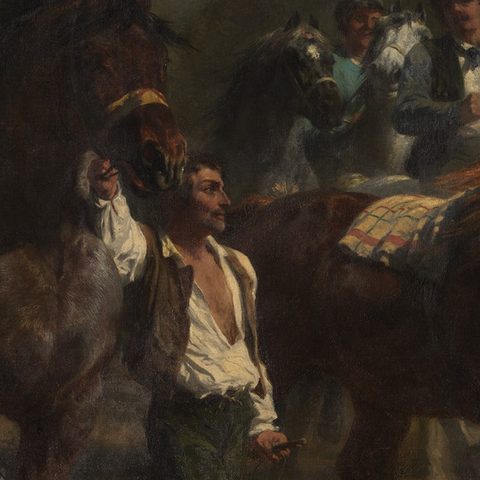
Close-up of a young man with his shirt open to the waist leading a dark horse by the halter.
A groom leads a dark horse at the left.

Show it unfinished, 1853

EvidenceThe Met's exhibition history and its summary of the 1853 reviews; your letter to Nieuwerkerke of 18 June 1853; Klumpke and Gambart on Bordeaux. The two prints made in 1853 record the picture as it was then, roughly.

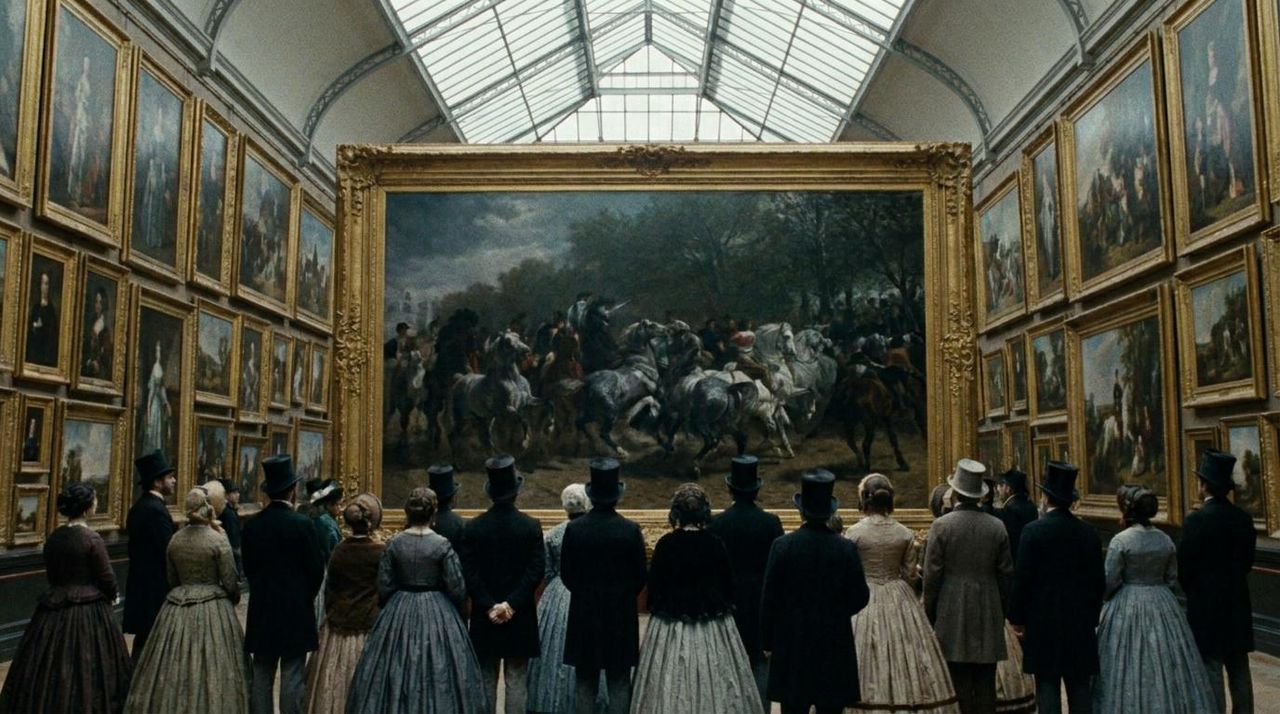
AI-generated reconstruction: a vast exhibition hall hung frame to frame with paintings, and in the middle of the long wall an enormous canvas of horses and grooms in a gilt frame, a crowd of visitors in 1850s dress seen from behind.
AI-generatedImagined: the Salon of 1853. How the rooms were hung is not shown here from any record.

The Salon opens on 15 May 1853, and your picture is number 134, Marché aux chevaux de Paris. It is a success; the jury exempts you from submitting to juries in future.

The critics also find it unfinished. One says it needs varnishing and seems unfinished in parts; others criticise its summary handling, dislike the heavy trees behind, or want more space between the horses and the trees. Clément de Ris sees Géricault's lithographs in it.

There are rumours that the Empress or the Comte de Morny will buy it. Your own letter that June tells a different story: Morny had preferred another subject, because you had not painted horses before, and the State commissions Haymaking in the Auvergne from you instead.

In August the picture goes to the exhibition in Ghent, where a critic describes its right side as still in the state of a sketch. In November 1854 it is shown in Bordeaux, your birthplace. You offer it to the city for 12,000 or 15,000 francs, depending on the account, and the city declines.

Rework it and sell it, 1855

EvidenceThe Met's entry and provenance; Ernest Gambart's memoirs as quoted by Roger-Milès (1900); Klumpke (1908); the National Gallery, London. That you retouched the ground, trees and sky is a suggestion of 1966, which the Met accepts with caution; no technical evidence has been published.

The London dealer Ernest Gambart wants the picture. Nathalie sets the price: if it leaves France, not for less than 40,000 francs. Gambart pays it.

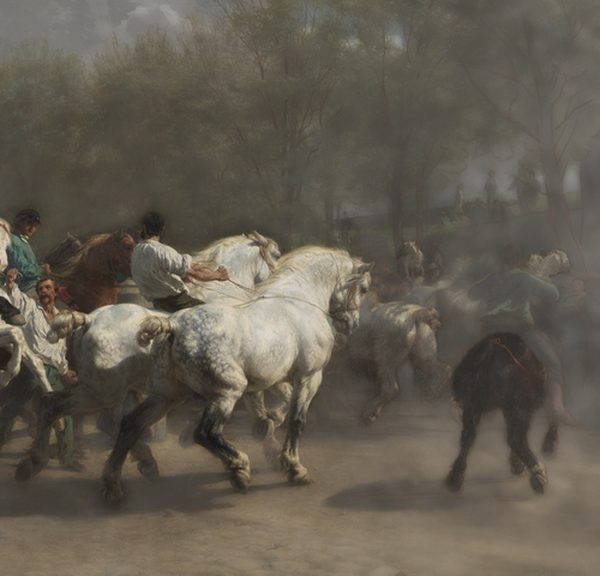
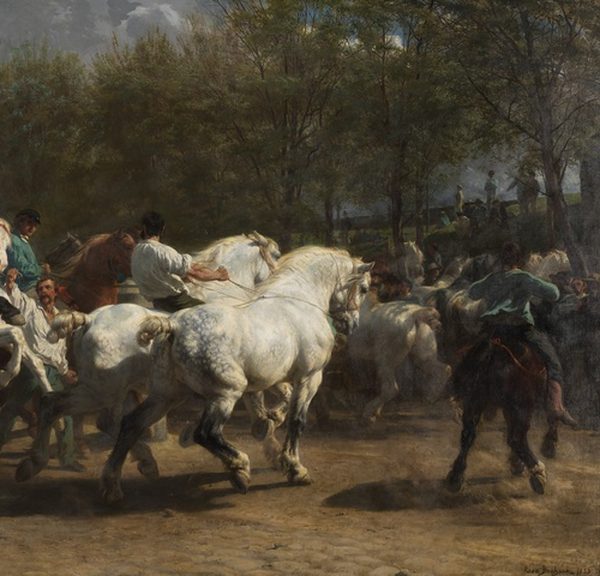
Before he takes it, you go back to work on it. The Met's catalogue follows the suggestion that, answering the complaints of unfinish, you retouched the ground, the trees and the sky. You add a 5 to the date, which now reads “1853.5”: most likely, the Met says, the year you returned to it, 1855.

AI-generated reconstruction: the right half of the painting, duller and hazier, the trees and the ground broader and the right edge sketchy.AI-generatedImagined: the right half as the Salon may have seen it in 1853.
The right half of the painting today: the dapple-greys, the rider in green-blue, the trees and the dusty ground.The painting today.

For the engraver, Gambart needs a smaller version. Nathalie begins one, about half the size each way, and you finish it; Gambart remembered that she carried it so far that you had to push it darker. Thomas Landseer engraves it, and the print is published in 1856 or 1857.

In July 1855 the big picture is shown at Gambart's gallery in Pall Mall, London, with a reception for you, and Queen Victoria asks to see it privately; the accounts disagree on whether it was sent to Windsor or to Buckingham Palace. Then it tours Britain: Glasgow, Liverpool, Manchester, Birmingham, Sheffield.

To New York

EvidenceThe Met's provenance and exhibition history; Gambart's memoirs; the published debate on the central rider, which the Met records.

In October 1857 the picture goes on show in New York. William P. Wright of Weehawken, New Jersey, buys it from Gambart; in 1866 it passes to the department-store owner Alexander T. Stewart. At the sale of his widow's estate in 1887 it fetches $53,000, bought for Cornelius Vanderbilt, who gives it to the Metropolitan Museum the same year.

You go on to paint at the Château de By, near Fontainebleau, from 1860; in 1865 you are made a knight of the Légion d'honneur. You die at By in 1899.

Is one of the riders you? In 1992 the art historian James Saslow proposed that the central horse tamer is a self-portrait of you; the National Gallery repeats it as fact, and a 2022 article rejects that reading. No document of yours says so.

What is still not known

What the canvas is made of, what its ground is, how the drawing was transferred and in what order it was painted: nothing technical has been published. What exactly you changed between 1853 and 1855, beyond the added 5. When you first had a permit to wear trousers, and whether you wore them at the market in 1850–52, which is told only from 1867 on. The address you gave the Salon in 1853. Whether the Queen saw the picture at Windsor or Buckingham Palace.

How Bonheur thought

  • Go where the animals are. A market, a slaughterhouse, an omnibus company's stables, and a stable beside the studio.
  • Dress for the work. Men's clothes among the dealers, by every later account.
  • Study without end. Countless drawings, an oil sketch, and figures drawn on their own.
  • Interpret, do not imitate. A Paris horse market seen as a Parthenon procession.
  • Paint animals at the scale of history. Five metres wide, for working horses.
  • Go back to it. Shown unfinished, then reworked before it left France.

Sources