Imagining Artist Methods
CassattLittle Girl in a Blue Armchair · 1878All 16

A studio guide · Paris, 1878

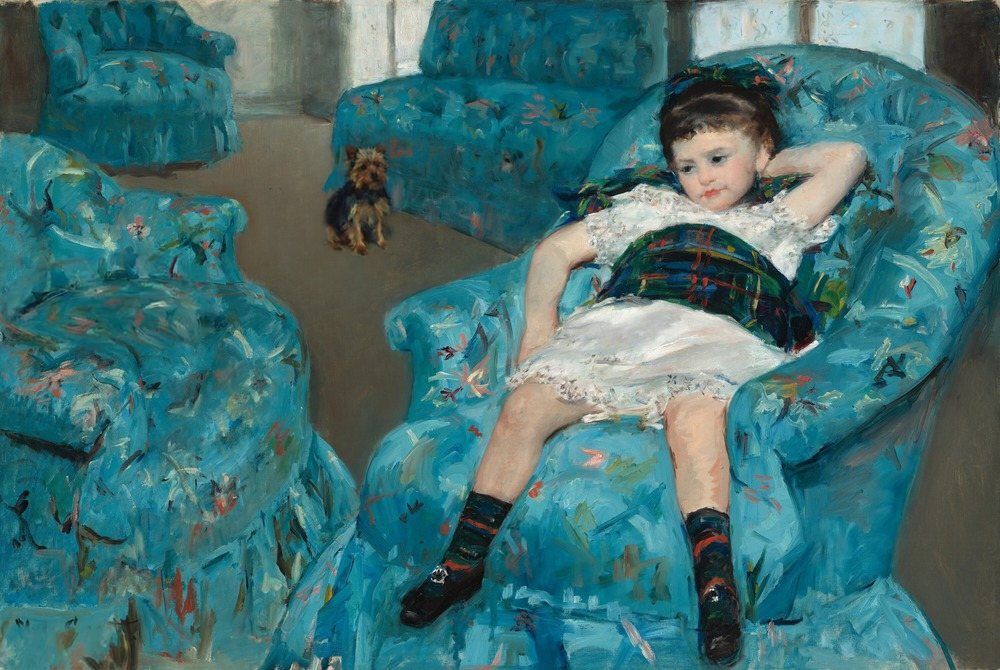
Little Girl in a Blue Armchair, with a corner by Degas

Imagine you are Mary Cassatt, thirty-four, an American who has lived in Paris for four years, newly invited by Edgar Degas to show with the Impressionists. This guide follows how the picture was probably made: a child sprawled in a turquoise armchair, a room that Degas reshaped, and a dog that moved and moved back.

Cassatt's own letter of about 1903 says Degas advised her on the background and worked on it. The National Gallery of Art cleaned and studied the painting for its 2014 exhibition Degas/Cassatt, and infrared shows what changed. The materials have not been published. Each chapter opens with a note on what its evidence is. The slider steps through six stages; stages 1, 2, 3 and 5 are AI reconstructions.

Back on the armchair

Stage 6 of 6

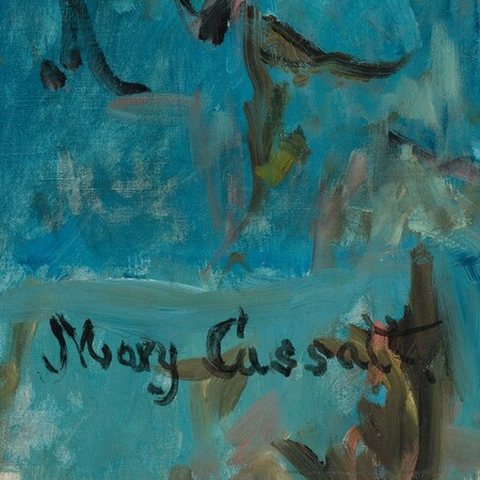
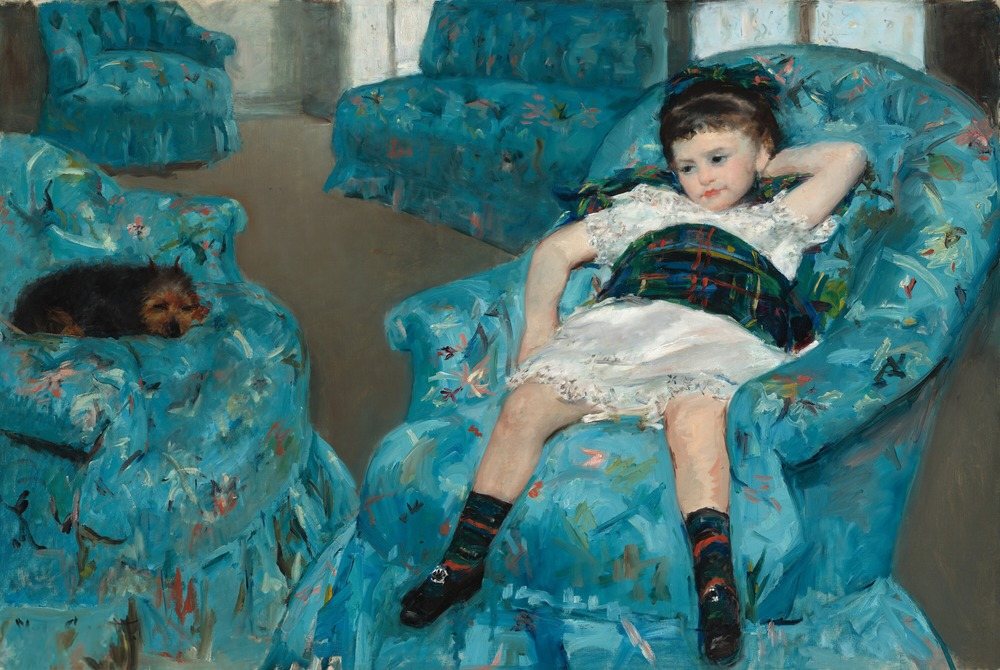
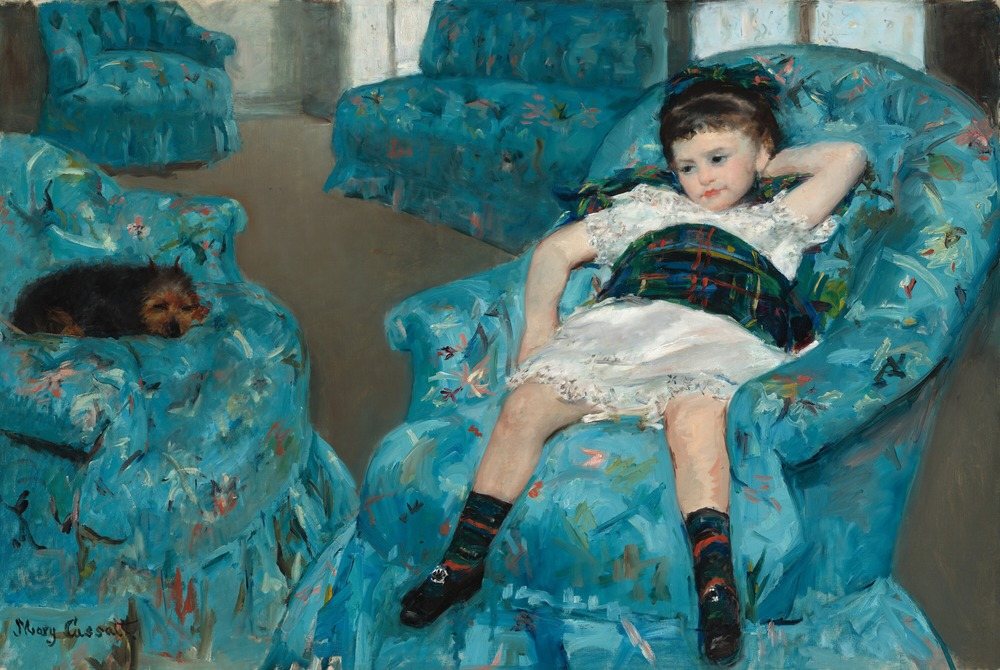
The dog returned to its armchair, and the canvas signed at lower left: Mary Cassatt. This is the painting today.

Mary Cassatt, Little Girl in a Blue Armchair, 1878. Oil on canvas, 89.5 × 129.8 cm. National Gallery of Art, Washington, Collection of Mr. and Mrs. Paul Mellon, 1983.1.18. Open access (CC0). AI-generated Stages 1 and 2 are reconstructions made with Prodia from this painting; in stages 3 and 5 only the back of the room, and the dog, are changed with Prodia; stage 4 is the painting with the signature removed.

Your training

EvidenceThe National Gallery of Art's 2014 exhibition brochure for the years in Paris; the dates of your schooling and Salons are from standard biographies and have not been checked against the archives.

You are Mary Cassatt, born in 1844 near Pittsburgh into a well-off banking family. You studied at the Pennsylvania Academy of the Fine Arts in Philadelphia, and in 1866 went to Paris, where women could not enter the École des Beaux-Arts: you took private lessons and copied in the Louvre. You have also studied pictures in Italy and Spain.

From 1868 the Salon accepted your work in several years, but its jury grew harder to please: in 1875 it refused one of your two entries, and in 1877 both. You moved to France for good in 1874.

In 1877 Edgar Degas, ten years older, invites you to exhibit with the Impressionists, who call themselves independents. Your first sight of his art, you said later, “changed my life”. He is said to have said of your work, “there is someone who feels as I do.”

Join the independents

EvidenceThe National Gallery of Art's brochure and press release for Degas/Cassatt (2013–14), and an interview with its curator, Kimberly A. Jones.

You and Degas have much in common: both realists, drawn to people and modern life rather than landscape, both educated, witty and from banking families. Over the next decade you trade advice and try new materials together: distemper, metallic paint, prints.

He gives you more than an invitation. For this picture, he brings you the model, the child of friends of his. When you have painted her, he looks at the canvas, finds it good, advises you on the background, and then picks up a brush and works on it himself.

He will paint and draw you many times. He goes on to buy nearly a hundred of your works, more than he owned by any other living artist.

“he even worked on the background”

Cassatt to Ambroise Vollard, about 1903, in English translation; the words are underlined in her letter

A child, a dog and four armchairs

EvidenceThe painting itself and the National Gallery of Art's collection page, which identifies the dog. Who the girl was is not known; where you painted the picture is not documented.

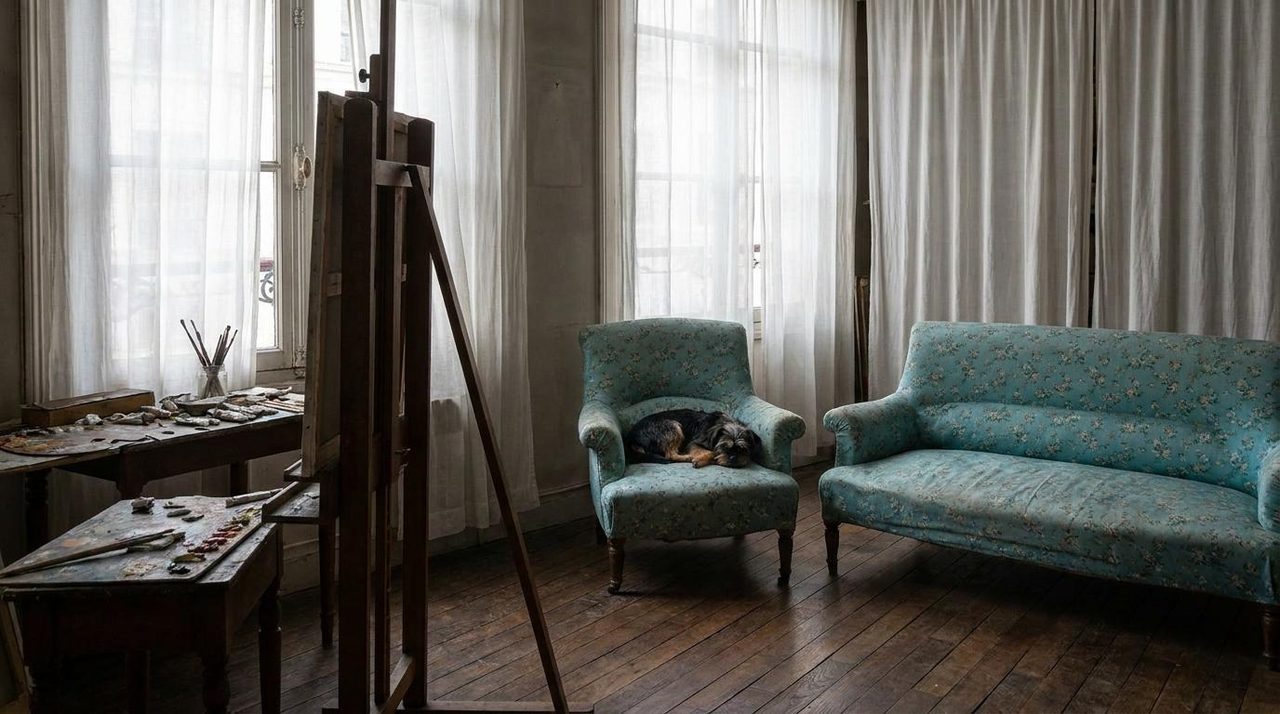
AI-generated reconstruction: a sunlit Paris room with tall curtained windows, low armchairs and a sofa in turquoise chintz, a small dog asleep on one chair, and an easel seen from the side.
AI-generatedA room like the one in the picture, with no one in it yet. Where you painted is not recorded.

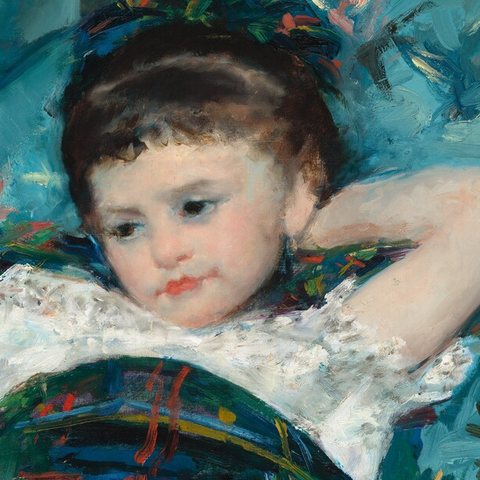
The model is a little girl, the daughter of friends of Degas. Her name has not come down to us. You let her slump: legs apart, one arm behind her head, eyes turned away, bored or tired. Your own dog sleeps on the next chair: Baptiste, a small Brussels griffon that Degas helped you find, who appears in several of your paintings.

You paint big for an intimate subject: the canvas is 130 centimetres wide. Seen from low down, at the child's level, the armchairs fill the picture and swallow her; the frame cuts them off on three sides.

A child as she is
Not posed or pretty: a real child, sprawling, with her dress rucked up.
Low and close
The viewpoint of someone sitting on the floor, with the furniture looming.
One colour
Four armchairs and a sofa in the same turquoise chintz, filling most of the canvas.

Gather your materials

EvidenceNothing published: the analysis of this canvas's ground and pigments, if it was made, has not appeared in any source this guide could read. Its size and medium are from the National Gallery of Art.

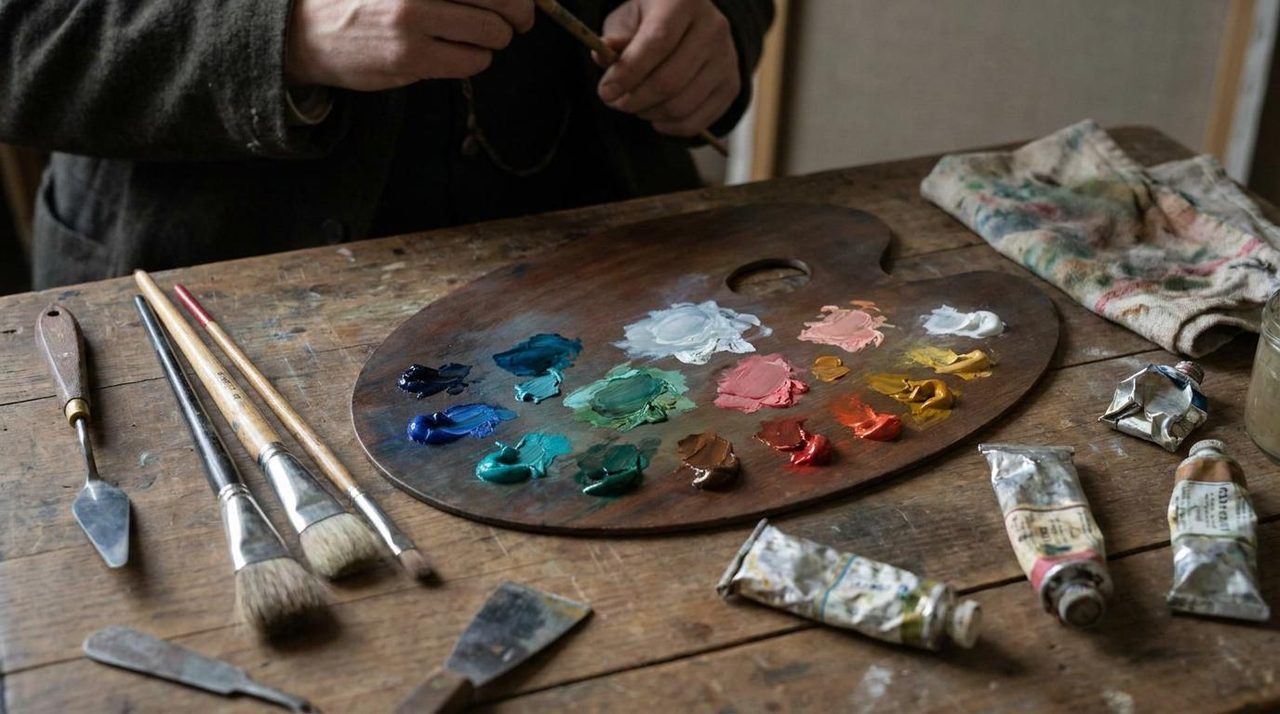
AI-generated reconstruction: a wooden palette with dabs of blue, turquoise, green, white, pink, red and brown oil paint, brushes, a palette knife and paint tubes on a table.
AI-generatedA palette for a turquoise picture. The colours are chosen from the painting's look, not from analysis.

Oil paint on a canvas 89.5 by 129.8 centimetres. Beyond that the record is silent. No study of this picture's canvas, ground or pigments has been published in anything this guide could read, so the layers below are only a schematic, and the colours on the palette are guesses from the surface.

What the surface does show: light colour throughout, quick loaded strokes in the upholstery, thin scumbled paint in the floor, and the pale, broken strokes of the lace. The National Gallery calls it, with its loose brushwork and light palette, “arguably” your first true Impressionist painting.

Not published

  • The canvas and its priming
  • Any drawing under the paint
  • The pigments, and the binding medium
  • What the X-rays show, beyond “changes beneath the paint surface”
  • The picture's history of varnish and repair before the latest cleaning

A 2014 essay by the conservator Ann Hoenigswald in the Degas/Cassatt catalogue, and an article by Kimberly A. Jones, may hold some of this; neither could be read for this guide.

Lay in the room

EvidenceInfrared images published by the National Gallery of Art in 2014 show the first line of the floor. How you began the canvas is otherwise not documented; stages 1 and 2 are plausible, not recorded.

AI reconstruction: A bare pale canvas.
CanvasPrimed, pale. AI-generated
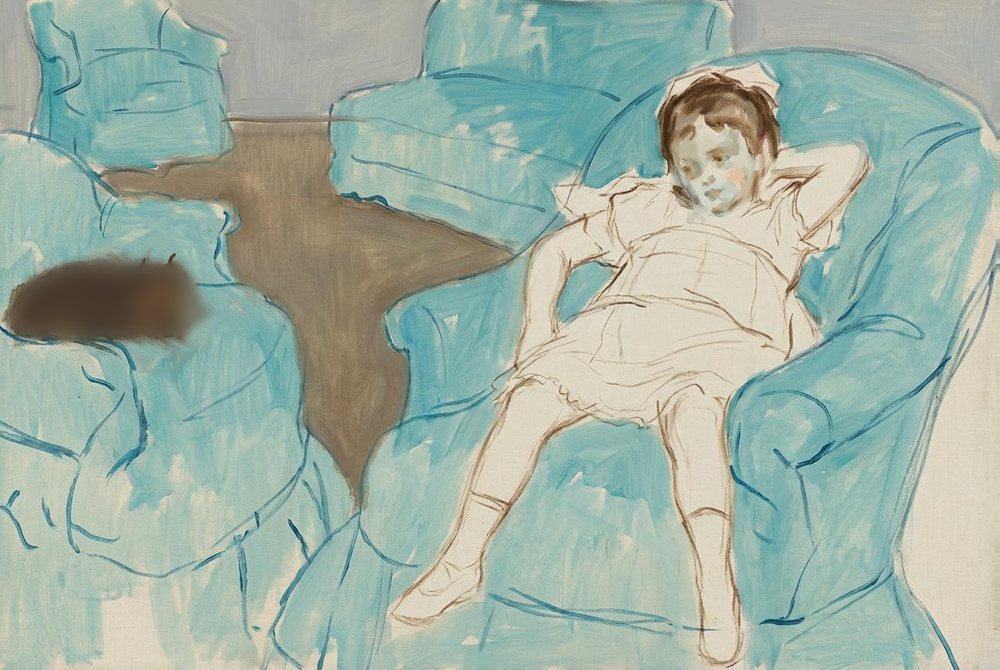
AI reconstruction: Thin turquoise washes for the armchairs, a pale sketch of the girl, a dark smudge for the dog, and the floor meeting the wall in a horizontal line.
Lay-inThin washes, a level floor line. AI-generated
AI reconstruction: The girl, the armchairs and the dog painted, in a room with one flat back wall.
The childPainted, before Degas. AI-generated
Generated with Prodia from the finished painting, so the composition stays in register. In stage 3 only the back of the room is generated; the girl, the armchairs and the dog are the painting itself.
  1. Place the furniture

    Big shapes first: the girl's armchair on the right, the dog's on the left, another armchair and an armless couch at the back.

  2. Set the girl in it

    Her body on a diagonal from the top of the chair to her feet at the bottom edge.

  3. Draw the floor's edge

    A single horizontal line, a little above her head, where the floor meets the back wall. The wall runs straight across, parallel to the canvas. Infrared still shows this line under the paint.

Paint it, then share it

EvidenceYour letter to Vollard for the order; the National Gallery of Art's 2014 findings (magnification, infrared, X-rays) for Degas's corner, the couch and the dog. The dog's place on the floor is not shown precisely in any open source.

The order of the first two steps is in your own words: “I had done the child in the armchair”, and then Degas advised you on the background. The rest comes from the National Gallery's study.

The child in the armchair
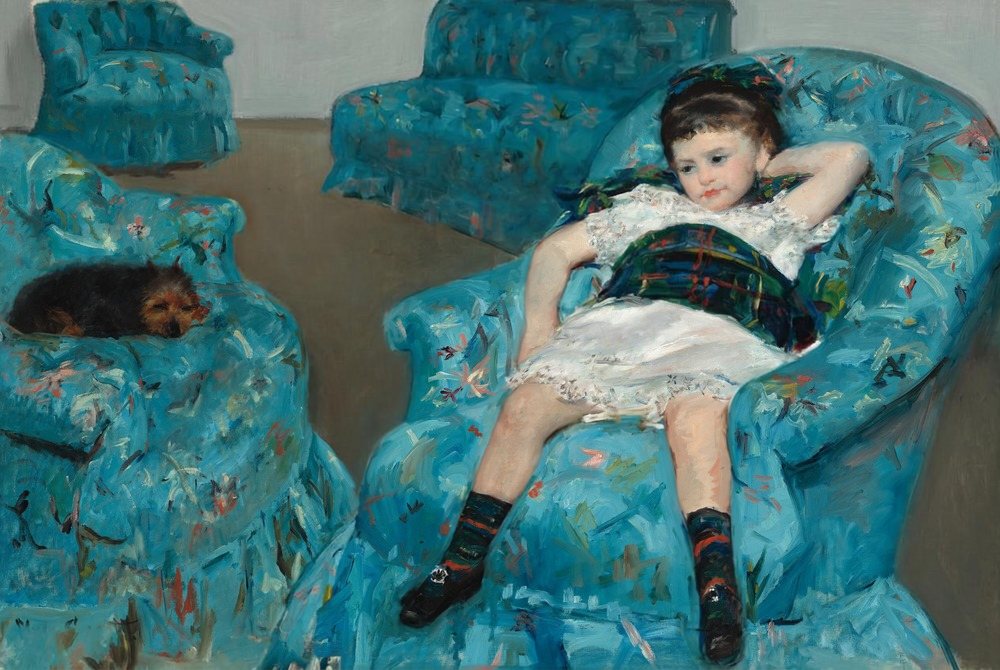
AI reconstruction after step 1: The girl, the armchairs and the dog painted, in a room with a single back wall parallel to the canvas. Cassatt's letter says she had done the child in the armchair before Degas advised her on the background.
After step 1 AI-generated
Close-up of the girl's face: dark hair with a ribbon, round cheeks, eyes looking down and to the left, one arm behind her head.
Her face, turned away from the visitor.

Paint the girl first, sprawled in the big armchair: one arm behind her head, the other hanging over the arm of the chair, her legs apart, her eyes turned away. Her white dress is lace and loose strokes; her sash and socks are a tartan of green, black and blue, with orange and yellow lines.

Cover the armchairs with turquoise and a scatter of quick strokes in green, pink, red and white for the chintz pattern. Put Baptiste, your dog, asleep on the armchair at the left. Behind the furniture, the floor meets a single wall straight across the picture.
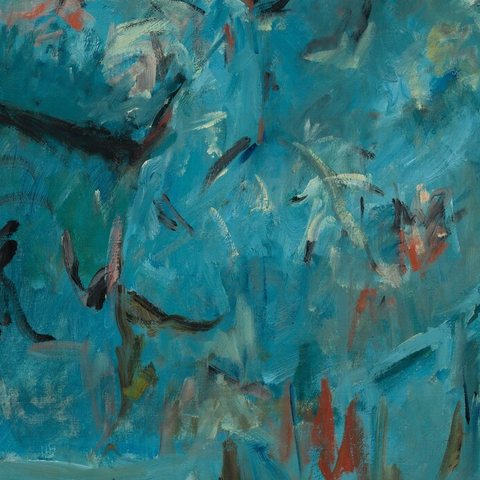
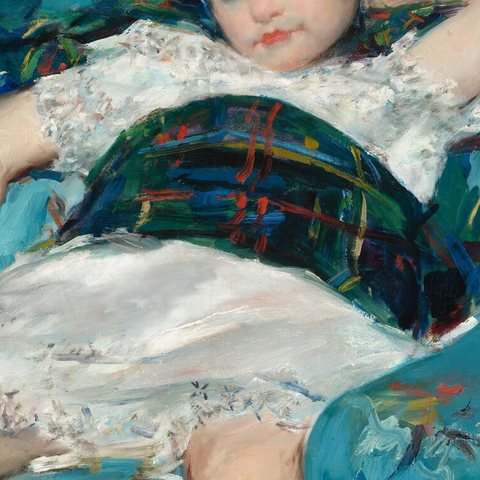
Close-up of turquoise upholstery covered in loose strokes of green, red, pink and white.
The chintz, in quick strokes.
Close-up of the girl's white dress with lace and her green and black tartan sash.
Lace dress, tartan sash.

Degas's corner

AI reconstruction after step 2: Degas paints a corner where the two back walls meet, in small, quick, silvery-brown strokes, and abrades the surface there. The floor edge now runs on a diagonal. This stage is the painting today, unsigned.
After step 2 AI-generated
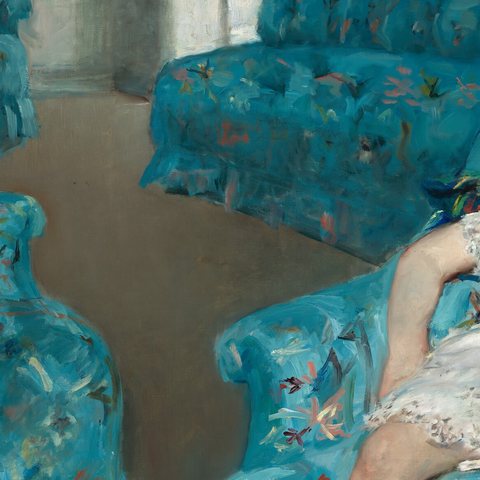
Close-up of the back of the room: grey-brown floor meeting a pale wall at an angle, with the edges of blue armchairs around it.
The corner beyond the furniture.

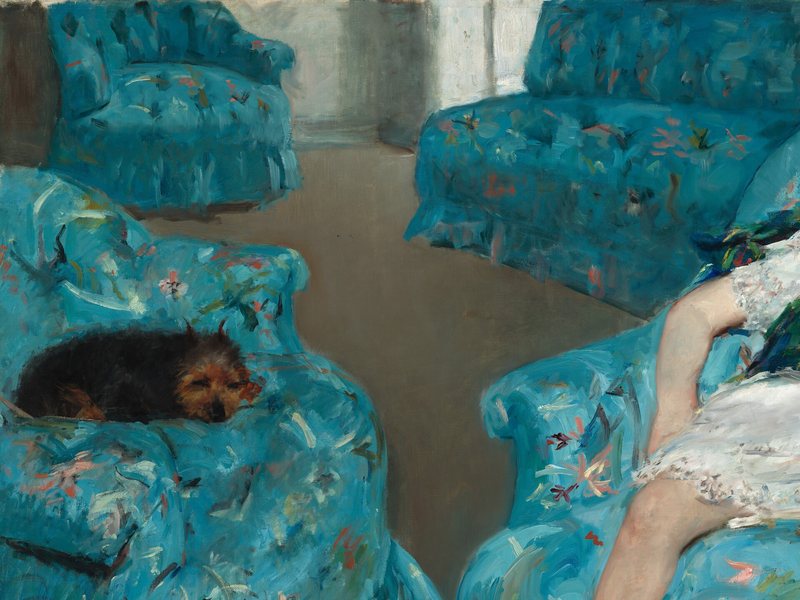
Degas likes the picture and advises you on the background, and then he works on it himself. Where the floor met the back wall in one straight line, he paints a corner: two walls meeting, the floor's edge running away on a diagonal.

Under magnification his strokes are different from yours: greyish, almost silvery-brown, small, sharp and quick, found nowhere else in the picture. The surface here was also deliberately abraded, scraped or rubbed, a habit of his and not of yours.

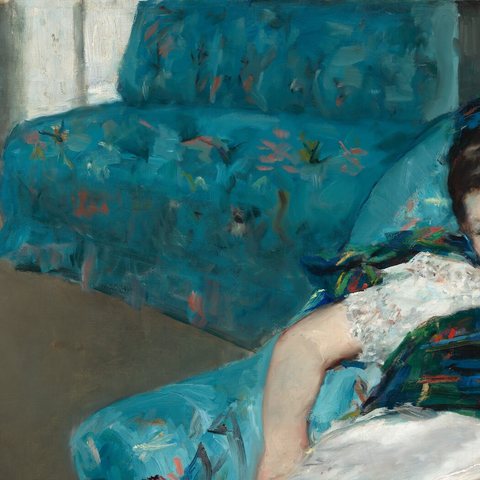
Close-up of the armless blue sofa at the back of the room, below a pale window.
The couch you rework to follow the new wall.

Where to put the dog

AI reconstruction after step 3: Cassatt reworks the couch at the back to follow the sloping wall, and tries the dog on the floor in front of it. The dog's place and pose here are invented; infrared shows only that it was there.
After step 3 AI-generated
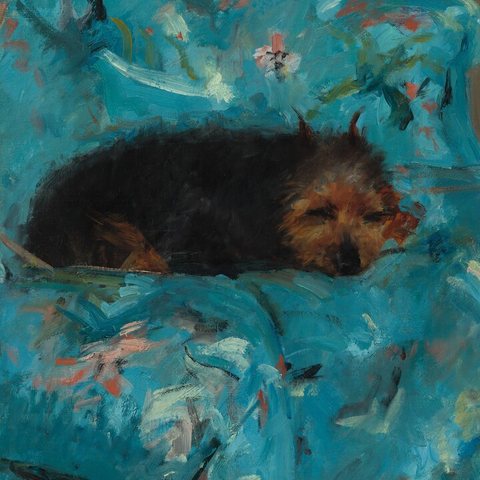
Close-up of a small black-and-tan dog curled asleep on a turquoise armchair.
Baptiste, asleep on the armchair.

The new corner changes the room, and you adjust to it. Rework the armless couch at the back so that it lines up with the sloping wall.

Try the dog somewhere else: infrared shows it once sat on the floor, in front of the reworked couch. Then paint it out and put it back where it was, on the armchair.

Sign it

AI reconstruction after step 4: The dog returned to its armchair, and the canvas signed at lower left: Mary Cassatt. This is the painting today.
After step 4 AI-generated
Close-up of the signature Mary Cassatt in dark paint on turquoise upholstery.
The signature, lower left.

Sign at lower left, in dark paint across the upholstery: Mary Cassatt. Later, someone writes the dealer's name and address in pencil on the stretcher: “M. Vollard / 6 Rue Lafitte”.

How the room changed

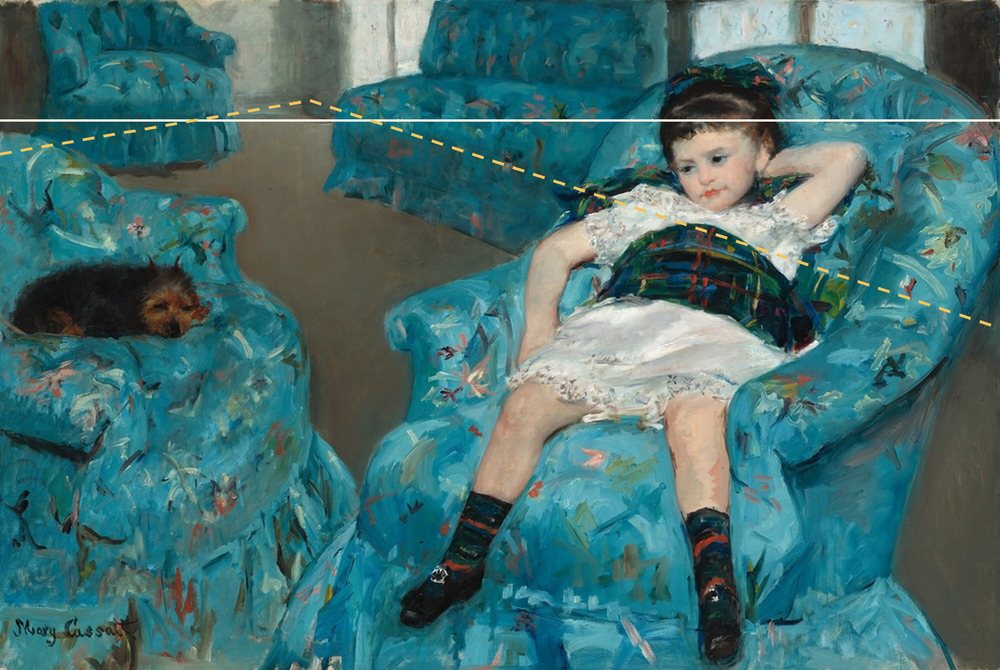
The lines below are redrawn by hand from the National Gallery's infrared diagram of 2014; the infrared image itself belongs to the Gallery and is not reproduced here. Their positions are approximate.

The painting with two lines drawn on it: a straight pale line across the top quarter, and a dashed line that rises from the left to a point about a third of the way across, then falls to the right edge halfway down.
  • Your first floor edge
  • Degas's corner

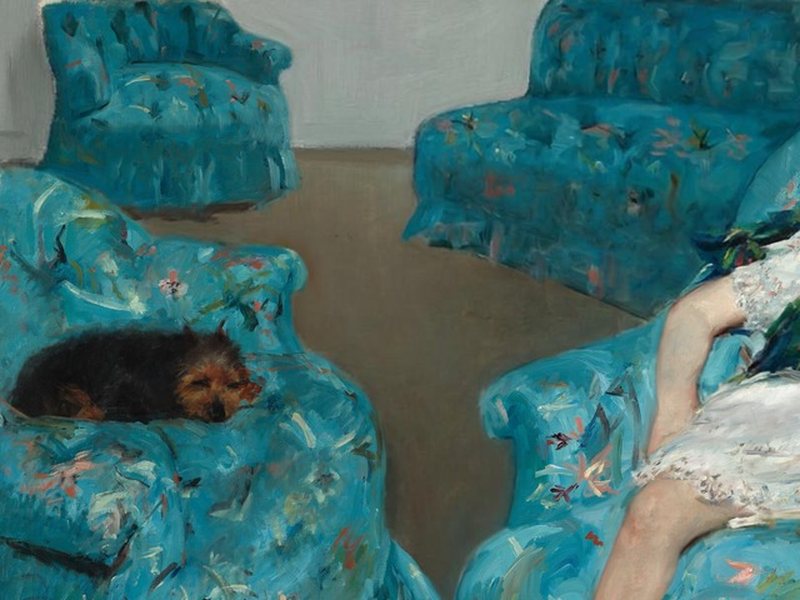
Laid over each other, the two rooms show what Degas did: one straight line becomes a corner. The room deepens; the floor opens out between the armchairs; the couch at the back, and the dog, have to find new places. Such wide-angle diagonals are common in his interiors, the National Gallery notes, and unprecedented in yours.

The back of the room with one flat grey wall meeting the brown floor in a straight line, behind blue armchairs.AI-generatedBefore: your flat back wall, reconstructed with Prodia.
The same part of the painting today: the floor meets two walls at a corner, with light from windows at the right.After: Degas's corner, the painting today.

Send it to the World's Fair, 1878

EvidenceYour letter to Vollard, about 1903, the only account of the refusal; no record of the jury's decision has been found for this guide.

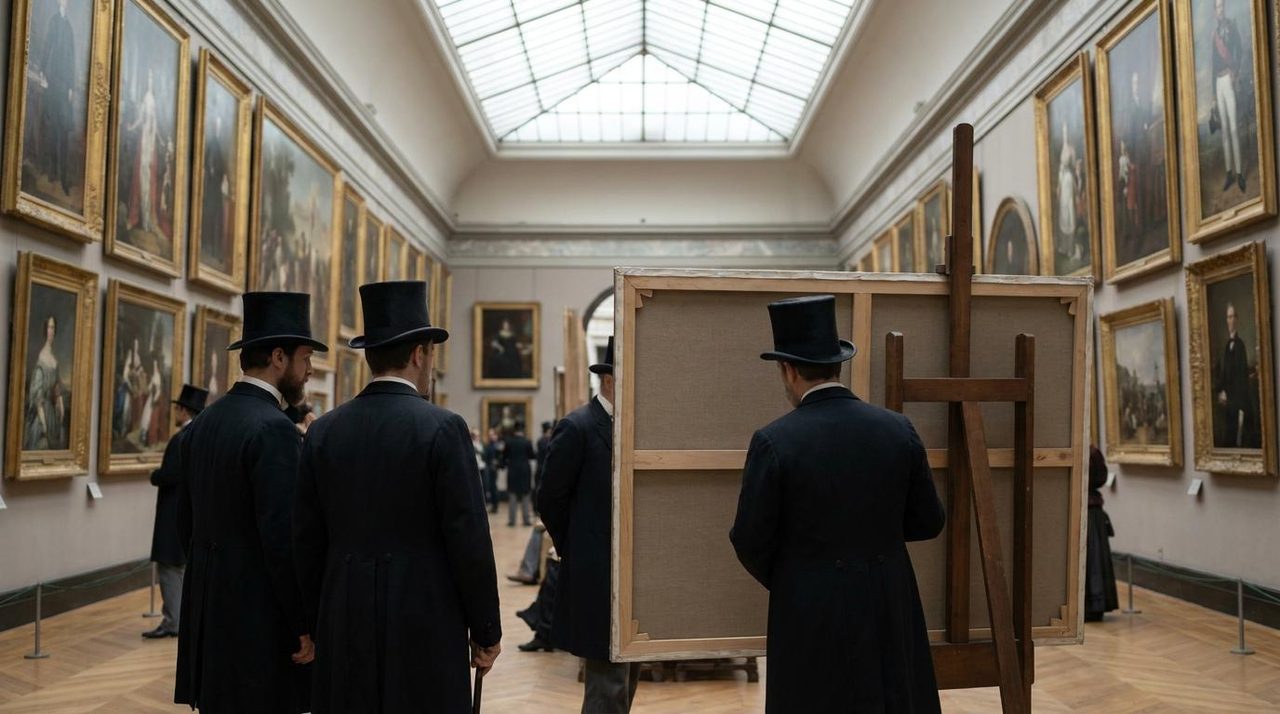
AI-generated reconstruction: three men in frock coats and top hats, seen from behind, looking at an unframed canvas turned away from us in a skylit gallery hung with gilt-framed paintings.
AI-generatedImagined: the jury of the American section looks at your canvas.

In 1878 Paris holds a world's fair, the Exposition Universelle, on the Champ-de-Mars. Each country hangs its own art. You send this picture to the American section, and it is refused.

Twenty-five years later you are still angry. Degas had thought it good, you write to Vollard, and he had worked on it; it seemed new then; and the jury was three people, one of them a pharmacist.

The refusal comes a year after the Salon turned down both your entries. From 1879 you show with the independents, who have no jury. You remember the change later as a release.

“of whom one was a pharmacist!”

Cassatt on the 1878 jury, to Vollard, about 1903, in English translation

“At last I could work with absolute independence without considering the opinion of a jury”

Cassatt on joining the independents, as quoted by her biographer, in English translation

What happened next

EvidenceThe National Gallery of Art's provenance and exhibition records; its 2013 press release, 2014 brochure and an interview with the curator on the study.

The fourth Impressionist exhibition opens in April 1879, and you make your debut with eleven works. The catalogue lists a Portrait de petite fille; the National Gallery records that it is possibly this picture.

You keep the canvas for a quarter of a century, then sell it to Vollard. In your letter to him you tell its story and underline that Degas worked on the background.

For a century nobody could say what he did. Before the 2014 exhibition the National Gallery's conservator Ann Hoenigswald cleaned it, and with the Gallery's scientists and the curator Kimberly A. Jones studied it under magnification, in infrared and in X-rays. They found his corner, your first floor line, the couch you reworked and the dog that left its chair and came back.

What is still not known

Who the girl was. Where you painted the picture, and over how long. What the canvas, ground and pigments are, and whether you drew on the canvas first. Exactly where the couch stood before you reworked it, and where the dog sat on the floor. Whether Degas did anything else to the picture. Whether it hung in the 1879 exhibition. The exact date and the French wording of your letter.

How Cassatt thought

  • Paint the child as she is. Slumped, bored and unposed, not a pretty portrait.
  • Get down to her level. A low viewpoint, with the furniture looming.
  • Let one colour carry it. Turquoise chintz across most of the canvas, in quick strokes.
  • Take advice, and adjust. Degas's corner accepted, the couch reworked, the dog tried and put back.
  • Trust your peers over juries. Refused in 1878; with the independents from 1879.

Sources