Imagining Artist Methods
LeysterSelf-Portrait · c. 1630All 16

A studio guide · Haarlem, about 1630

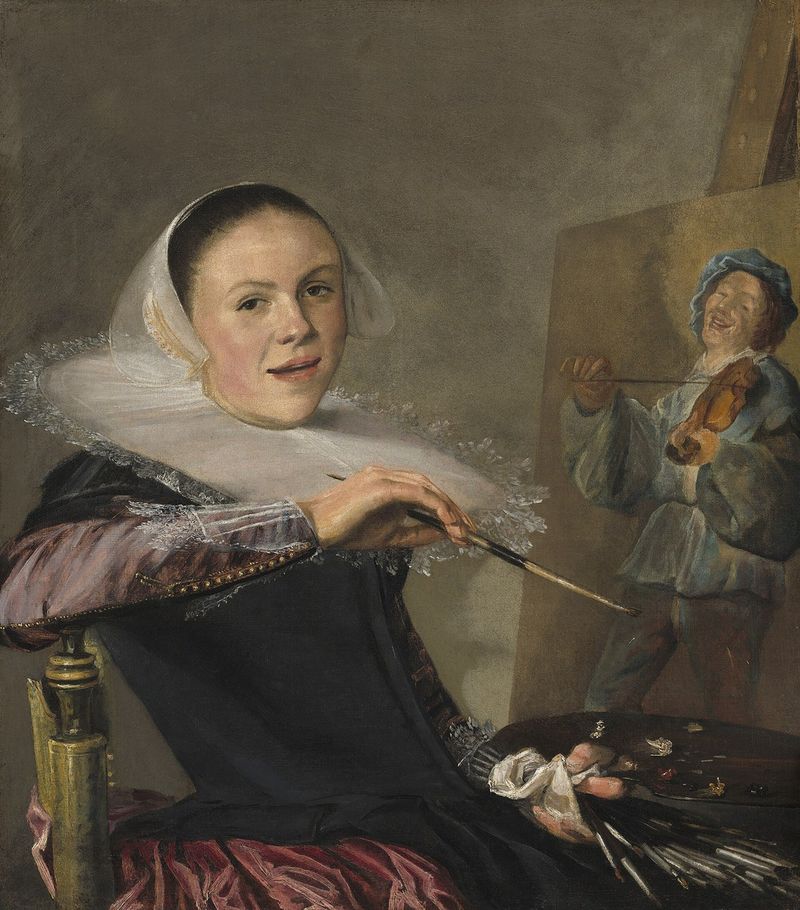
Self-Portrait, caught mid-stroke

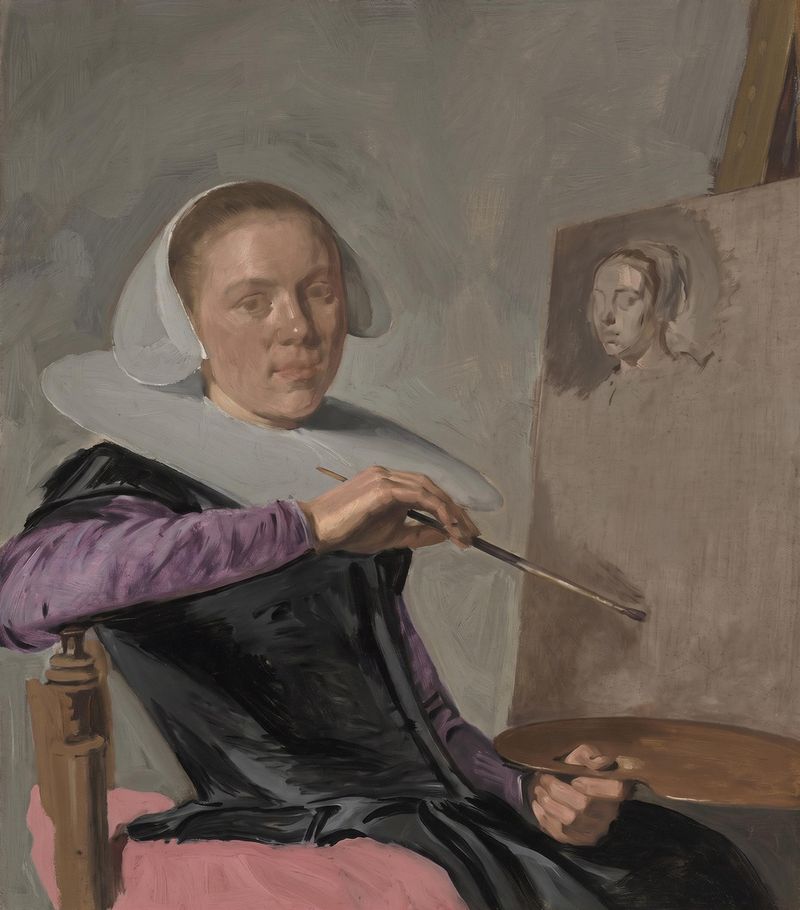
Imagine you are Judith Leyster, about twenty-one, the brewer's daughter whom Haarlem's chronicler has already praised in print. You paint yourself turning from your easel, brush raised, in a collar no one would work in. This guide follows how you might have made it: a white ground and a grey-brown wash, a sketch in paint, a dress laid in with liquid strokes, and on the easel a woman's face that you painted out for a laughing fiddler. Then it follows the canvas: sold as a Frans Hals, damaged and cleaned, and given back to you.

The National Gallery of Art's catalogue entry of 1995 and its technical summary describe the canvas, the ground, how several passages were painted, and the head found under the violinist by infrared. No pigment analysis of this painting has been published, and the order of the stages is inferred. Each chapter opens with a note on its evidence. The slider steps through eight stages; stages 1 to 7 are AI reconstructions or imagined states.

Today

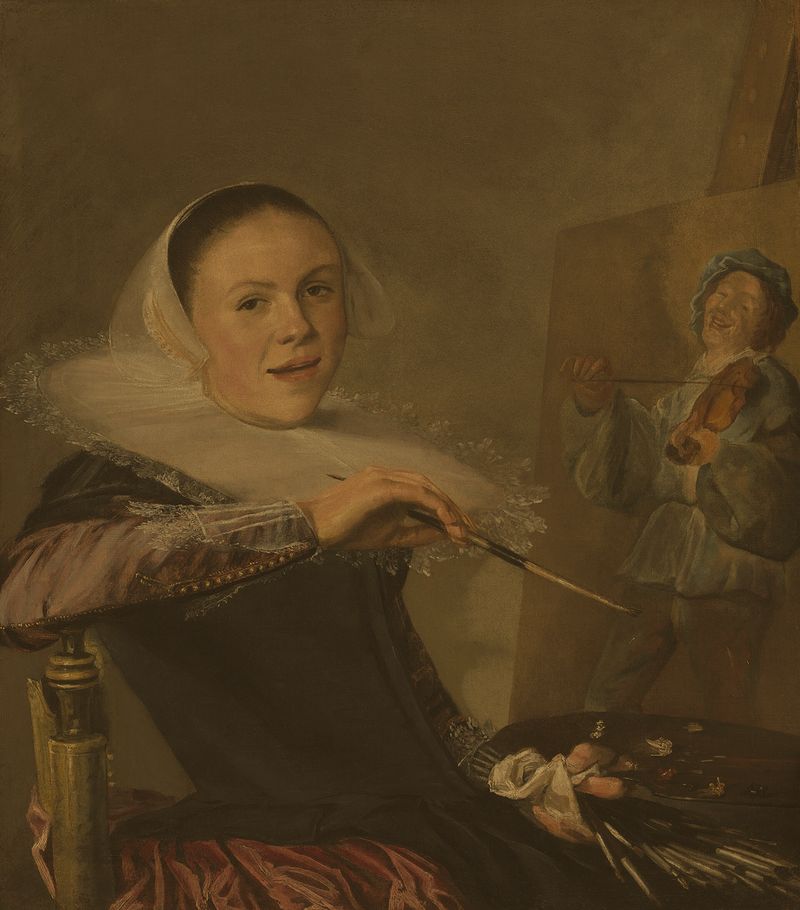
Stage 8 of 8

After the cleaning of 1992. The red skirt at lower left is painted on a later insert of new canvas, not by you.

Judith Leyster, Self-Portrait, about 1630. Oil on canvas, 74.6 × 65.1 cm. National Gallery of Art, Washington, Gift of Mr. and Mrs. Robert Woods Bliss, 1949.6.1. AI-generated Stages 3 to 6 are reconstructions made with Prodia from the NGA's open-access photograph; stages 1, 2 and 7 are imagined states made from it.

A brewer's daughter in Haarlem

EvidenceThe NGA's biography of Leyster and its catalogue notes, citing Ampzing (1628), Schrevelius (1648) and Hofrichter (1989). Who taught you is not documented.

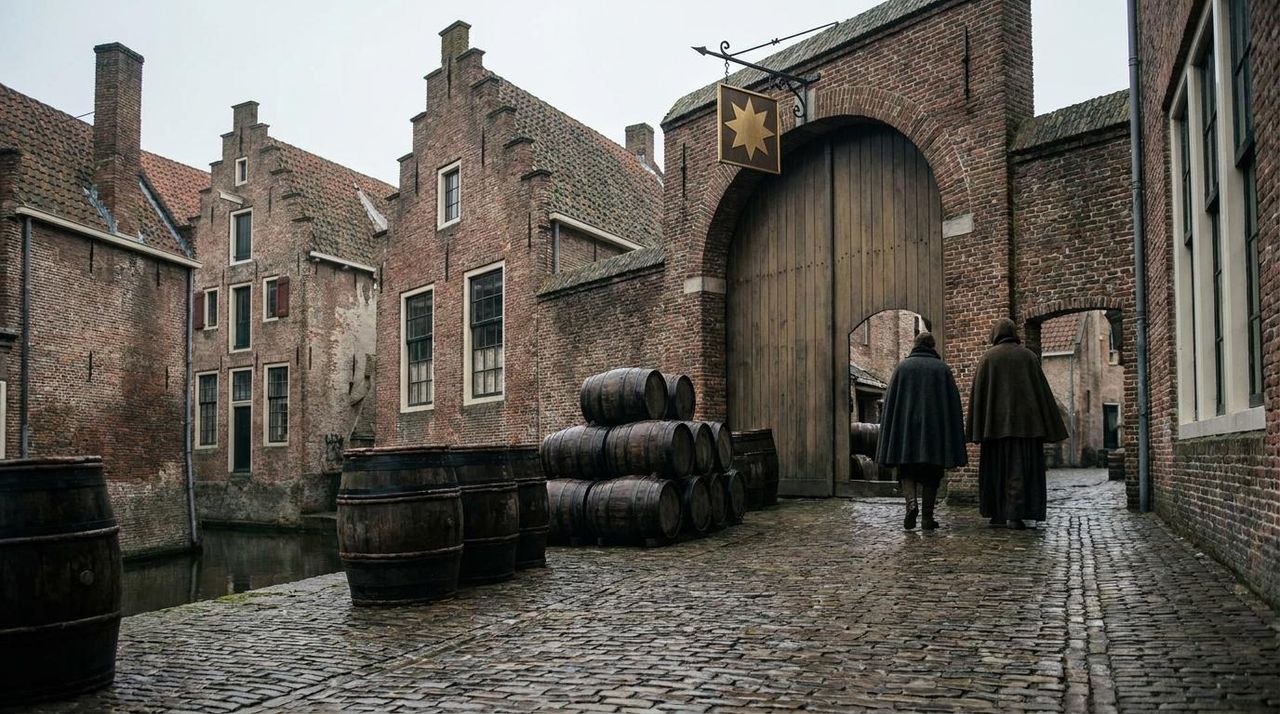
AI-generated reconstruction: a canal street of stepped brick gables in grey light, a brewery gate with barrels and a gilded star hanging over it.
AI-generatedA Haarlem street around 1630, as it might have looked. Your father's brewery was called the Leyster, the lodestar; its sign is imagined.

You are baptised in Haarlem on 28 July 1609. Your father, Jan Willemsz, owns a brewery called the Leyster, the lodestar, and the family takes its name from it.

Who taught you is not recorded. Samuel Ampzing's book in praise of Haarlem, published in 1628 and written before February 1627, mentions you beside the workshop of Frans Pietersz de Grebber, whose daughter Maria also painted, but his wording leaves it unclear whether you trained there. No document says you studied with Frans Hals, though your work comes closer to his than almost anyone's.

Ampzing's own question shows how rare you are: "Who ever saw a painting made by the hand of a daughter?" Your family moves to Vreeland near Utrecht and, by September 1629, to Zaandam; you are back in Haarlem by November 1631, a witness at the baptism of one of Hals's children.

The leading star

EvidenceThe NGA's biography and catalogue; the Rijksmuseum's entry for The Jolly Drinker; Peter Sutton's review of the 1993 exhibition. Sources differ on details of the guild dispute of 1635.

From 1629 you sign and date your pictures, with a monogram of your own: the letters J and L joined, with a star beside them, a play on your name. This self-portrait carries no signature.

By 1633 you are a master in Haarlem's Guild of St Luke, one of very few women ever admitted; the NGA calls you the first for whom a body of work can be named. In 1635 you have three pupils. One of them, Willem Woutersz, leaves for Frans Hals's studio, and in October you go before the guild and win payment from his mother.

In 1648 the Haarlem historian Theodorus Schrevelius, listing women who could compete with men in painting, singles you out as the true "leading star" in art, the same pun on your name.

Was Hals fined?

Accounts of the guild case differ. The NGA says only that your claim succeeded. Other accounts say you were fined for not registering the pupil, or that Hals was; a 1994 review dates the complaint to 1633. This guide follows the NGA.

Fine clothes, a quick turn

EvidenceArthur Wheelock's catalogue entry (NGA, 1995) and its notes, and the NGA's article of 2025. The reasons given here are scholars' readings, not your words.

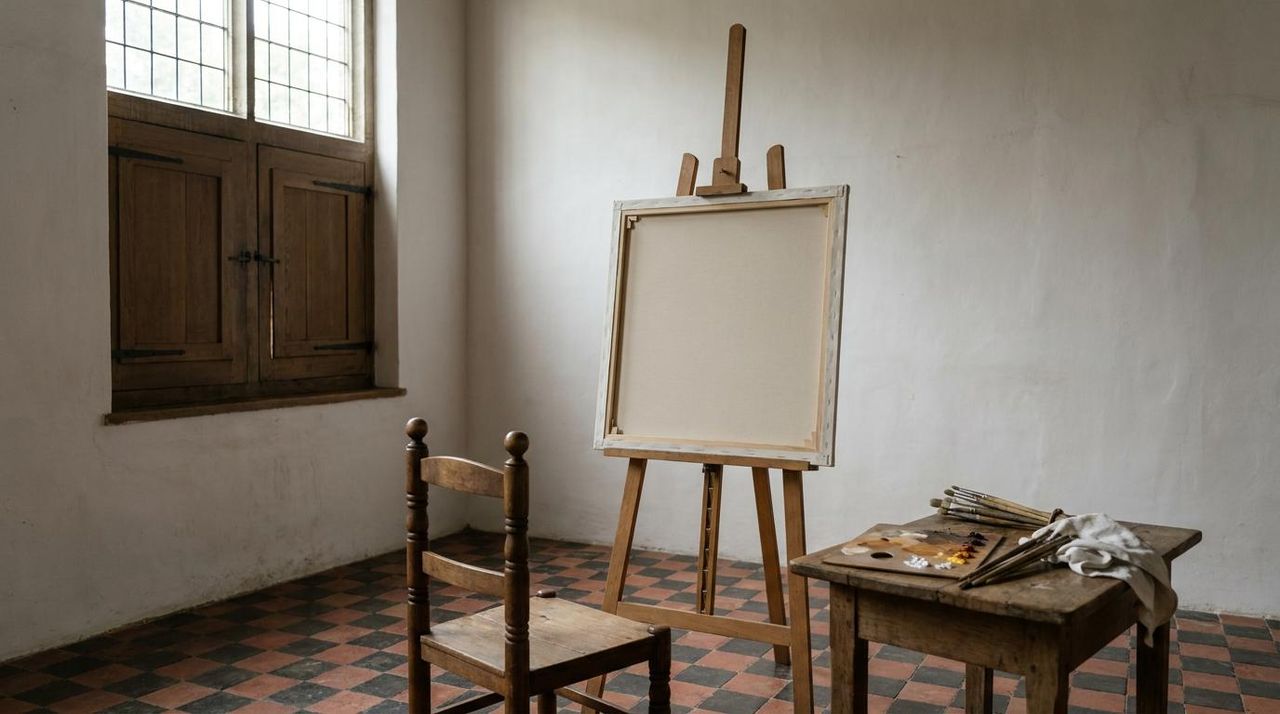
AI-generated reconstruction: an empty room with whitewashed walls and a tiled floor, light from a high leaded window, an easel with a blank canvas, a chair with turned posts and a small table with a palette, brushes and a white cloth.
AI-generatedA painter's room in Haarlem around 1630, as it might have looked. Where you painted is not recorded.

A self-portrait at the easel is an old type. Painters show themselves dressed well, at work, to claim that painting is a liberal art and not a craft; Catharina van Hemessen did it in 1548. You keep to that tradition and break it at once.

Dress for the claim
A starched collar edged with lace, a fine cap, silk sleeves: formal clothes, the NGA notes, inappropriate for anyone busy painting. They say what you can afford, and what painting is worth.
Turn and speak
Your arm over the back of the chair, your lips parted, you turn to us as if interrupted. That momentary air belongs to Frans Hals's portraits of the 1620s; such active poses were rare in portraits of women.
Show what you sell
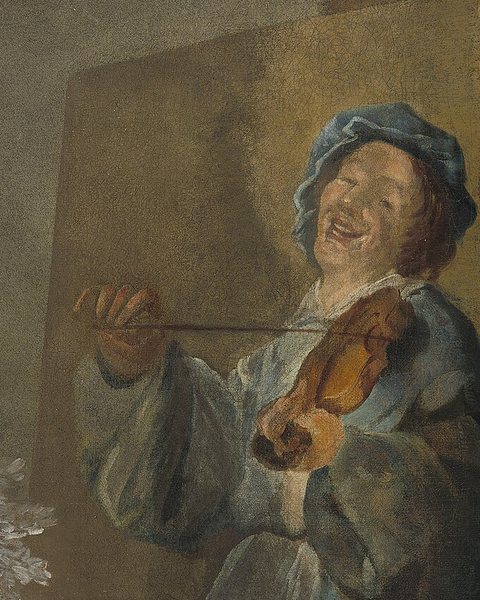
On the easel, not your own face but a laughing fiddler from one of your merry company scenes: the kind of picture a buyer could order from you.
Bow and brush
His bow and your brush lie almost parallel. Wheelock reads it as a claim: as he has mastered his instrument, you have mastered yours.

When is this? The NGA dates it about 1630, from the collar's style, the cap (close to one in your Carousing Couple of 1630) and the violinist's source. Frima Fox Hofrichter proposed instead that you painted it in 1633 as your masterpiece for the guild, which required a painting "two feet large" of new masters; Wheelock thinks that probably not correct.

Canvas, white ground, grey-brown wash

EvidenceThe NGA's technical summary for this painting; Hendriks and Groen's study of six of your paintings (1993), known here only through a review. No sample from this canvas has been published.

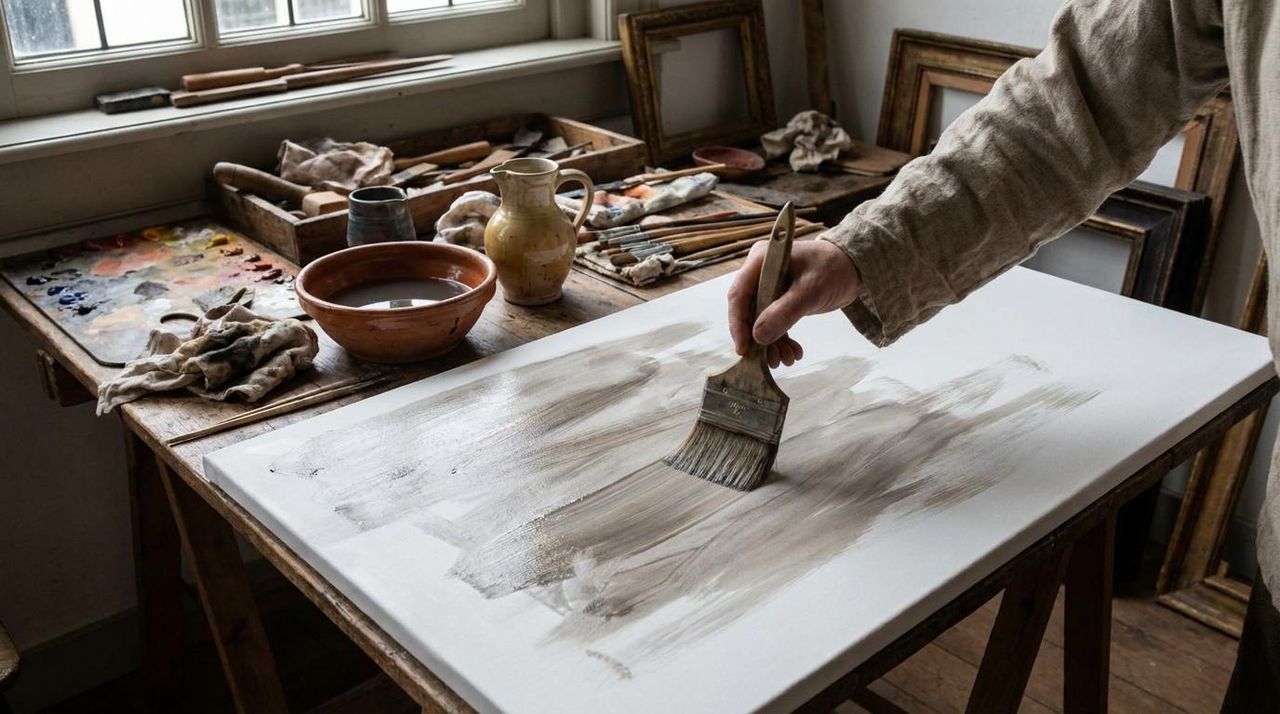
AI-generated reconstruction: a hand brushing a thin grey-brown wash over a white-primed canvas lying on a trestle table, a dish of the wash and a jug of oil beside it.
AI-generatedImagined: a grey-brown imprimatura brushed over the white ground.

The canvas is a plain weave with many slubs and irregular threads. Over it goes a smooth, thin white ground, and over that a grey-brown imprimatura, a thin coloured wash that will show through in the half-tones and give the whole picture its key.

The X-radiographs show cusping, the wavy distortion of the weave where it was pulled onto a frame, along all the edges except at the lower left. So the picture is about the size you made it, though the tacking margins were trimmed when it was lined.

Ella Hendriks and Karin Groen examined six of your signed paintings for the 1993 exhibition. As a review summarised them, your canvases had an oil imprimatura over a flesh-coloured chalk ground, the usual Haarlem practice. The NGA describes this ground as white; this guide follows the NGA for this painting.

What pigments you used here is not known: no analysis of this painting has been published. The swatches in the diagram are colours seen, not colours found.

Draw with the brush

EvidenceHendriks and Groen (1993) through Sutton's review, on your work in general. For this painting no underdrawing and no preparatory drawing are reported; the lay-in shown is inferred.

AI reconstruction: A bare canvas with a pale ground through which the weave shows.
GroundWhite, smooth, thin. AI-generated
AI reconstruction: The same canvas covered with an even grey-brown wash.
ImprimaturaA grey-brown wash. AI-generated
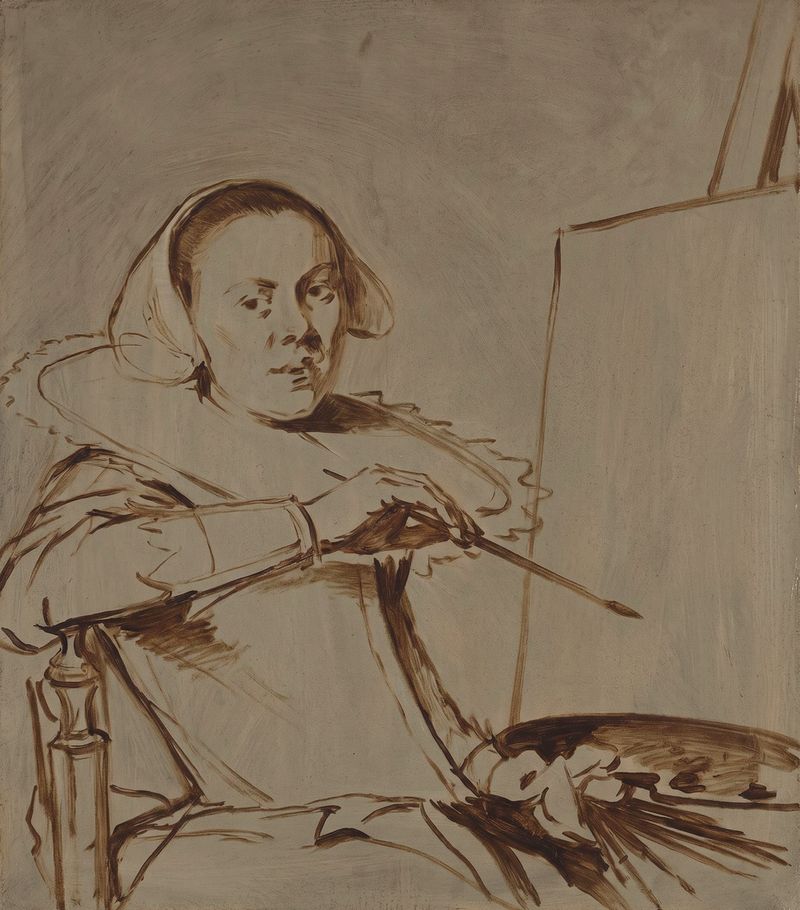
AI reconstruction: A loose sketch in brown paint of the seated painter, her chair, palette and the easel.
Lay-inBrown lines in oil. AI-generated
AI reconstruction: The dress and background laid in in flat colour, the face still pale, a woman's head roughly painted on the easel.
Laying inDress, chair, a first head. AI-generated
Generated with Prodia from the finished painting, so the composition stays in register. They show plausible stages, not scans of the real layers.
  1. No drawing first

    No preparatory drawing for this painting is known, and none of the technical reports mentions an underdrawing. Hendriks and Groen found that you usually did without preliminary studies and sketched straight onto the primed canvas in oil, as Hals did.

  2. Sketch in thin paint

    Brush in the figure, the chair, the palette and the easel in a thin, dark paint on the grey-brown. The lines in stage 3 are invented: they show the kind of sketch the evidence allows, not the one beneath this picture.

  3. Hold the pose

    Looking over your shoulder with your arm on a chair back is hard to keep up. You would have had to take the pose again and again to paint it, presumably at a mirror.

Paint the figure, then change the easel

EvidenceThe NGA's technical summary describes how the peplum, the flesh, the sleeves and cuffs, and the skirt were painted. The order of the four steps is inferred; on The Jolly Drinker (1629) the Rijksmuseum found you worked from the back to the front.

The paint changes from passage to passage: liquid in the black, thick and blended in the flesh, thin in the sleeves, glazed in the skirt. The technical summary does not say in what order you worked; the four steps below are one plausible sequence.

Dress, sleeves and skirt

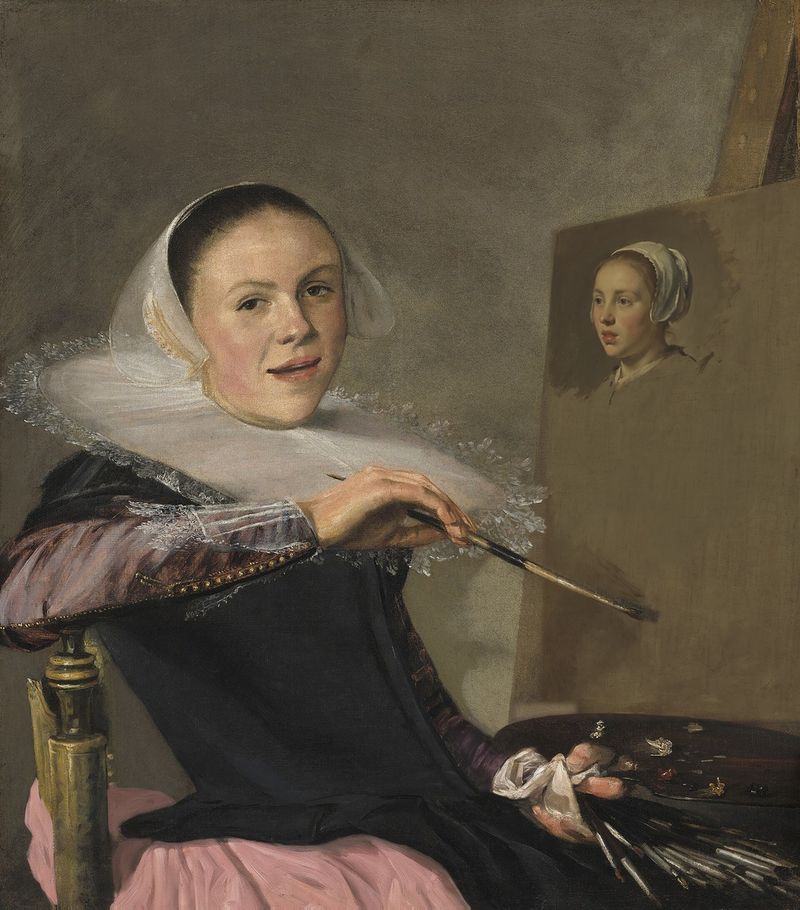
AI reconstruction after step 1: The black dress in loose, liquid strokes, thin purple on the sleeves, pink under the skirt; on the easel, a woman's head, as the infrared images show. Its looks are imagined.
After step 1 AI-generated
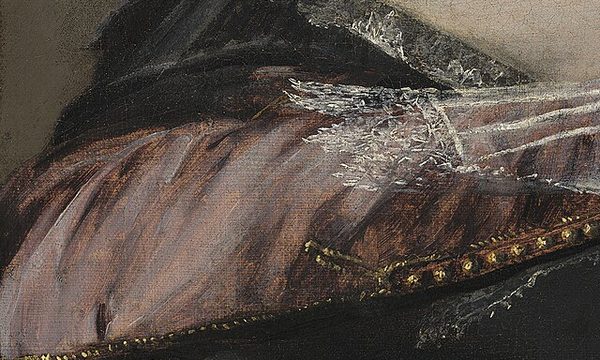
Close-up of a purple silk sleeve with a gold-studded seam, over a black bodice.
The sleeve: thin purple, scumbled.

Lay in the background and the dress first. The NGA's conservators describe fluid paint in loose, liquid strokes in the black peplum, the short skirt of the bodice.

Keep the purple of the sleeves thin, scumbled over what lies beneath, and put an opaque pink under the red skirt, ready for glazes later.

Face, hands and collar

AI reconstruction after step 2: Your face and hands blended wet into wet, the collar and cap. The easel still holds the woman's head; the cuff and the red glazes are still to come.
After step 2 AI-generated
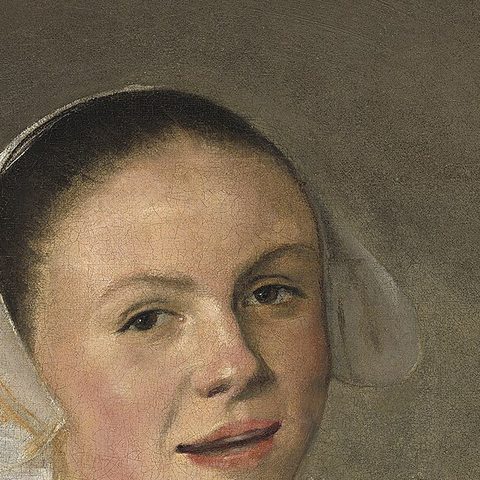
Close-up of a young woman's face under a white cap, her lips parted, her cheeks flushed.
Your face, blended wet into wet.

Now the flesh: thicker pastes, blended wet into wet, so the cheeks turn without a hard edge.

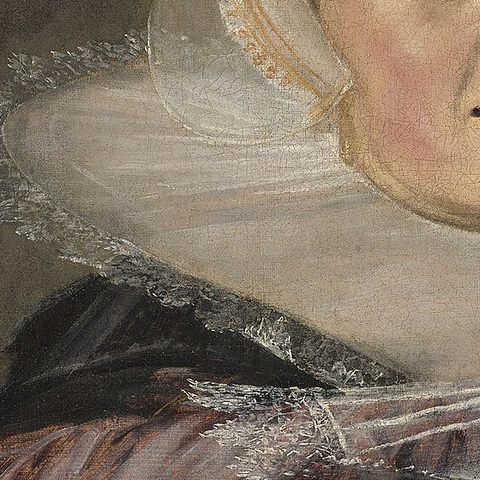
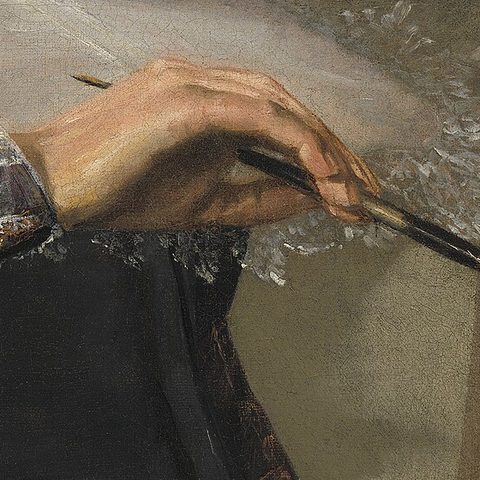
Then the great collar, starched and edged with lace, and the hand that holds the brush. The NGA notes how smoothly the head is modelled; it is one of the reasons the catalogue dates the painting to about 1630.

Close-up of a wide white collar edged with lace, below the chin.
The collar's lace edge.
Close-up of a hand holding a long brush lightly between the fingers, a lace cuff at the wrist.
The brush hand.

Change the picture on the easel

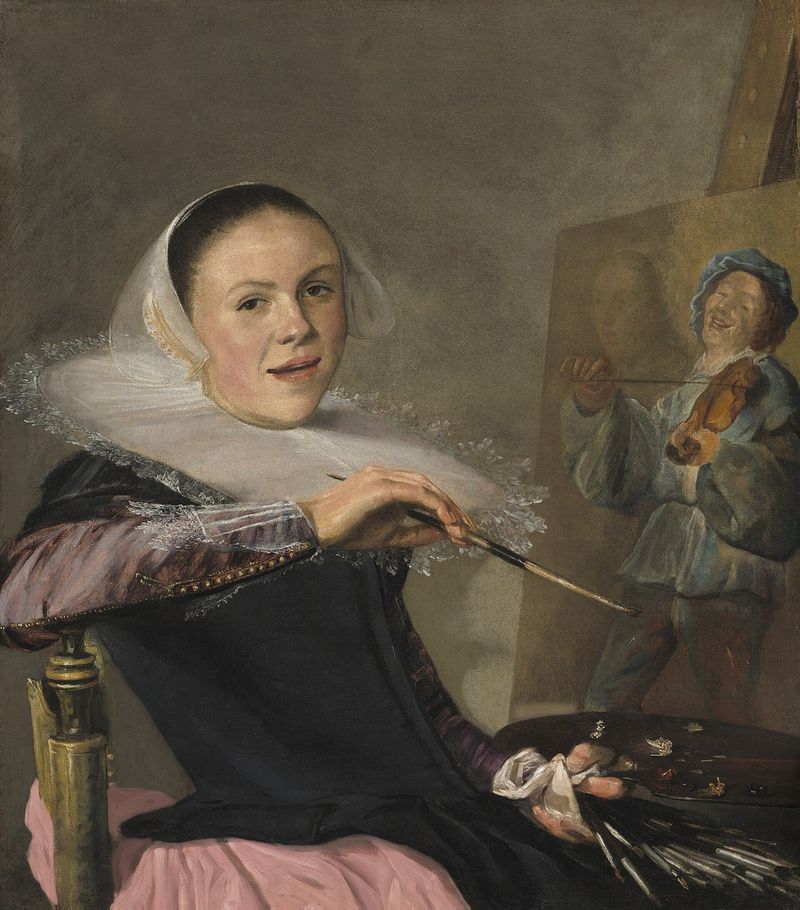
AI reconstruction after step 3: The head on the easel painted over and a laughing violinist from your Merry Company brushed in its place, left unfinished. The head still shows faintly, as it does today.
After step 3 AI-generated
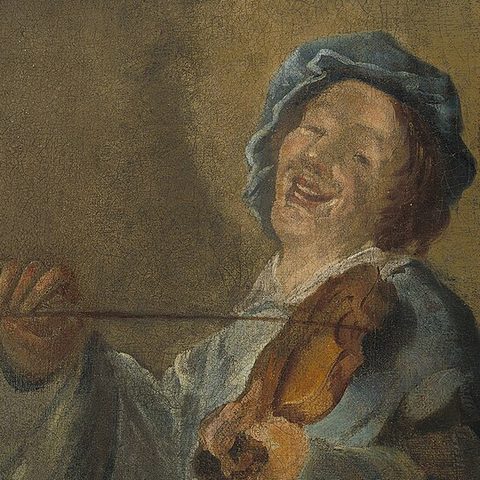
Close-up of the unfinished painting on the easel: a laughing young man in a blue beret playing a violin.
The violinist, left unfinished.

The canvas on your easel first held a woman's head. Paint it out and put in its place a laughing violin player, the same figure as in your Merry Company.

Leave him unfinished, as if you had just turned from him to look at us. His bow, raised, answers the brush in your hand.

Cuffs, glazes and the palette

AI reconstruction after step 4: After the cleaning of 1992. The red skirt at lower left is painted on a later insert of new canvas, not by you.
After step 4 AI-generated
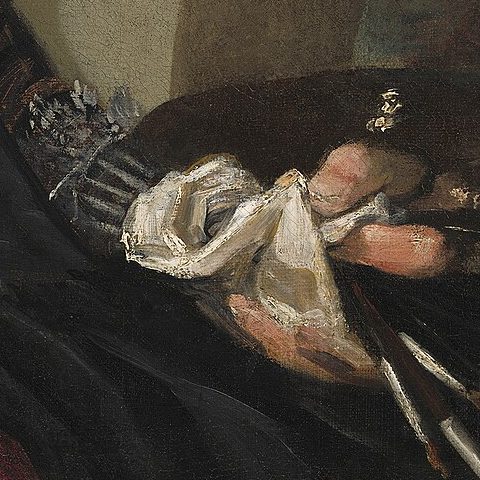
Close-up of a hand holding a palette, a white cloth and a bundle of brushes, with a lace cuff at the wrist.
Palette, brushes and a cloth in one hand.

When the sleeves are dry, put the white cuffs on top of them, wet over dry.

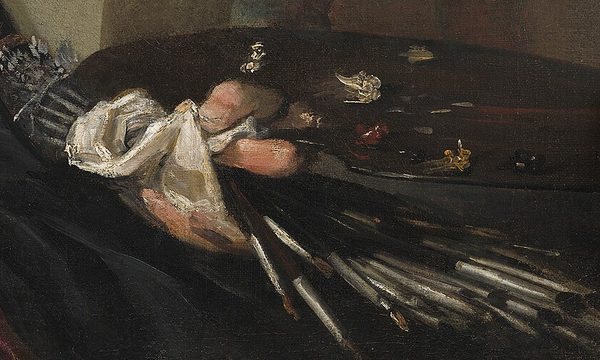
Over the opaque pink of the skirt, lay red glazes. Then the palette with its dabs of colour, the white painter's cloth and the bundle of brushes in your left hand.

Close-up of a dark palette with small dabs of white, red and ochre paint, a white cloth and many brush handles.
The palette, with dabs of paint.

The face under the fiddler

EvidenceThe NGA's catalogue and technical summary, from infrared photography and infrared reflectography; its figures are not reproduced here. Whose face it was, and why you changed it, are scholars' suggestions.

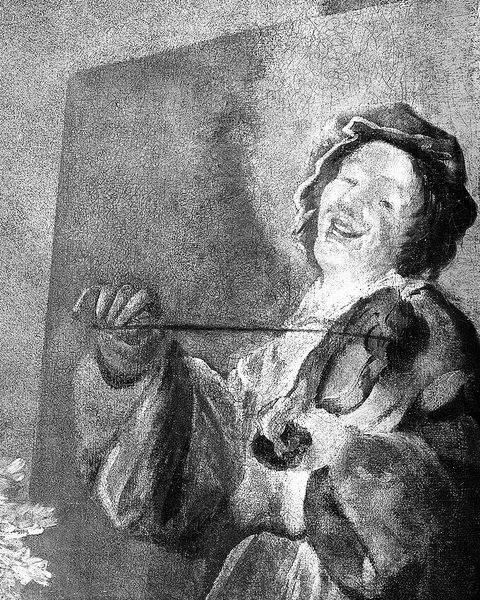
Infrared photography and infrared reflectography, which see through some paint to darker layers beneath, show that the picture on your easel first held something else: a woman's head, with parted lips, turned slightly to the left. The NGA's conservators call it a major change. It is now partly visible to the naked eye, as a pentimento.

Whose head? Wheelock thinks it was probably you, a self-portrait within the self-portrait, as the tradition of the painter at the easel would lead one to expect. Why change it? Perhaps because the merry company with the fiddler had sold well, or, as Hofrichter suggested, to show that you could paint both portraits and lively scenes from life. No document says.

The fiddler comes from your Merry Company of about 1629 to 1631: the same blue beret, the same open laugh, the same bow raised across the strings. On the easel you leave him unfinished. Today he is the most worn part of the painting.

The painting on the easel: the violinist in blue against a brownish ground.The easel today.
The same area in grey with its contrast stretched: to the left of the violinist's head, a darker shape like a head turned to the left.The same, contrast stretched: a darker head-shaped form left of his face.

Both are cut from the NGA's open-access photograph; the right one is only that photograph in grey with its contrast stretched, not an infrared image. The NGA's reflectogram, which shows the head clearly, is in its online catalogue.

Lost to Hals, found again

EvidenceThe NGA's provenance, exhibition history and technical summary. The London sales of 1810–12 are only possibly this painting; when the canvas at lower left was lost is not known.

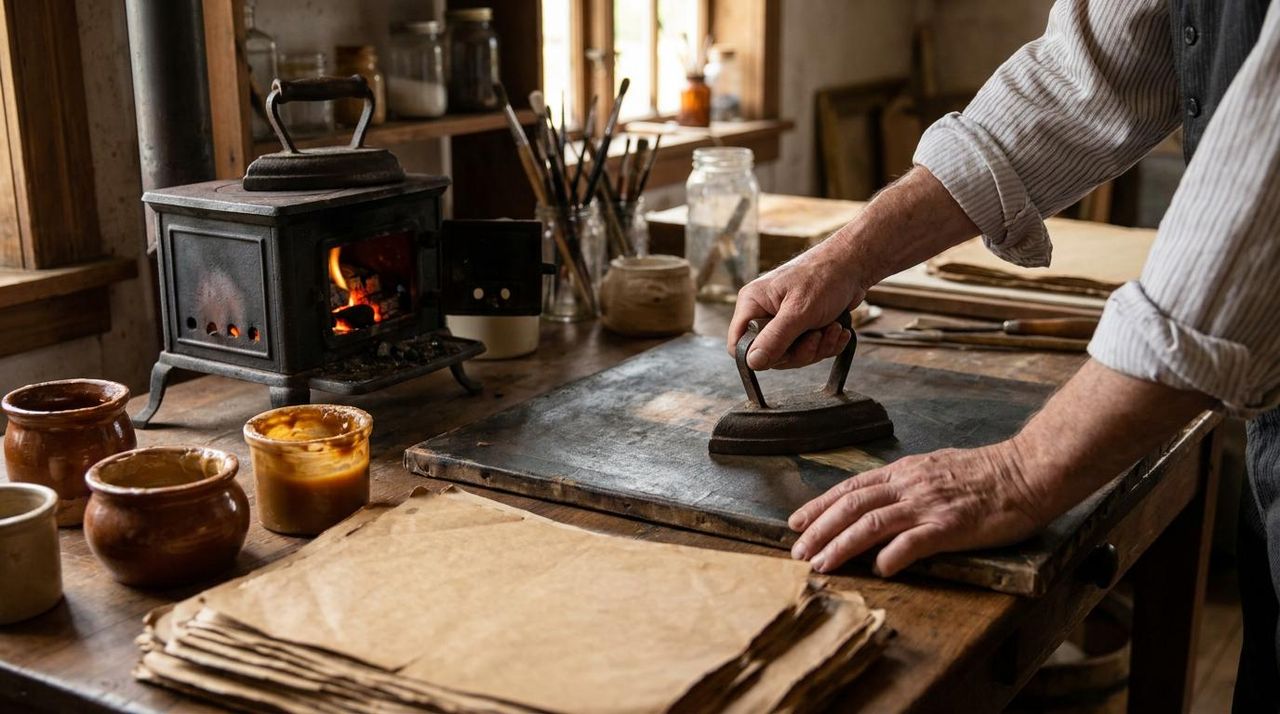
AI-generated reconstruction: a restorer's hands pressing a heated iron onto an old canvas laid face down on a table, glue pots and a small stove beside it.
AI-generatedImagined: a canvas being lined with a hot iron. Such heat can leave the tiny pits seen all over this painting; when it was lined is not recorded.

After your death your name fades, and dealers and scholars give your pictures to Hals. This one carries no monogram to argue with them. It was attributed to you in 1926, then given to Hals by many scholars through the 1930s, shown at the Hals exhibition in Haarlem in 1937, and is now accepted as yours by the NGA and by scholars generally.

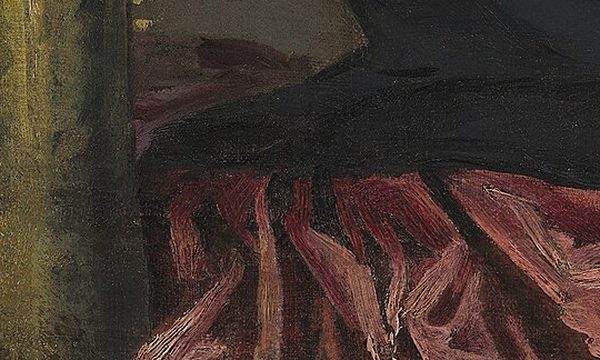
The canvas has had a hard life. A long horizontal rectangle of it is missing at the lower left, in the red skirt, and has been replaced by an insert of fine, tightly woven canvas with none of your paint or ground; the red there is a restorer's. The paint is pitted all over with tiny holes of the kind made by too much heat during lining, abraded and flattened, with small losses at the top and in your left cheek.

In 1992 the NGA removed the discoloured varnishes that, in Wheelock's words, had severely disfigured the painting, and the old retouching. Since then the picture has become, as he puts it, iconic.

Close-up of a red silk skirt with pale highlights, below a black bodice and beside a gilt chair post.
The red skirt at lower left Cut from the NGA's photograph Much of this area is painted on the later insert. Its exact outline shows in the NGA's X-radiograph, not here. Public domain (CC0) · National Gallery of Art, via Wikimedia Commons

What is still not known

What pigments and medium you used here: no samples have been published. Whether the head on the easel was ever more than a lay-in, and whose it was. Whether you began with a sketch in paint, as in your other works, since no underdrawing is reported. The order in which you painted the parts. When the canvas was lined and when the piece at lower left was lost. Whether the painting was finished about 1630 or in 1633. The technical study of 1993 by Hendriks and Groen, and the NGA's own fuller reports, were not read for this guide.

How Leyster thought

  • Claim the profession. Fine clothes and a brush in hand: a painter, not a craftswoman, and a woman at that.
  • Catch a moment. A turn, a half-spoken word, the work interrupted, as in Hals's portraits.
  • Advertise your wares. The picture on the easel is the kind of picture you sell.
  • Draw in paint. No drawings first; the sketch goes straight onto the toned canvas.
  • Let each passage have its own paint. Liquid black, blended flesh, thin purple, glazed red.
  • Change your mind on the canvas. A face painted out, a fiddler put in.

Sources