Imagining Artist Methods
Vigée Le BrunSelf Portrait in a Straw Hat · c. 1782All 16

A studio guide · Brussels and Paris, 1782

Self Portrait in a Straw Hat, painted twice

Imagine you are Élisabeth Vigée Le Brun, twenty-seven years old, a portrait painter much in demand in Paris, and married to one of its leading picture dealers. In Antwerp you have just seen a Rubens portrait of a woman whose face lies in the shade of her hat, lit only by the light thrown back around her. In Brussels you paint yourself the same way, on an oak panel. This guide follows the second version you painted, on canvas, now in the National Gallery, London: its drawing, its sky laid thinly over a pale ground, and the changes you made as you went.

The National Gallery's 2018 catalogue entry by Humphrey Wine, with an infrared image and a microscope examination, documents the canvas, the ground, the drawing and the changes. No analysis of the pigments has been published. The order of the painting is inferred, and so are the colours of stages 2 and 3. Each chapter opens with a note on what its evidence is. The slider steps through six stages; stages 2 to 5 are AI reconstructions.

Today

Stage 6 of 6

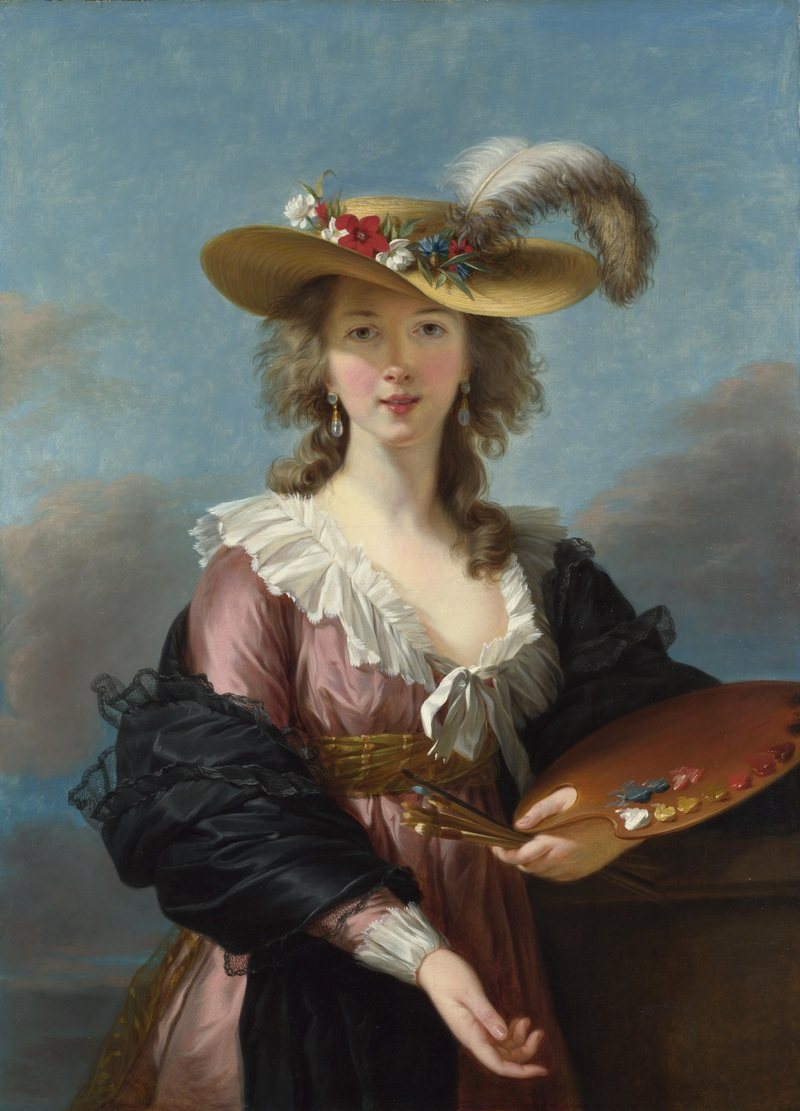
The painting today, 97.8 by 70.5 cm, with its feather, garland of flowers and dabs of colour on the palette.

Élisabeth Louise Vigée Le Brun, Self Portrait in a Straw Hat, about 1782. Oil on canvas, 97.8 × 70.5 cm. National Gallery, London (NG1653), bought 1897. An autograph replica of the signed and dated panel of 1782 in a private collection. AI-generated Stages 2 to 5 are reconstructions made with Prodia from this painting; stage 1 is drawn.

No master but nature

EvidenceYour own Souvenirs, published in 1835–37, more than fifty years after these events and not always right about dates; the National Gallery's catalogue entry (Wine, 2018).

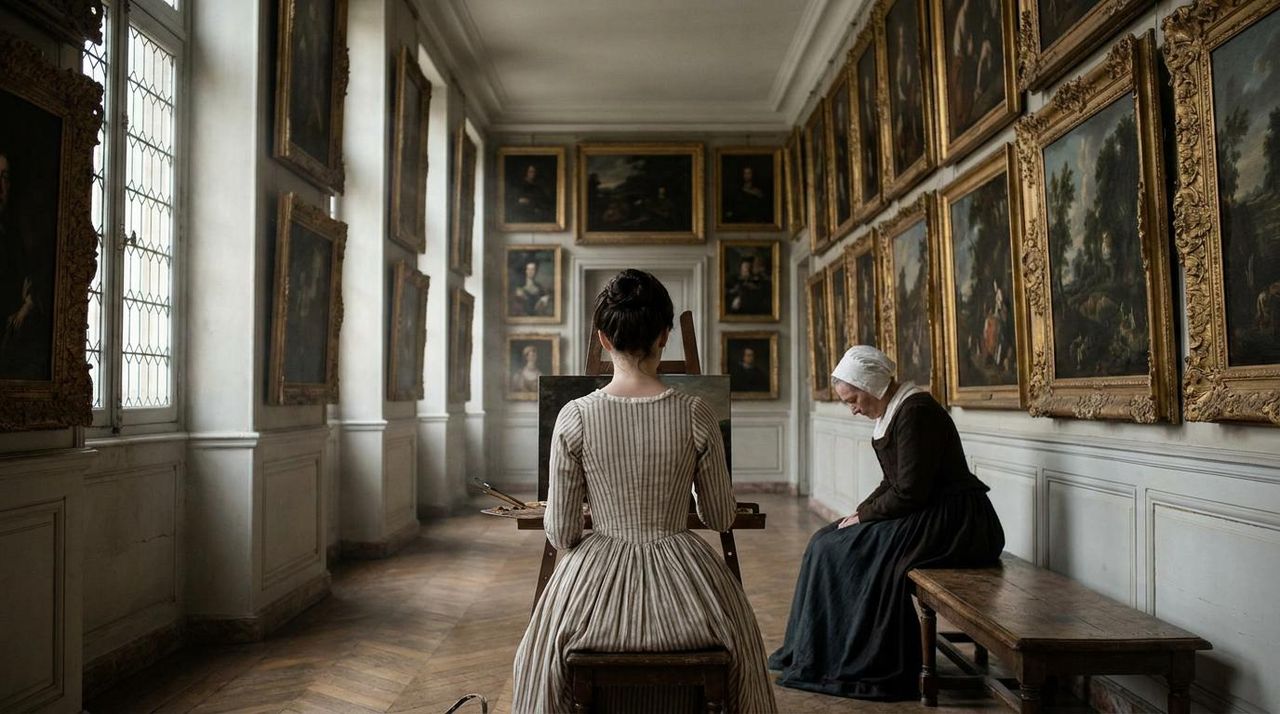
AI-generated reconstruction: a young woman in a striped 1770s dress, seen from behind, copying at a small easel in a long gallery hung with large Flemish paintings, an older woman in black sitting on a bench beside her.
AI-generatedA Paris picture gallery around 1770, as it might have looked. You say you copied Rubens, Rembrandt and Van Dyck in such collections.

You are Élisabeth Louise Vigée, born in Paris in 1755. Your father, Louis Vigée, makes portraits in pastel and lets you use his crayons all day. When you are about eleven, the wife of a painter called Davesne teaches you to mix oil colours.

Joseph Vernet, the marine painter, gives you the advice you say you always followed: follow no school's system, look at the great Italian and Flemish masters, and above all work from nature. “I never had a master, properly speaking,” you write.

Your mother takes you round the Luxembourg Palace and the private collections of Paris. You copy pictures by Rubens, heads by Rembrandt and Van Dyck, and Greuze's girls, for the half-tints of their delicate flesh.

You marry Jean-Baptiste-Pierre Le Brun, a dealer in pictures. By 1782 the orders for portraits come “from every side”, and he has, you say, got into the habit of pocketing your fees. You work fast, sometimes three sittings in a day, and you dislike powder and hooped skirts: you persuade your sitters into loose muslin and draped scarves.

Two journeys to Flanders

EvidenceYour Souvenirs, which put a single journey in 1782; Wine (2018), who matches them against the dates of the sales Le Brun went to and shows there were two, in 1781 and 1782.

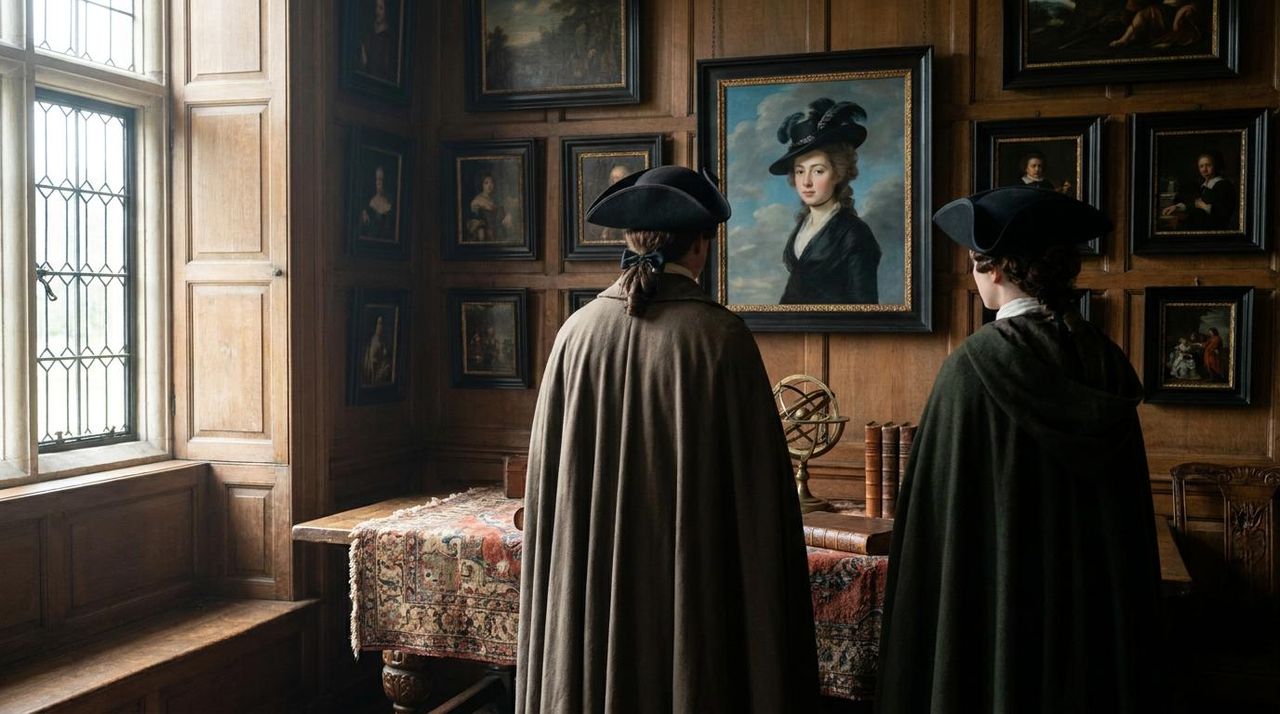
AI-generated reconstruction: a man and a woman in 1780s travelling cloaks, seen from behind, standing in a dark panelled collector's room in Antwerp before a portrait of a young woman in a broad dark hat with feathers.
AI-generatedA private collection in Antwerp, 1782, as it might have looked. The portrait on the wall is invented, not the Rubens.

Le Brun's business takes you to Brussels in the summer of 1781, for the sale of the paintings of Prince Charles of Lorraine, held from 19 to 23 June. You meet the Prince de Ligne, see his Van Dycks and Rubens heads, stay at his house at Beloeil, and travel on into Holland, ending in Amsterdam. He has to be back in Paris for a sale on 26 November.

“We returned to Flanders to see the masterpieces of Rubens,” you write. Your memoirs make it one journey, in 1782; Wine shows it was a second one, after Le Brun's last Paris sale of the season on 29 April 1782. The Rubens paintings hang in the Flemish churches, where you think they look far better than they will in Paris; others are in private houses.

In one of those houses in Antwerp, probably that of Jean-Michel-Joseph van Havre, who had married into the Lunden family, you find “the famous Straw Hat”.

Two different lights

EvidenceYour Souvenirs (French text of 1835 and Lionel Strachey's translation of 1903); the National Gallery's page on the Rubens (NG852); Wine (2018) on the guidebooks.

The painting is a half-length portrait of a young woman by Rubens, believed in your day to be one of his wives. A broad hat with a feather throws her face into shade; the sun from a clear sky falls on her chest and hands. You put its effect in a sentence: “two different lights”, plain daylight and the glow of the sun.

You did not come to it unprepared. Three guidebooks you could have read, by Descamps, Mensaert and Michel, all describe the face shaded by the hat, lit only by the light around it.

“It delighted and inspired me to such a degree,” you write, “that I made a portrait of myself at Brussels, striving to obtain the same effects. I painted myself with a straw hat on my head, a feather, and a garland of wild flowers, holding my palette in my hand.”

The Rubens is now thought to show Susanna Lunden, and its hat is not straw but beaver felt; the name may come from a slip of paille, straw, for poil, the felt. It was sold to Sir Robert Peel in 1824 and has belonged to the National Gallery since 1871, so both pictures are now in the same collection.

The hat, the feather and the flowers were not what made yours new. They were the fashion of 1782 in its country mode, and you put them on other sitters that year. What was new, Wine argues, was to leave a portrait's face in shadow.

The first version, on panel

EvidenceWine (2018), who examined the panel in its private collection; your Souvenirs. The panel has not been technically studied in print, and the only free photograph of it is small and dark.

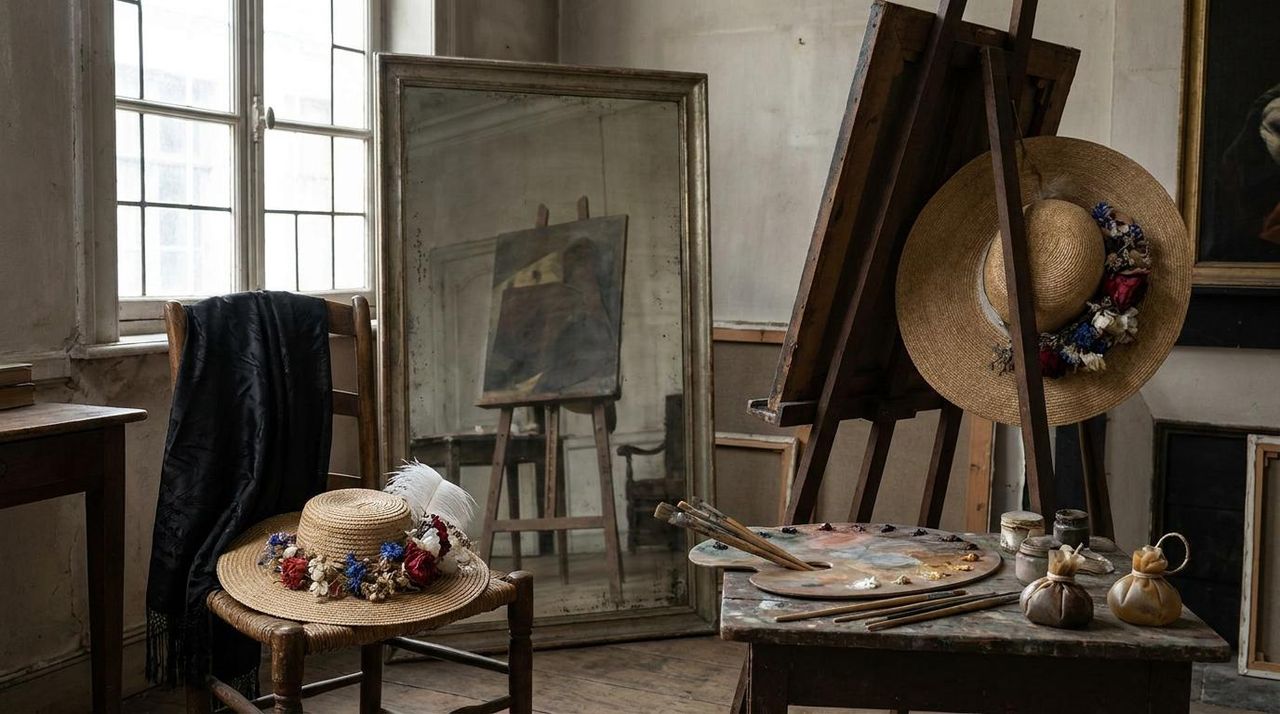
AI-generated reconstruction: a bare room with a tall window, a big standing mirror angled towards an easel, a wide straw hat trimmed with red, blue and white flowers on a chair with a black shawl, and a palette and brushes on a small table.
AI-generatedA room in Brussels set up for a self-portrait, as it might have looked. You must have used a mirror; where you worked is not recorded.

In Brussels you paint the first version on an oak panel, like the Rubens, and set yourself out of doors, like the Rubens, under a sky. It is not an open-air painting: the setting is a fiction, and you would have worked indoors, from a mirror.

You sign and date it on the panel, “L. ze. Le Brun f. / 1782”. It measures 95.5 by 69 centimetres. Back in Paris it is on show by 7 June 1782 at the Salon de la Correspondance, an exhibiting society outside the Académie, where by chance it hangs as a pair with a self-portrait by your rival Adélaïde Labille-Guiard.

By July 1783 it belongs to your friend the comte de Vaudreuil. It later went to England, and it is now in the collection of the baronne Edmond de Rothschild. Wine, who examined it, found it in excellent condition: a recent writer called it a marvel of bravura painting.

That same year you paint the duchesse de Polignac, the queen's friend, in almost the same costume: straw hat, feather, flowers, black shawl, her face partly in shade. Perhaps it was the queen who asked for it, having heard of yours.

The Salon of 1783

EvidenceThe reviews of 1782 and 1783 quoted by Wine (2018); your Souvenirs. The painting shown was the panel, not the canvas in London.

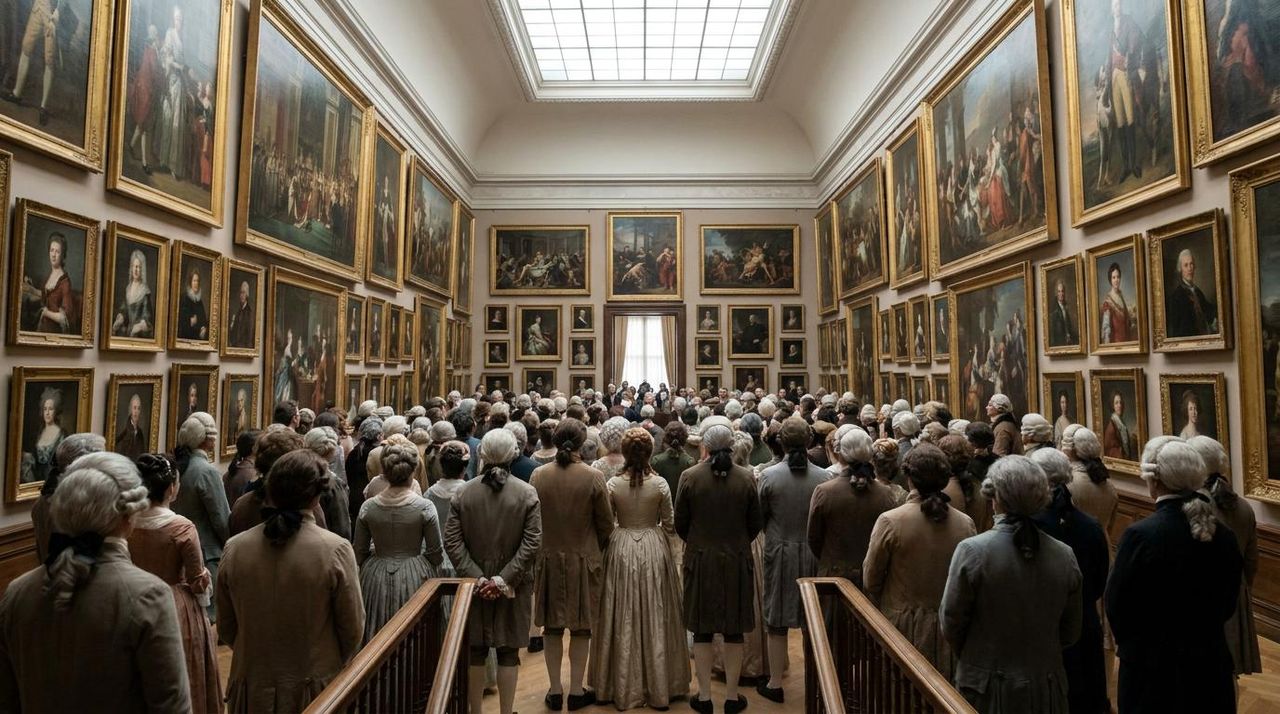
AI-generated reconstruction: a crowd in 1780s dress, seen from behind, in a tall top-lit room whose walls are covered from floor to ceiling with paintings in gilt frames.
AI-generatedThe Salon in the Louvre, 1783, as it might have looked. The paintings on the walls are invented.

The self-portrait helps carry you into the Académie royale. You say that it, with other works, decided Joseph Vernet to propose you, against the opposition of M. Pierre, the king's first painter, who did not want women admitted. In 1783 you are received, and so is Labille-Guiard.

At the Académie's Salon that year the panel hangs again, near Labille-Guiard's self-portrait, and few critics fail to mention it. One reviewer had seen nothing as seductive and harmonious, and thought the shadow of the straw hat on the face utterly true. Baron Grimm called it your masterpiece, and praised the light that made the straw almost transparent.

There were complaints too. The sky was rudimentary, or too blue; the hands were not quite right; a hat that wide and a shawl over the sleeves, one writer objected, would get in the way of painting; and a portraitist, he thought, should not put a face in shadow. Another found the likeness so loose you could hardly be recognised.

Johann Gotthard von Müller drew the composition in 1783, presumably for his engraving published in 1785. You disliked it: the black shadows of an engraving, you said, destroy the whole effect of such a picture.

A second version, on canvas

EvidenceWine (2018), Technical Notes: examination with the microscope and infrared reflectography; Mills and White (1985) on the medium. The drawing is documented in places only; the rest of it, and the colours of the lay-in, are invented.

You paint the composition again, this time on canvas, 97.8 by 70.5 centimetres: a fine plain-weave linen, its tacking edges since cut away, though it has probably not been cut down. You neither sign nor date it.

When is not certain. The same changes were made to the top of the hat and to the right hand in both versions, so Wine thinks you painted the two at nearly the same time, in 1782. But this canvas has a sky broken by thin cloud, where the panel's is an almost unbroken blue, and it is just possible you painted it after the Salon of 1783 opened, in answer to the critics who found the sky too blue.

The ground is off-white, and it matters to the picture: you will paint the sky so thinly over it that it shows through as the wisps of cloud. The oil is probably walnut, though linseed cannot be ruled out. You often repeat your own portraits: there are three versions of the self-portrait with the cerise bow, an original and three replicas of the duchesse de Polignac, and you noted five replicas of your 1784 portrait of the comte de Vaudreuil.

AI reconstruction: A bare canvas with an even off-white ground.
GroundOff-white, on fine canvas. AI-generated
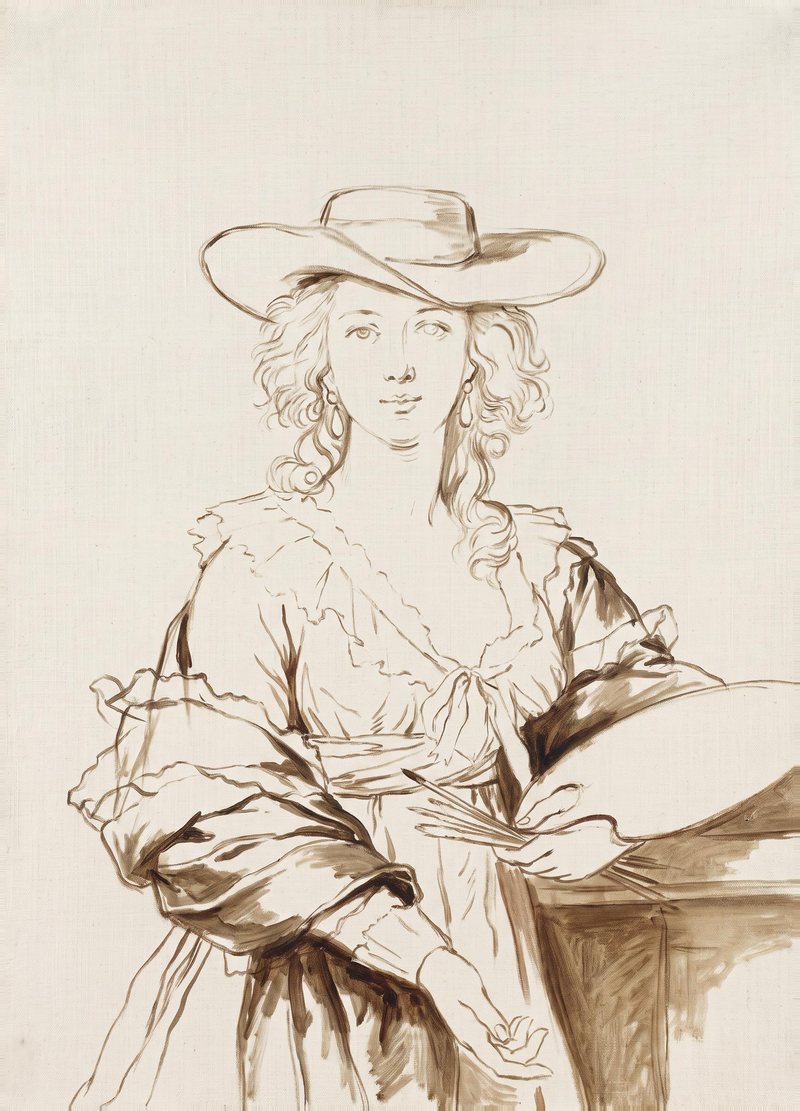
AI reconstruction: The whole figure drawn in thin brown lines on the off-white ground, the hat set a little higher than in the painting.
DrawingOutlines in dark paint. AI-generated
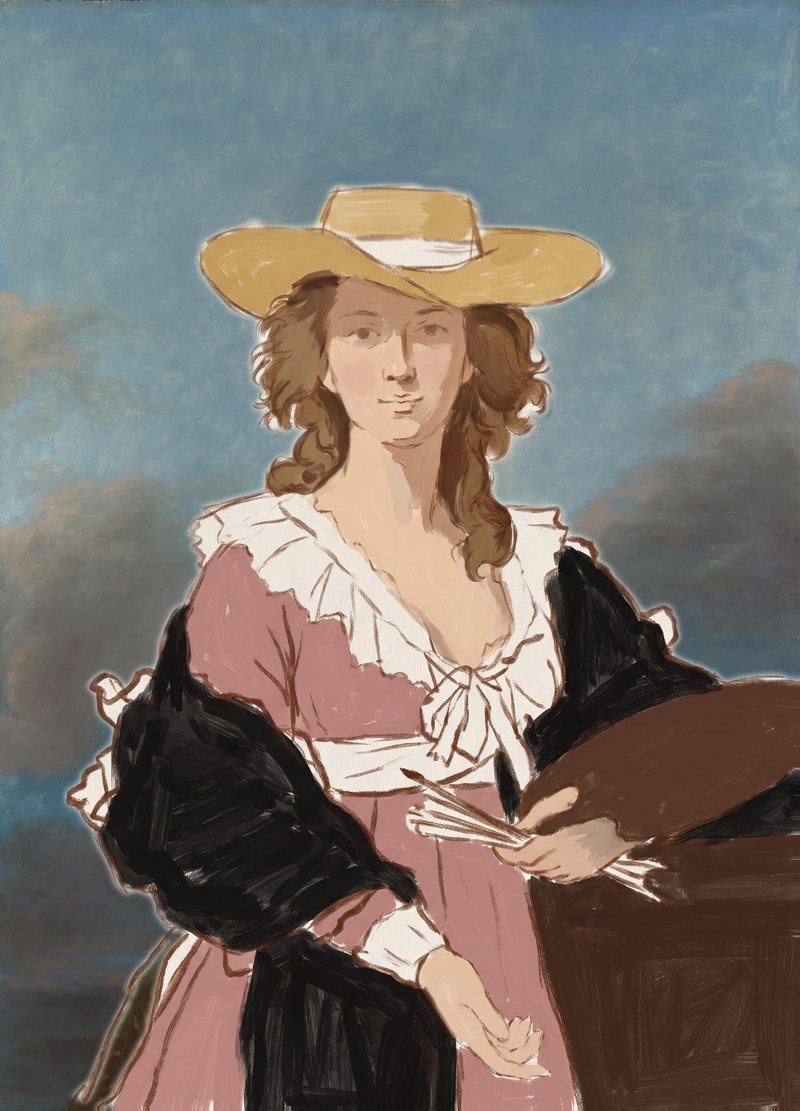
AI reconstruction: Blue sky around the figure, with the figure blocked in in flat pink, black, flesh and straw yellow.
Sky and lay-inThin blue over the ground. AI-generated
Generated with Prodia from the finished painting, so the composition stays in register; stage 1 is drawn by script. They show plausible stages, not scans of the real layers.
  1. Draw with the brush

    Brush the outlines on the ground in dark paint. The infrared image shows such lines around the hand and the right nostril, and dark lines in the dress that do not quite follow the folds as they were finally painted; the microscope shows brushed outlines at the lower left and right of the hat, and more faintly along its edges, covered by the yellow.

  2. Hat over hair

    The lower right brim of the hat is painted over the hair, so the hair went in first there.

  3. A thin sky

    Lay the blue of the sky thinly over the off-white ground and let the ground show through. That, and no white paint over the blue, is what makes the clouds, as a microscope examination in 2012 confirmed.

  4. The shawl, then the shoulder

    Part of the right shoulder seems to have been painted over the black shawl.

The infrared reflectogram itself is reproduced in Wine's entry as its figure 4, © The National Gallery, and is not shown here; it can be seen with the catalogue entry online.

Paint the light

EvidenceWine (2018) on the changes found with infrared and the microscope. The changes themselves are documented; the order of the three steps, and when the feather and flowers went on, are inferred.

The figure, the dress and the shawl are painted, and then the picture is changed in its details. The three steps follow the slider's stages 4 to 6.

1 2 3

AI-generatedAfter step 3: feather, flowers, palette

  1. 1The face in the shade
  2. 2Bring the hat down
  3. 3Feather, flowers, palette

The face in the shade
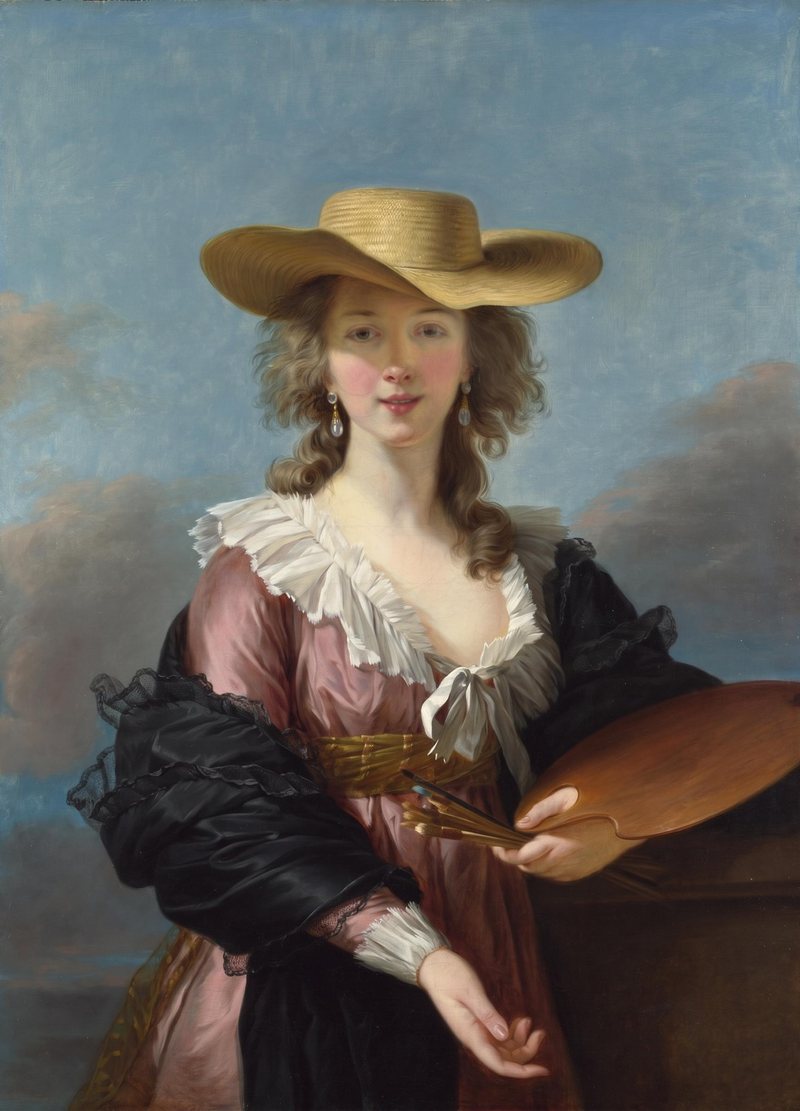
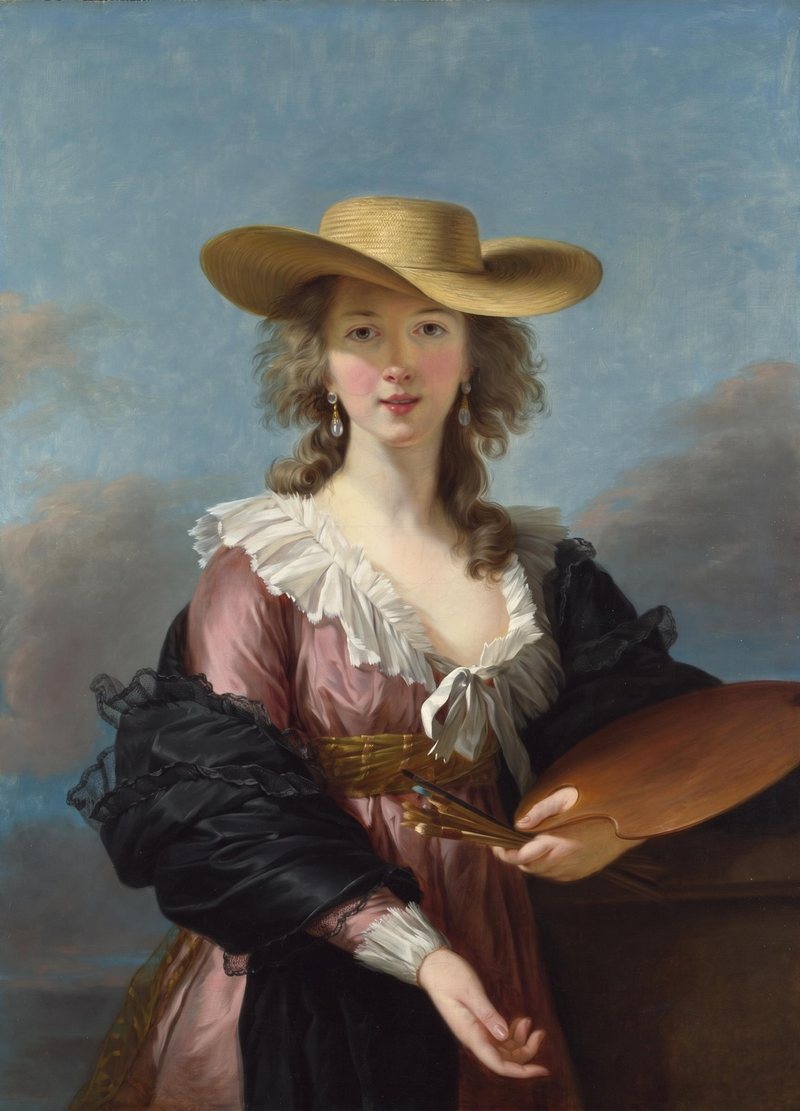
AI reconstruction after step 1: The figure painted, with the hat's crown and right brim about a centimetre higher, the mouth more closed and the eyelids lower, as the infrared image and the microscope show. No feather or flowers yet: that order is a guess.
After step 1 AI-generated
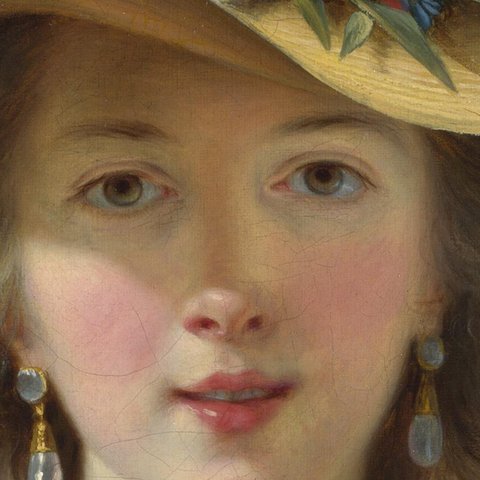
Close-up of the painter's face under the brim of a straw hat: a shadow across the forehead and eyes, pink cheeks, parted lips, drop earrings.
The face in the hat's shadow, lit by the light thrown back from below.

The idea of the whole picture is here. Leave the upper face in the shadow of the brim, but keep the shadow transparent and warm, lit by daylight reflected up from below, so that the eyes read clearly; then bring the full sun onto the chin, the throat and the chest.

In this second version, the infrared image shows, you first painted the mouth more closed, with less of the teeth showing, and the eyelids lower over the whites of the eyes. That is close to how the face looks in the panel.
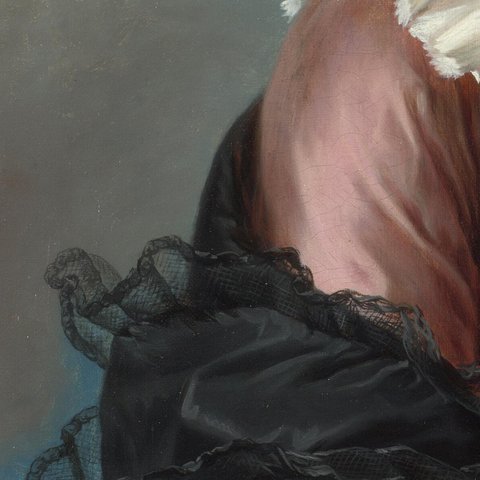
Close-up of a black silk shawl with a lace edge, falling over a pink satin sleeve, against the sky.
The black shawl; part of the shoulder was painted over it.

Bring the hat down

AI reconstruction after step 2: The hat brought down: the new outline drawn in black, and blue sky painted over the top of the old yellow. The mouth opens a little and the eyes widen.
After step 2 AI-generated
Close-up of the top of the straw hat with red, white and blue flowers and the base of a feather against blue sky; fine cracks run through the paint.
The top of the hat, where the crown came down.

Then change your mind about the hat. The crown, and the brim to the right, were first about a centimetre higher. Redraw the outline lower in black, and paint the sky's blue over the top of the old yellow.

The change shows to the naked eye, and under the microscope; the same correction was made to the top of the hat in the panel. Wine takes that as a sign that you painted the two versions at much the same time.

Feather, flowers, palette

AI reconstruction after step 3: The painting today, 97.8 by 70.5 cm, with its feather, garland of flowers and dabs of colour on the palette.
After step 3 AI-generated
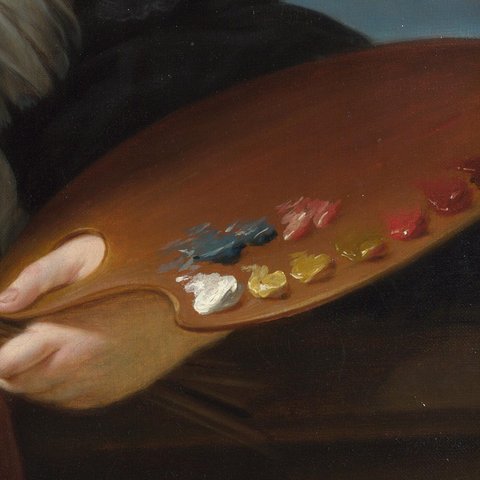
Close-up of a hand holding an oval wooden palette with neat dabs of white, blue, yellow, pink and red paint, and brushes.
The palette, with its dabs of colour.

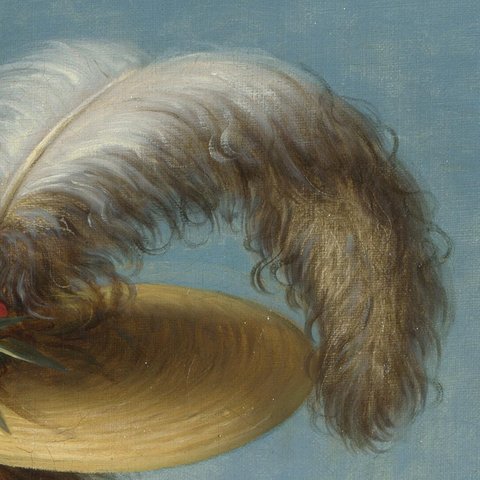
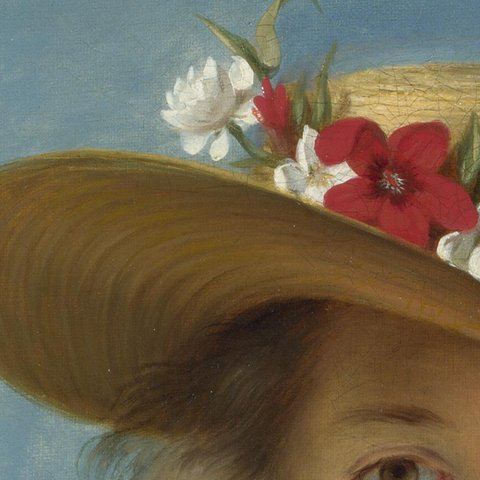
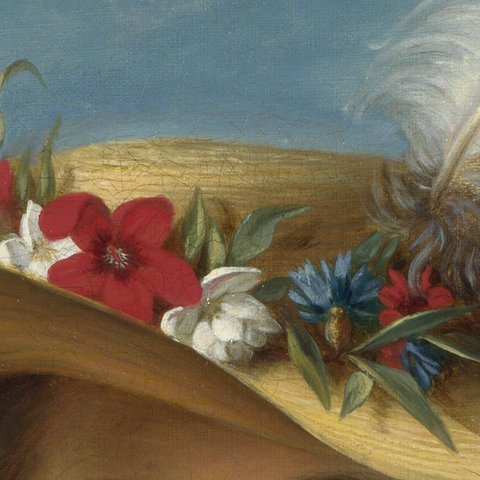
Last, or at least late, the trimmings: a white ostrich feather, with lines scratched into it, and a garland of red, blue and white flowers; then the dabs of colour on the palette in your hand.

Nobody has recorded when in the work they went on. Their place at the end of the slider is a guess.

Close-up of a long white and grey ostrich feather curling over the brim of the straw hat.
The feather. The infrared image suggests lines scratched into it.
Close-up of a red flower, white flowers and blue cornflowers with leaves on the straw brim.
The garland: red, perhaps hibiscus; blue cornflowers; white, perhaps camellias.

Not quite a copy

EvidenceWine (2018), from the infrared image of the canvas and his own comparison with the panel, made with the permission of its owner.

A replica is not a tracing. Set beside the panel, this canvas differs in ways you chose. The eyebrows are heavier and the eyelids more marked; the lower lip is fuller and the mouth smiles more. The infrared image shows you getting there as you painted: the mouth at first more closed and the eyelids lower, close to the panel, then opened. Wine reads the result as more assertive and self-assured.

The dress is a dusty rose where the panel's is lilac. The black shawl's outline differs a little at the elbow and along the forearm. More of the striped sash hangs from the waist, though that may be because the panel is worn there. And the sky, laid thinly over the pale ground, breaks into cloud.

Your hands changed too. The fingers of the open right hand were altered, and the left hand, holding the palette, was first slightly lower. The panel has a matching change to the right hand.

Replica or copy

EvidenceWine (2018), from the National Gallery's archive: the Trustees' minutes, letters and the conservation dossier. Where the canvas was between your studio and 1897 is not known.

Nothing is known of this canvas from the time you painted it until 1897, when the dealer S. T. Smith bought it at the posthumous sale of an otherwise unknown A. P. Pickering in Hyde Park and offered it to the National Gallery for £800.

In December one of the Trustees, Alfred de Rothschild, warned the Director, Sir Edward Poynter, that he believed it to be an old copy, and the dealers Colnaghi sent round the version they held, presumably your panel. Poynter compared the two in his room on 11 December. Smith dropped his price to £600, and Poynter bought it.

The doubt stuck. The Gallery's catalogues of 1946 and 1957 called it “after” you, at best a replica of a better version. After the canvas was cleaned and restored in 1984–85, the Director, Sir Michael Levey, restored it to you; in 1987 Joseph Baillio, the specialist in your work, wrote that he was convinced it was a true replica. Wine, in 2018, sees no reason to doubt them, given how often you repeated your own portraits.

It is in good condition. There is a small L-shaped tear near the bottom right corner, a loss about 2 centimetres long in the sky left of centre, a few small losses elsewhere and some flattening of the thickest paint. The cracks in the black shawl, in the hat and in the shadow under the table edge have been retouched. On the back of the stretcher are a label with a blue border numbered 5066 and a chalk mark nobody has explained.

What is still not known

When the canvas was painted: in 1782 beside the panel, as Wine thinks most likely, or after the Salon of 1783. Where, and for whom, and where it was before 1897. What the ground is made of, and which pigments you used: no analysis has been published, so this guide shows no palette of pigments. How much of the figure was drawn before painting; only parts of the drawing show in the infrared image. When the feather, the flowers and the dabs on the palette went on. The panel itself has not been published technically, and only a small, dark photograph of it is free to use.

How Vigée Le Brun thought

  • Learn from the masters, then from nature. Vernet's advice, and a Rubens studied in Antwerp.
  • Make the light the subject. A face in shade, lit from below; the sun on the throat and hands.
  • Paint yourself as a painter. Palette and brushes in hand, at the Salon where your talent was being judged.
  • Let the ground work. A sky brushed thinly over a pale ground, which makes its own clouds.
  • Repeat, and revise. A replica is a second chance: a centimetre off the hat, a wider smile.

Sources