Lead white
The body of every light, applied thick.

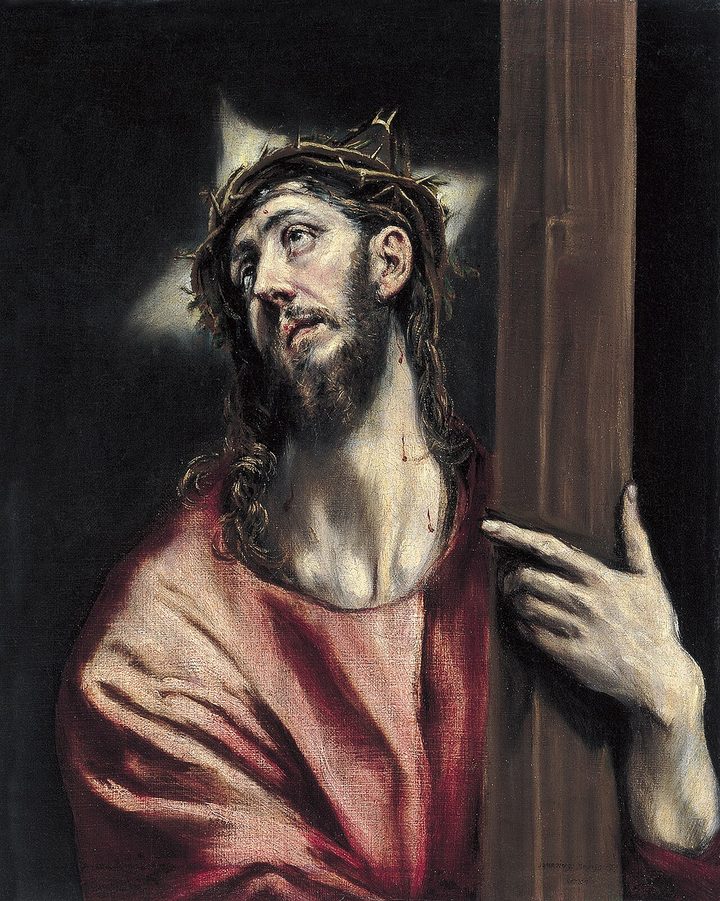
 El GrecoChrist Carrying the Cross · c. 1580All 16
A studio guide · Toledo, about 1580
Imagine you are El Greco, a Cretan painter trained in Venice, newly settled in Toledo and about to paint a Christ who embraces his cross instead of buckling under it. This guide follows what your process would have been, from a reddish ground to the last wet light in the eyes.
This canvas, probably your first version, has no published technical study, so the materials and layers come from a 2014 study of another version in the Thyssen-Bornemisza museum and from your practice generally; the Met's records describe this canvas's condition. Each chapter opens with a note on what its evidence is. The slider steps through nine stages; all but the last are AI reconstructions.

Final lights
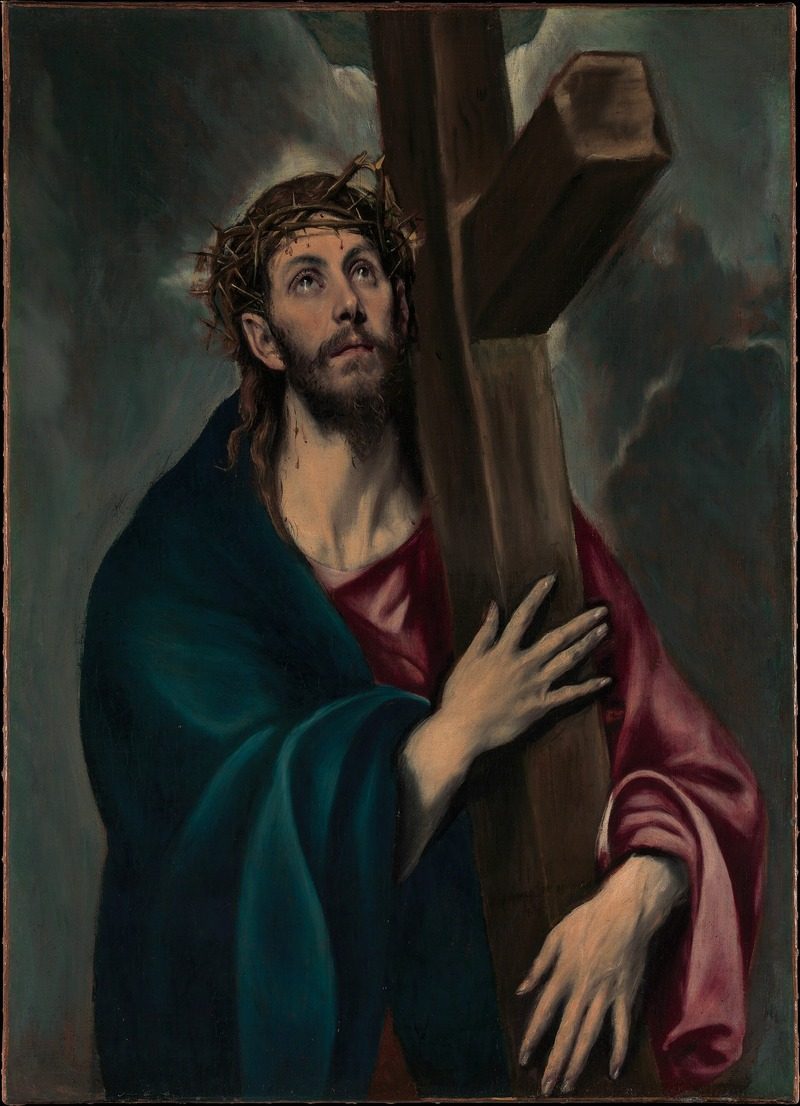
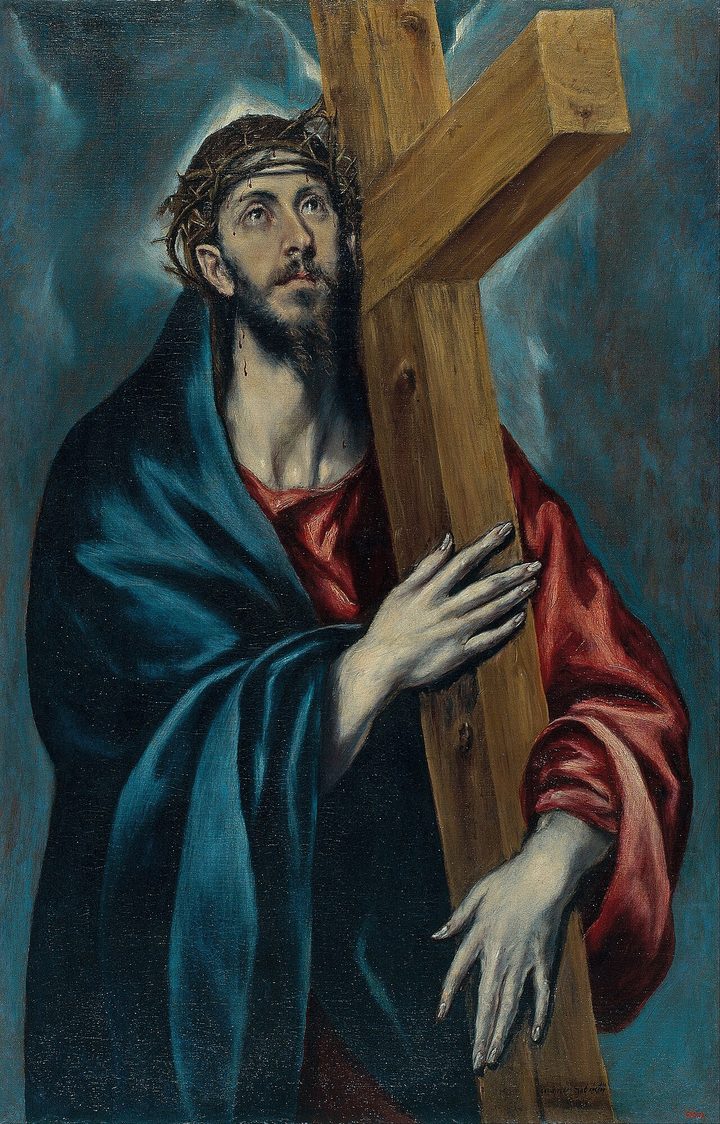
Stage 9 of 9White touches on the brow, nose and knuckles, wet eyes, and the Greek signature. This is the painting today.
EvidenceThe Vatican Museums' biography, the Met's essay and the Lehman catalogue.
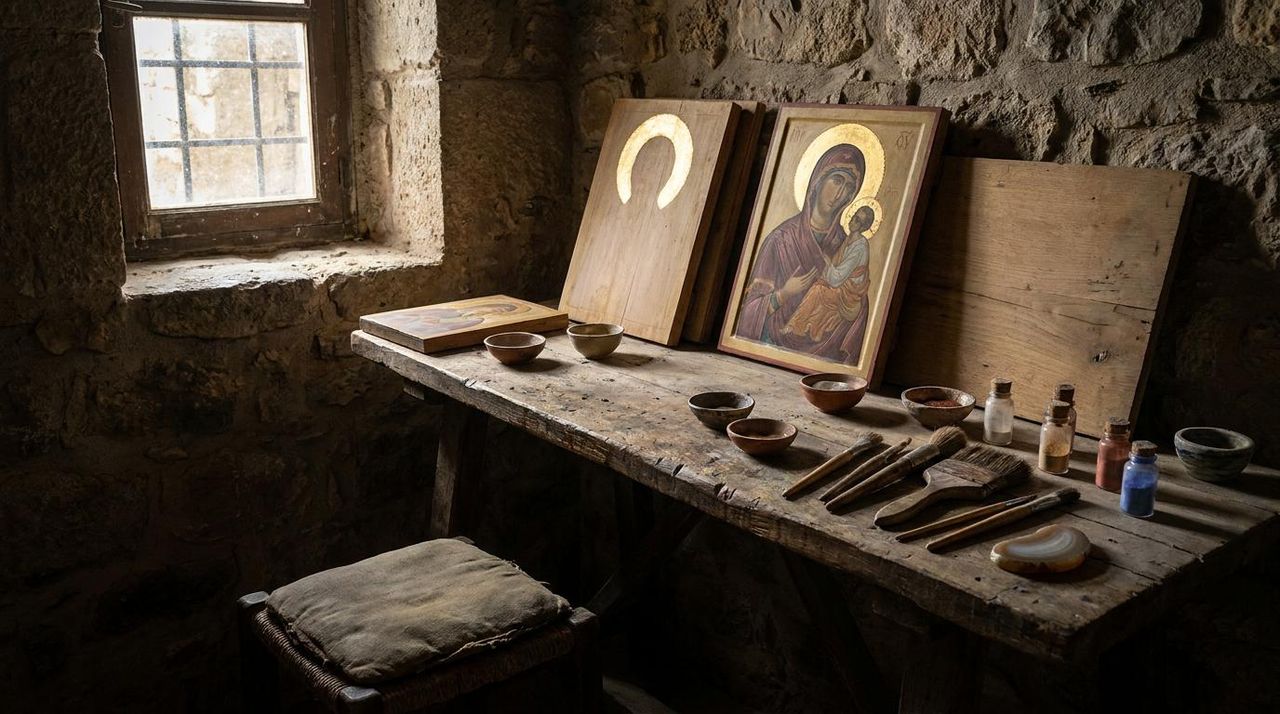
You are Domenikos Theotokopoulos, born in Candia, on Crete, in 1541, and a master icon painter by 1563. Two icons by you are certain, a Dormition and a Saint Luke.
In 1567 you go to Venice, where you absorb Titian, Tintoretto, Veronese and Jacopo Bassano. In Rome in 1570 the miniaturist Giulio Clovio introduces you to Cardinal Alessandro Farnese as a disciple of Titian, which is his word, not proof of an apprenticeship. In 1572 you join the painters' guild in Rome and open a workshop.
In 1576 you are in Madrid, and from 1577 in Toledo, where you paint the Espolio for the cathedral and the altarpieces of Santo Domingo el Antiguo. You will die there on 7 April 1614.
EvidenceJonathan Brown's catalogue entry (1998) and the Met. The influence of Saint Teresa's followers is a hypothesis.
Spanish patrons know Christ carrying the cross from Sebastiano del Piombo: a Christ bowed under the weight. A version on slate in the Escorial was especially dear to Philip II, and the Spanish painter Luis de Morales repeated the type.
You change it. Your Christ stands upright, embraces the cross and looks up to heaven, so that the cross becomes, in Brown's phrase, a medium of salvation rather than a burden.
This canvas is probably your first version, painted about 1580–85, though scholars' dates for it range more widely.
EvidenceFrancisco Pacheco's account of his visit in 1611 (published 1649), the inventories of 1614 and 1621, and Wethey's catalogue as summarised by Brown.
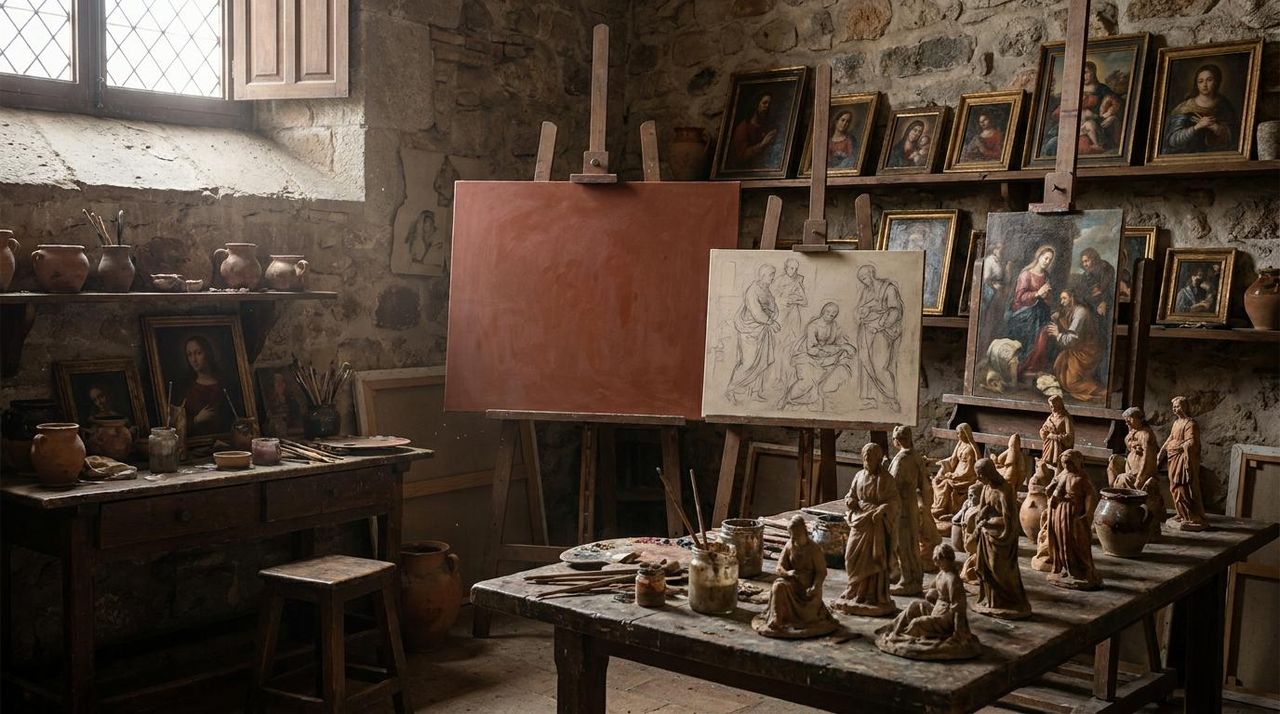
A successful design gets repeated. When the painter Francisco Pacheco visited in 1611, he saw small canvases of the originals of everything you had painted, kept as models, and clay, wax and plaster figures you used for poses. His account is first-hand but critical.
Assistants help. Your Italian assistant Francisco Preboste worked with you from about 1596 to 1607 and acted as witness and agent; your son Jorge Manuel joined you, and Luis Tristán trained with you from 1603 to 1607.
The inventory of 1621 lists canvases as prepared, sketched in, begun and finished, which is documentary support for showing your work in stages. One count gives eleven versions of this subject partly or wholly by you, and ten by followers.
EvidenceThe Thyssen-Bornemisza's 2014 study of its version and of its other El Grecos. This canvas has not been analysed.
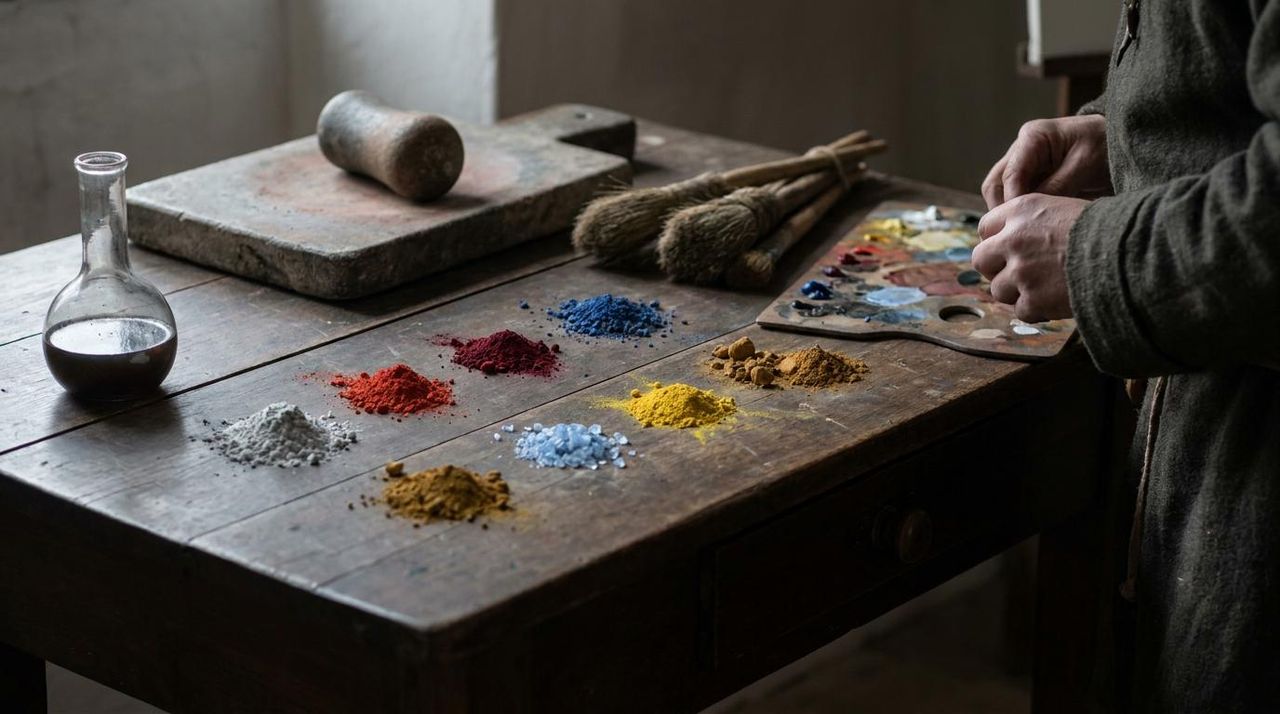
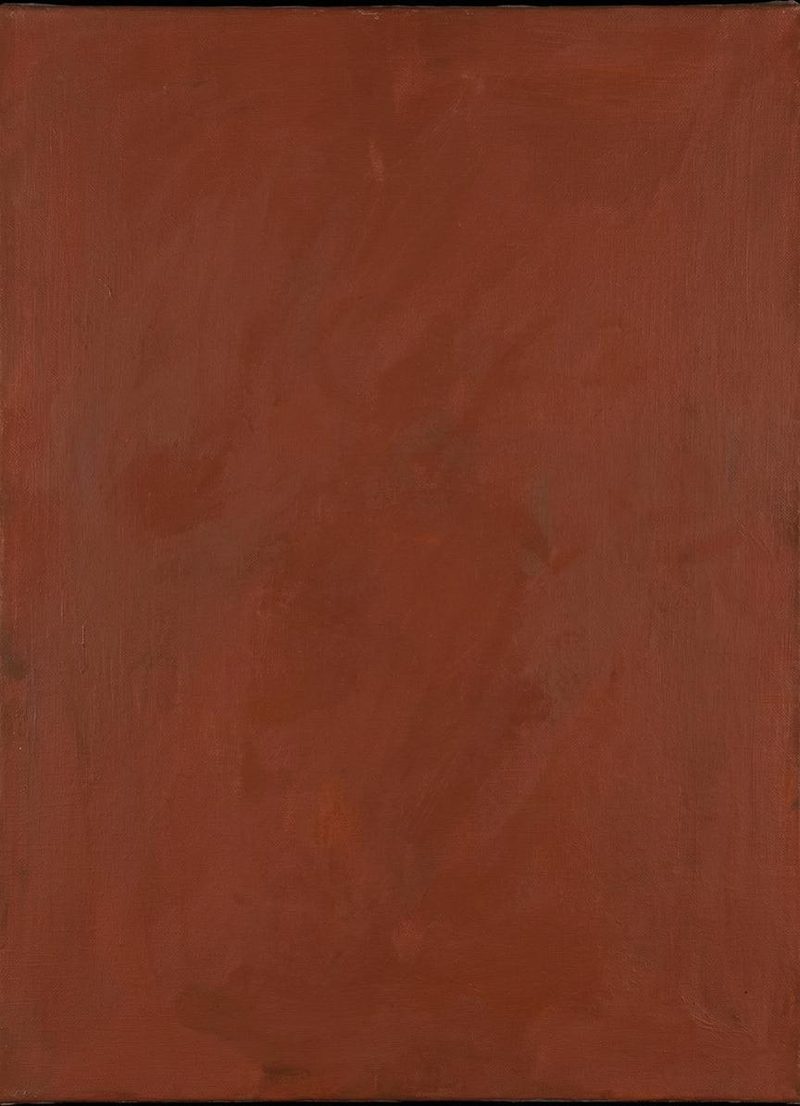
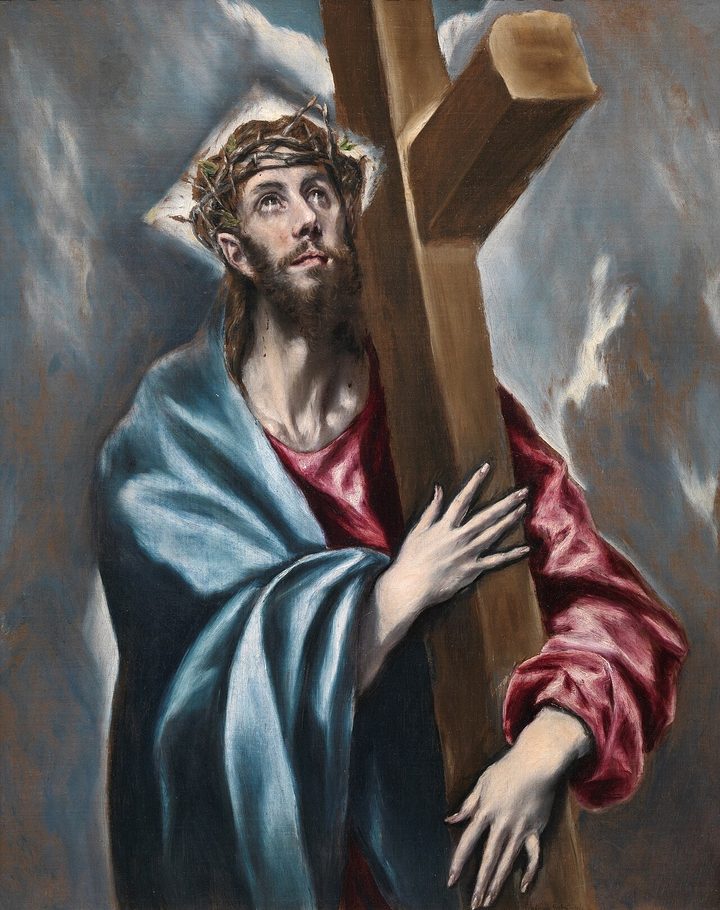
For the version now in the Thyssen-Bornemisza, conservators found a gesso and glue ground under a reddish-brown primer of red ochre, lead white, umber and black in linseed oil, with scrapings from your palette mixed in. The flesh was bound in walnut oil.
Across your Spanish works they found smalt, azurite, lapis lazuli, verdigris and copper resinate, ochres, minium, vermilion, carmine, charcoal and bone black. For this canvas, every card below is a likelihood.
The body of every light, applied thick.
A warm orange-red.
A red lake for glazes.
Blues, cheaper than lapis lazuli.
A light, bright yellow.
Earths for the primer.
EvidenceThe Thyssen study (infrared and X-ray), the Met's notes on another of its El Grecos, and your practice generally. Inferred for this canvas.
Glue-sized linen with a thin white ground. Another of your paintings at the Met has a thin white ground under a reddish-brown layer.
In Italy your grounds were white or light grey; in Spain they turn reddish-brown, and you leave them showing where the paint is thin.
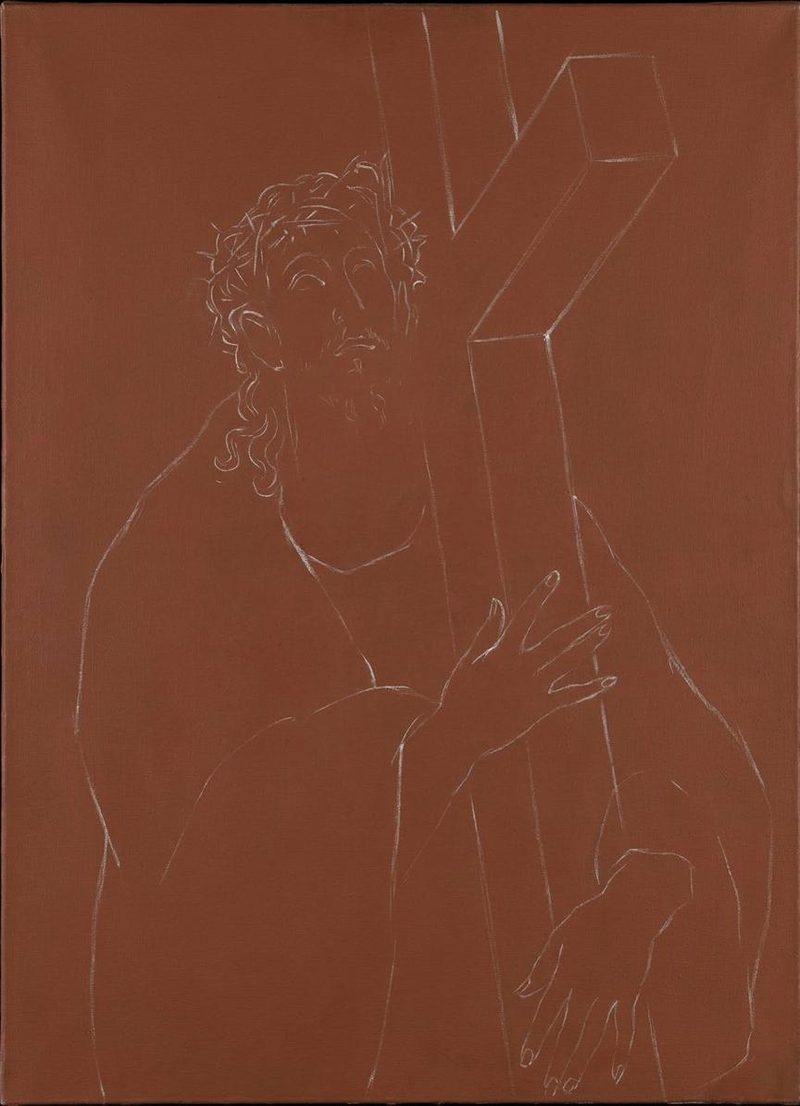
Your gridded Italian underdrawing has all but disappeared. In infrared, the Thyssen version shows only a few faint lines for the head, curls, hand and tunic.
In the Thyssen version you altered the neck, curls, fingers and ear, and raised the gaze, which first looked to the left. No changes are published for this canvas.
EvidenceThe Thyssen study and your practice generally; the order of steps here is inferred for this canvas.
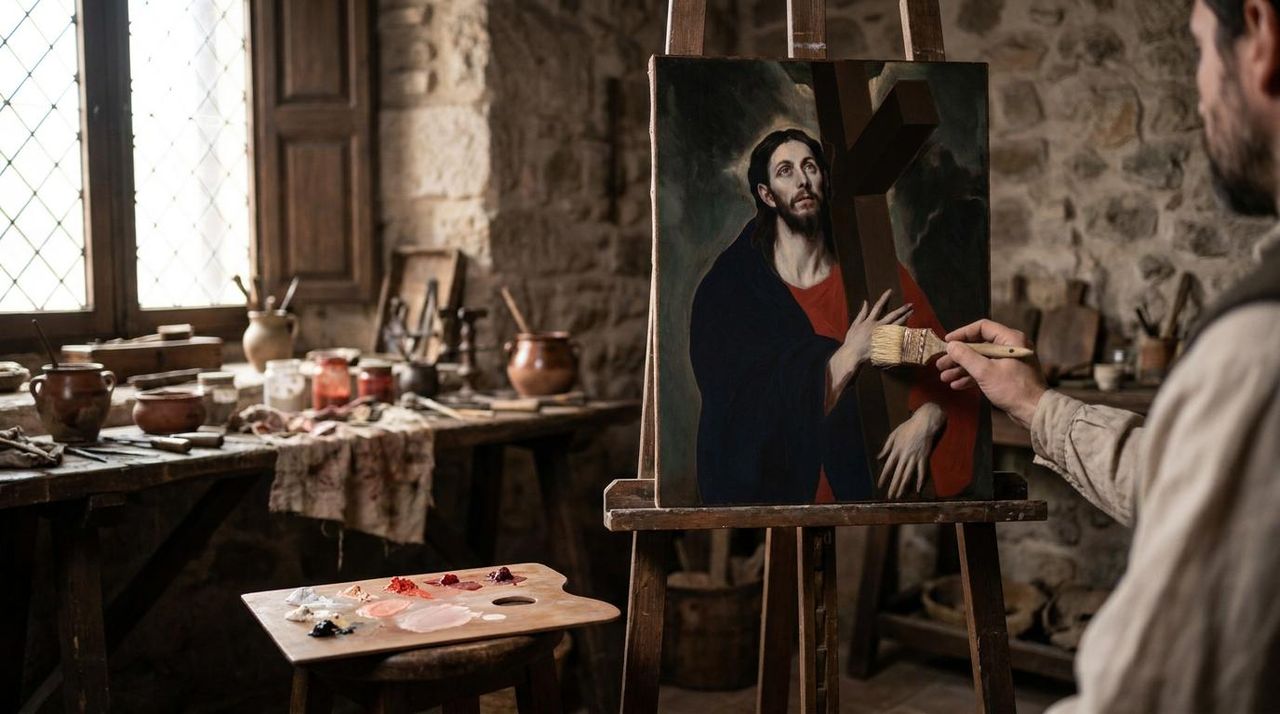
You build up layers rich in lead white, pure white in the brightest lights, and then glaze what you want to stress. Each stage needs time to dry, so the picture takes several sessions.
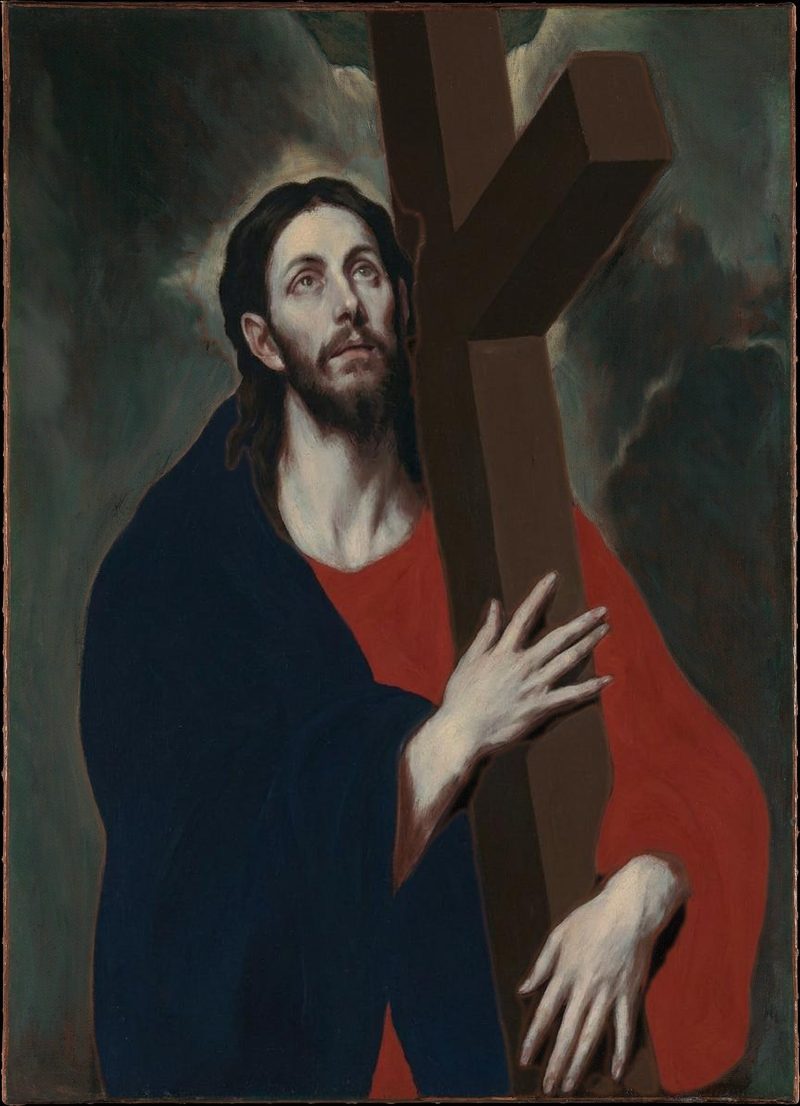
AI-generatedAfter step 6: final lights
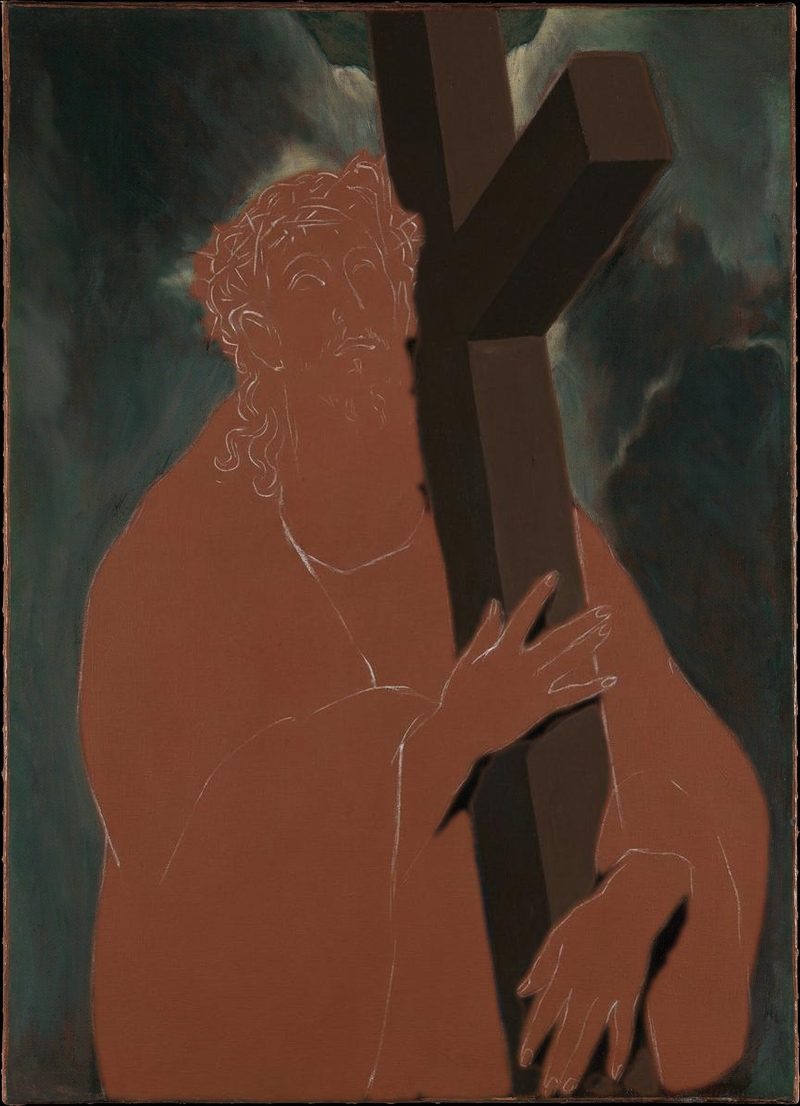
Stain the background first, leaving a space for the figure: grey-blue storm clouds, darker toward the edges. In the Thyssen version, early base tones under the cross and the dark sky seem to have darkened the primer there.
Block in the cross in dark brown, the base for the light edges you will add later.
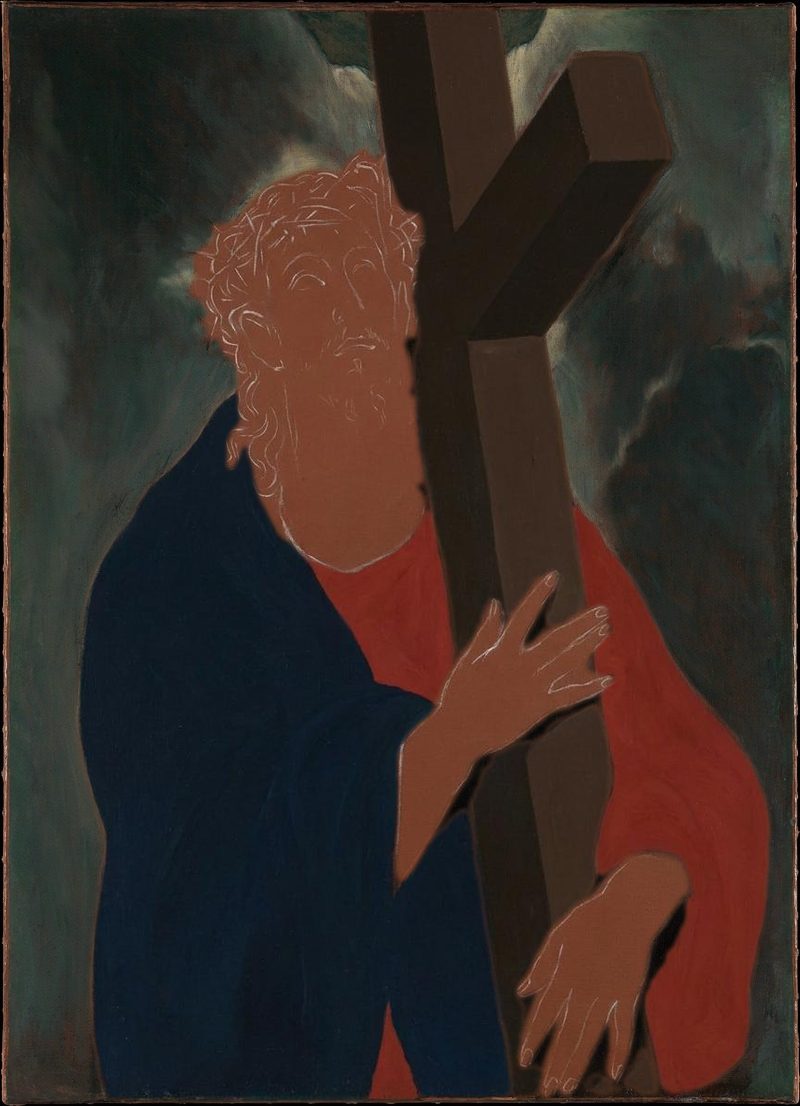
Lay in the blue cloak over the shoulder and the crimson tunic as broad, flat masses, without folds yet. The colours here are not analysed; azurite or smalt for the blue and vermilion with red lake for the red are likely.
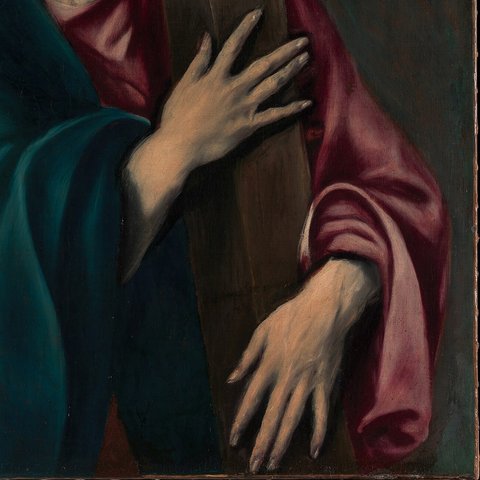
Paint the face, neck and hands in thin, warm lead white. In the Thyssen version the flesh of the hand is lead white with vermilion, lead-tin yellow and carmine, bound in walnut oil.
Let the reddish primer show through in the half-tones. It does the work of the shadows.
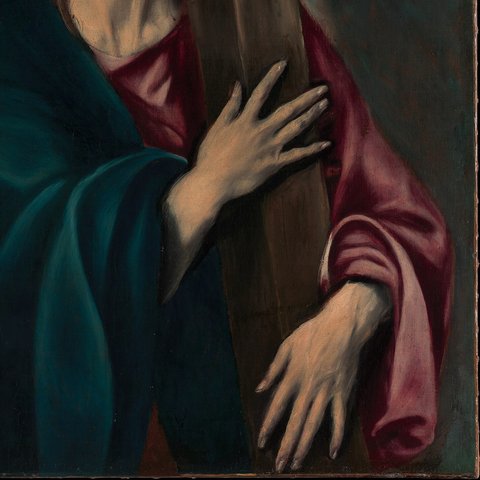
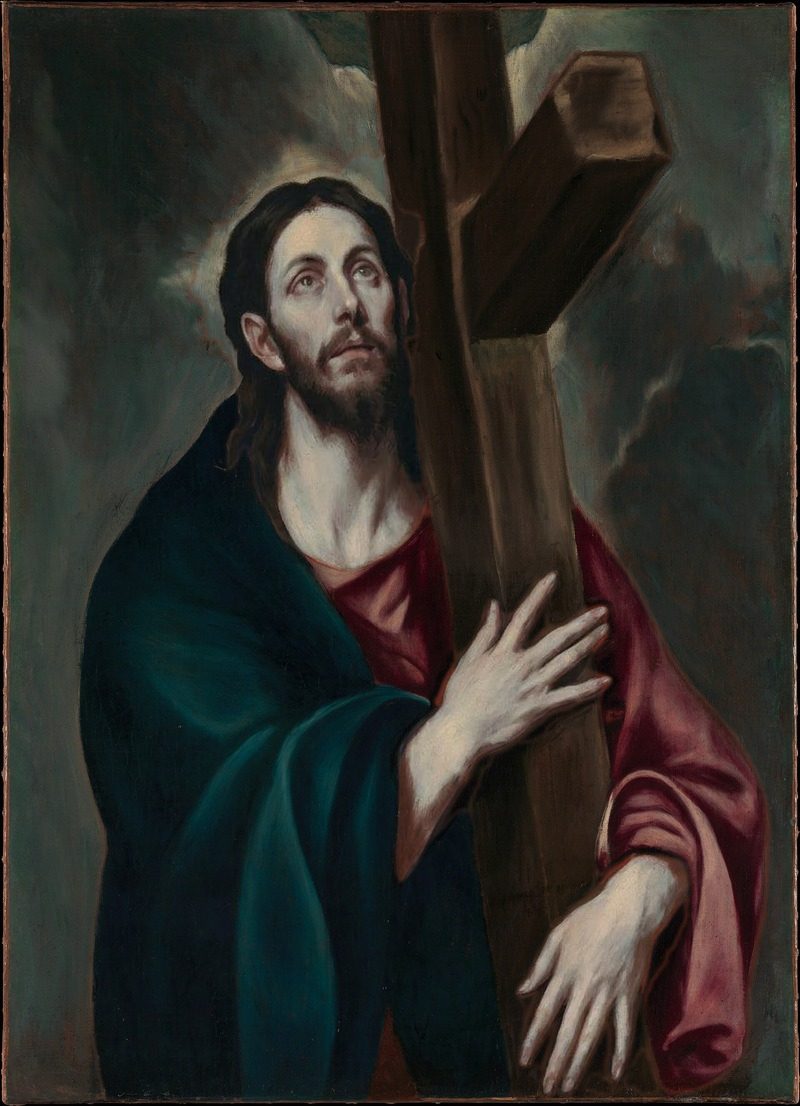
Now model the folds. Drag stiff, thick-bristled brushes through paint rich in lead white for the lights, then glaze over what you want to deepen.
Catch the light along the edges of the cross. Your brushwork stays visible; you never blend it smooth.
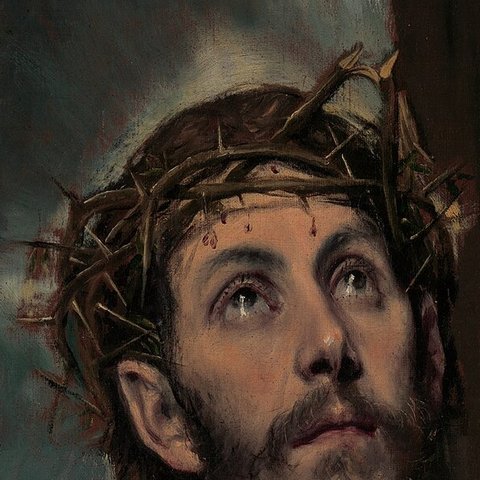
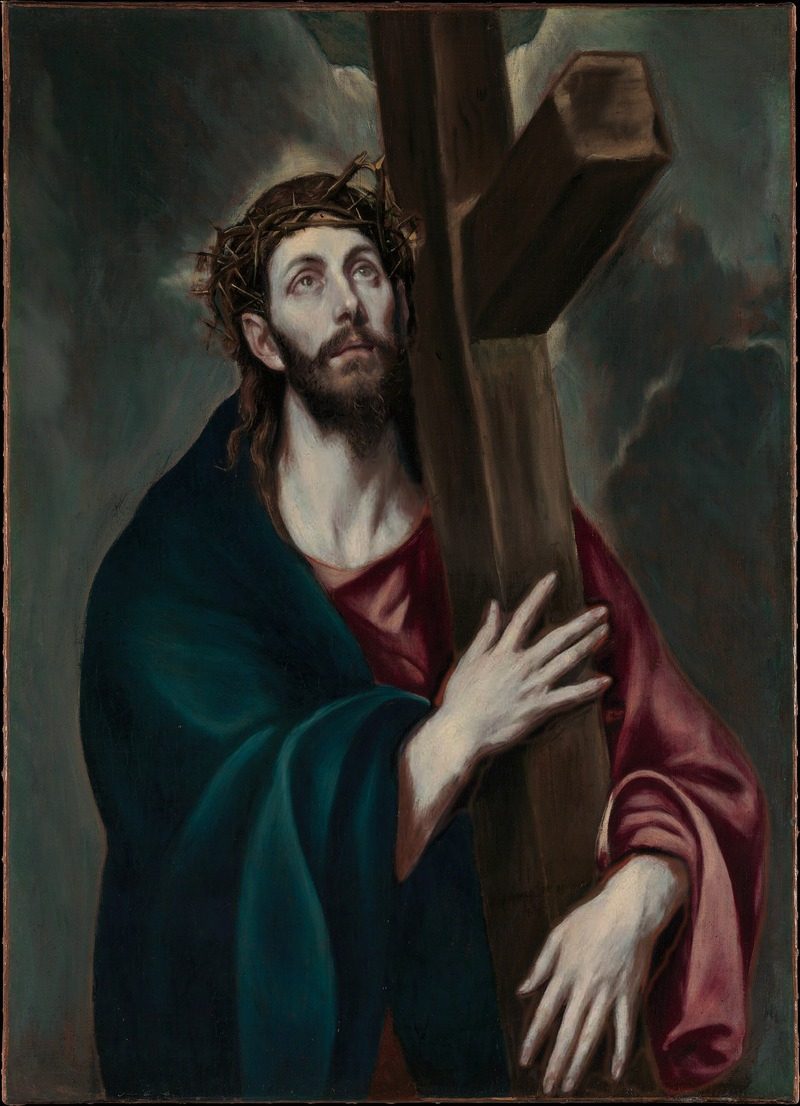
Paint the curls and the beard, then the crown of thorns, crisp and sharp-pointed against the hair, with drops of blood on the brow.
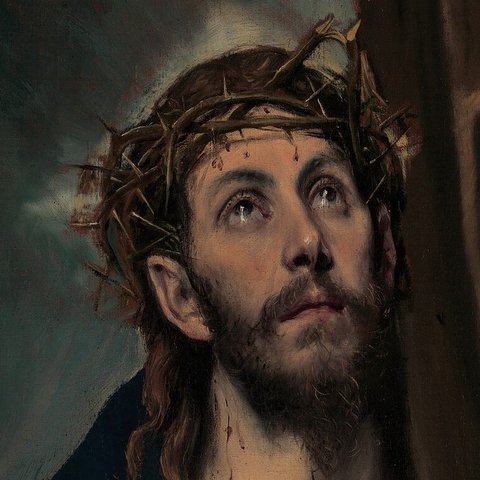
Last, the brightest lights: pure white on the brow, the nose and the knuckles, and white and crimson touches in the eyes so they look wet with tears. In the Thyssen version these touches are what give the eyes their shine.
EvidenceThe inscription on this canvas; Pacheco's criticism, a hostile witness.
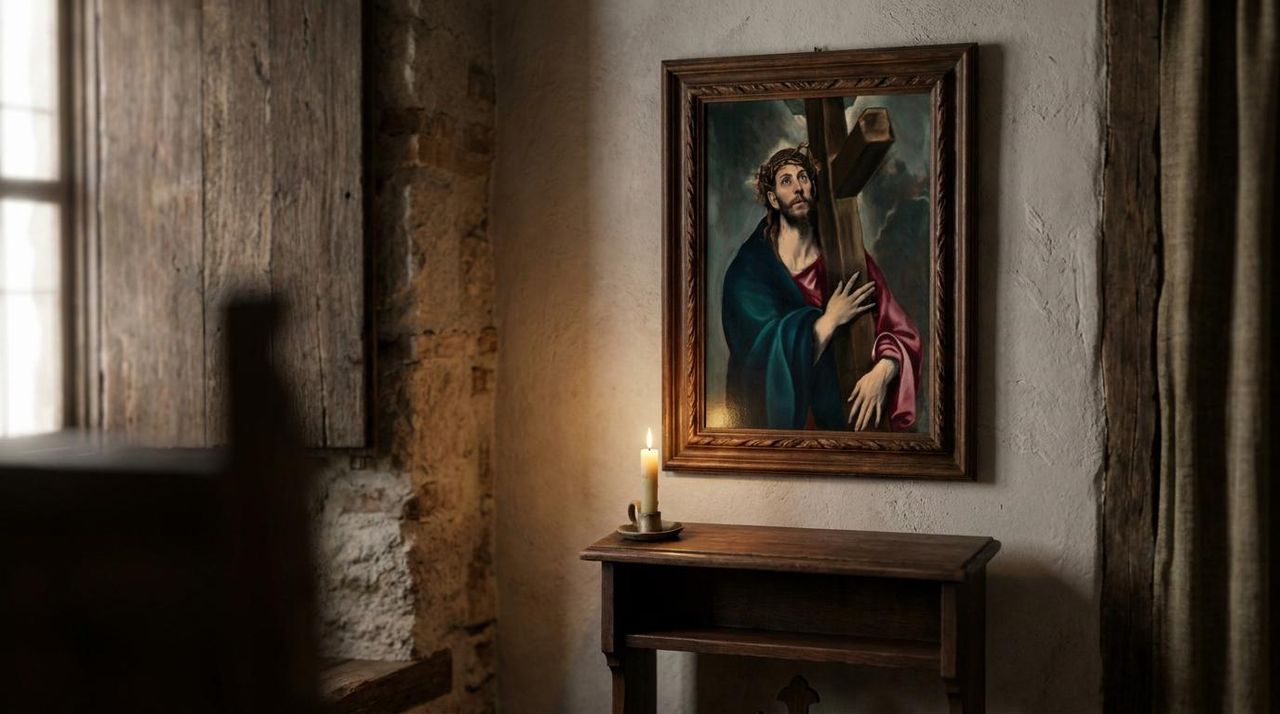
Sign it on the cross above Christ's left hand, in cursive Greek: doménikos theotokópoulos epoíei, Domenikos Theotokopoulos made this. The verb is in the imperfect, “was making”, an old formula that leaves the work open. The signature is now partly worn.
Not everyone admires your finish. Pacheco faulted your habit of retouching again and again and leaving colours unblended, so that your pictures looked unfinished. He meant it as criticism; it describes what you chose to do.
EvidenceThe Met's catalogue (1998) and its photographs of the canvas.