Imagining Artist Methods
RaphaelThe School of Athens · 1509–11All 16

A studio guide · Rome, 1509–1511

The School of Athens, day by day

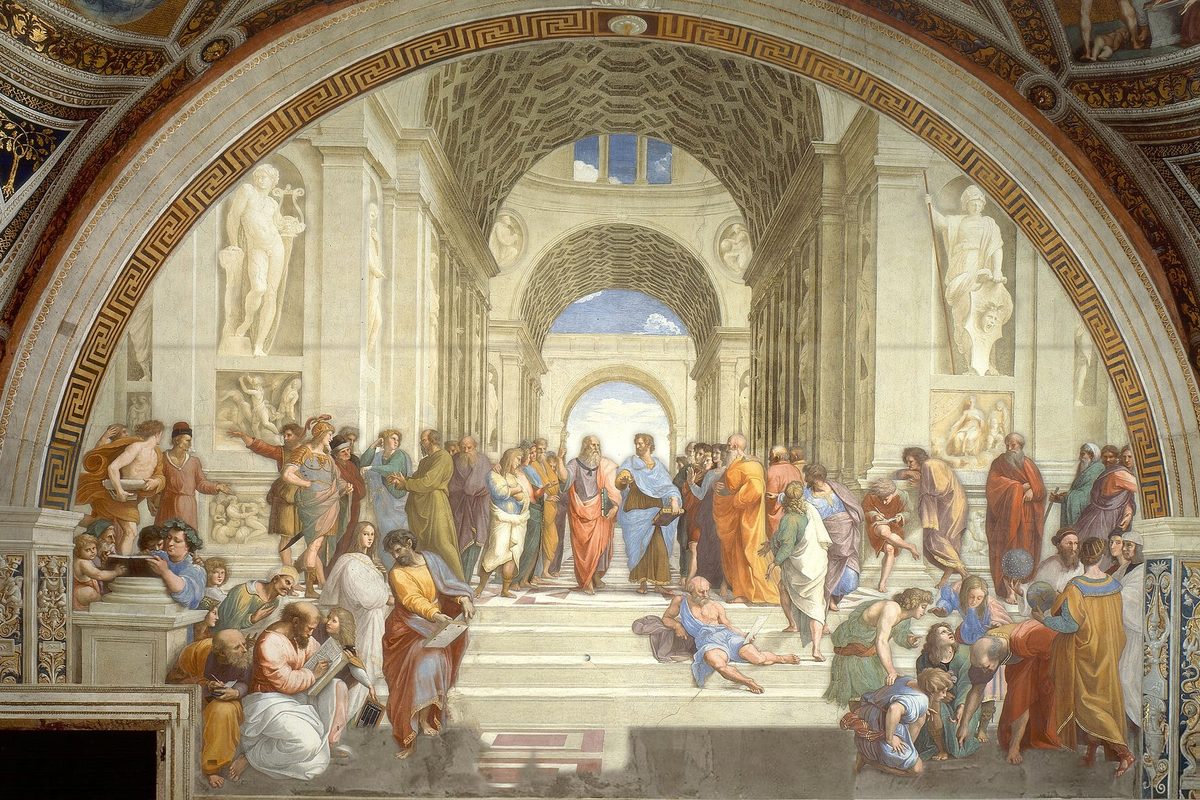
Imagine you are Raphael, about twenty-six and new to Rome, about to paint a wall of the pope's library. This guide follows what your process would have been, from the drawings and the giant cartoon to the days of wet plaster and the figure you added last.

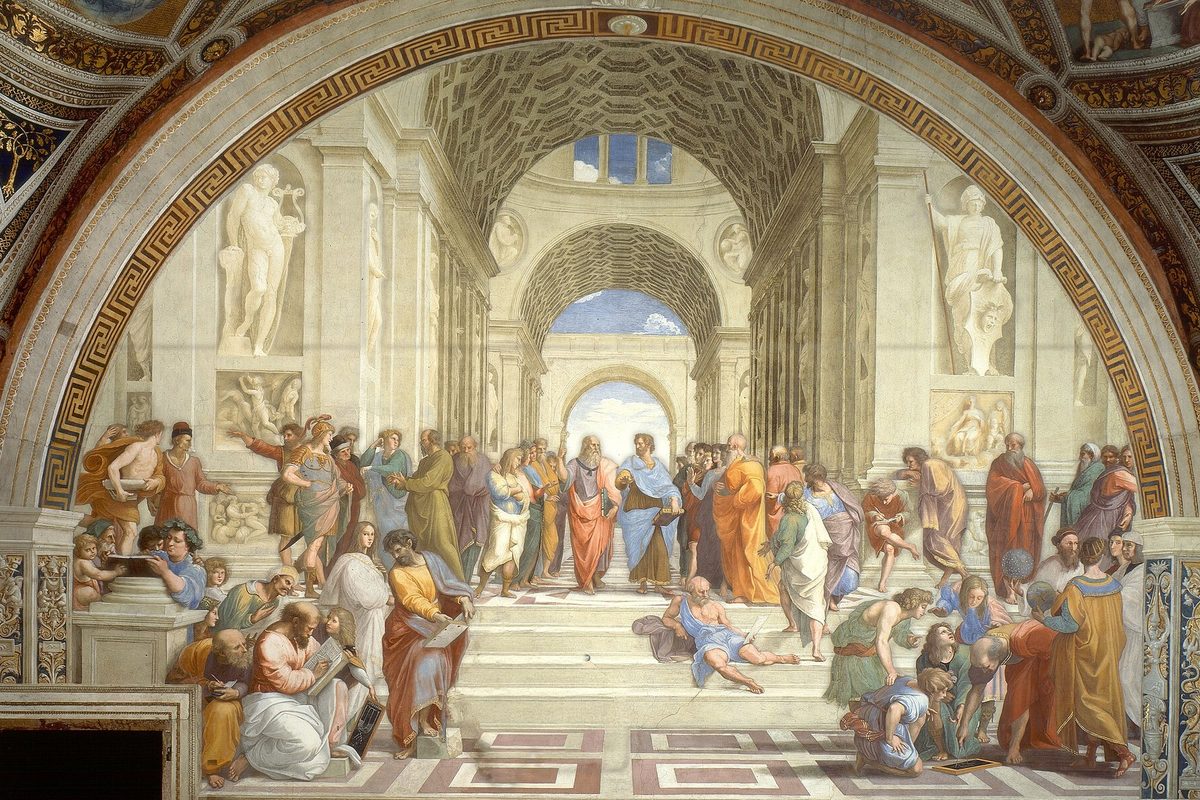
The design evidence is unusually rich: drawings in Vienna, Oxford and Frankfurt, and the full-size cartoon in Milan, restored in 2014–19. The order of painting on the wall is inferred from fresco practice. Each chapter opens with a note on what its evidence is. The slider steps through nine stages; all but the last are AI reconstructions.

Heraclitus

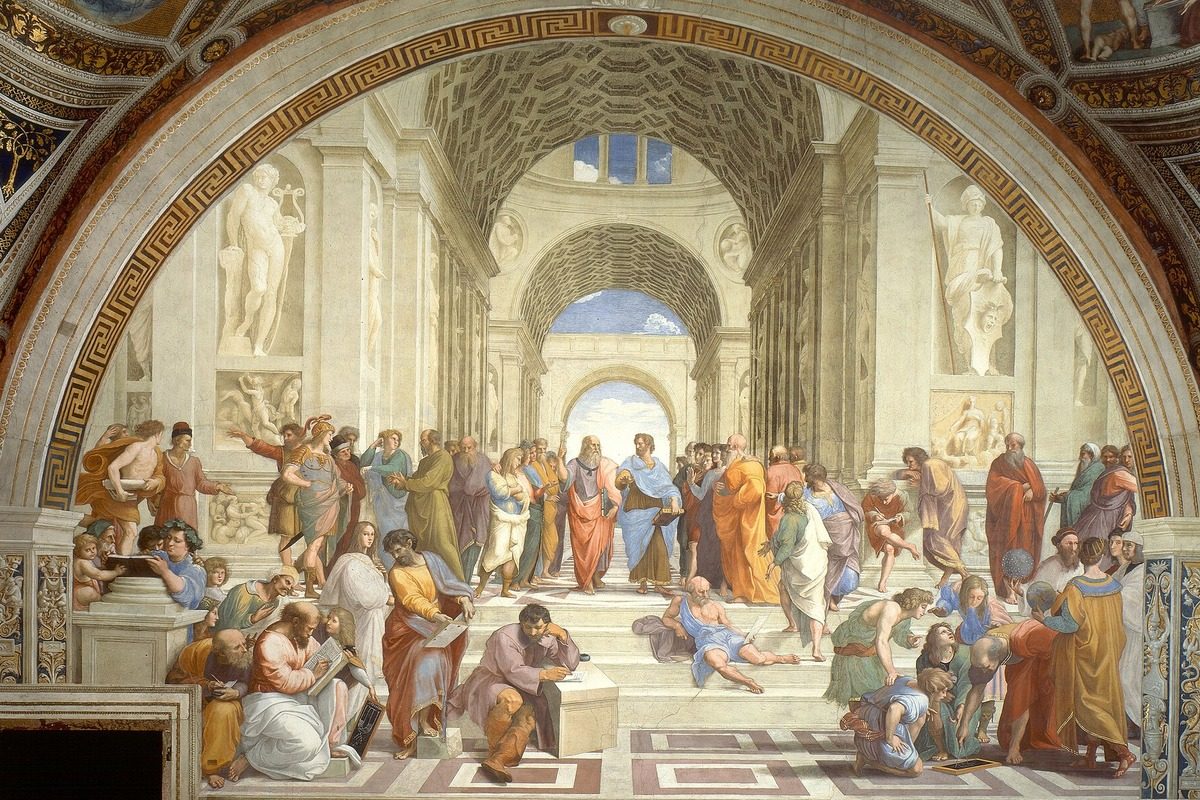
Stage 9 of 9

Added last, on his own patch of plaster. This is the wall today.

Raphael, The School of Athens, 1509–1511. Fresco, about 5 × 7.7 m. Stanza della Segnatura, Vatican Palace. The photograph includes the surrounding wall; the later dado below is cropped off. AI-generated Stages 1 to 8 are reconstructions made with Prodia from this photograph.

Your training

EvidenceThe Palais des Beaux-Arts in Lille, the Royal Collection and Vasari; the payment of January 1509.

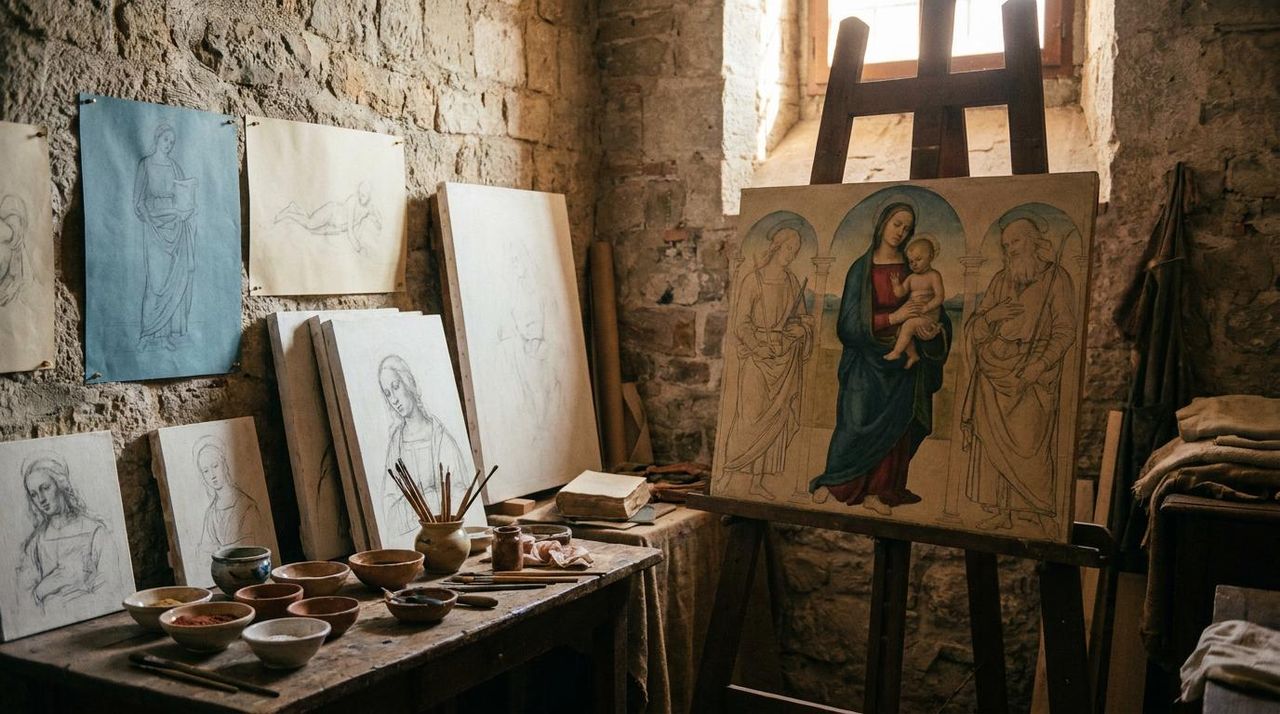
AI-generated reconstruction: an Umbrian painter's workshop around 1500 with drawings on coloured paper pinned up, panels and an altarpiece in progress.
AI-generatedAn Umbrian workshop around 1500: drawings on coloured paper, panels, an altarpiece in progress.

You are Raffaello Sanzio, born in Urbino in 1483, the son of the court painter Giovanni Santi. You trained in the circle of Perugino and took your first commission, an altarpiece, in 1500.

From about 1504 to 1508 you worked in Florence, where you studied Leonardo and Michelangelo. By late 1508 you were in Rome, and on 13 January 1509 you are first documented there.

Vasari says it was Bramante, the pope's architect and a man from your own region, who wrote to you and talked Pope Julius II into using you. Other painters, Sodoma and Lorenzo Lotto among them, were already at work in the papal apartments.

A library for a pope

EvidenceThe Vatican Museums and Vasari. The order in which the room's walls were painted is disputed.

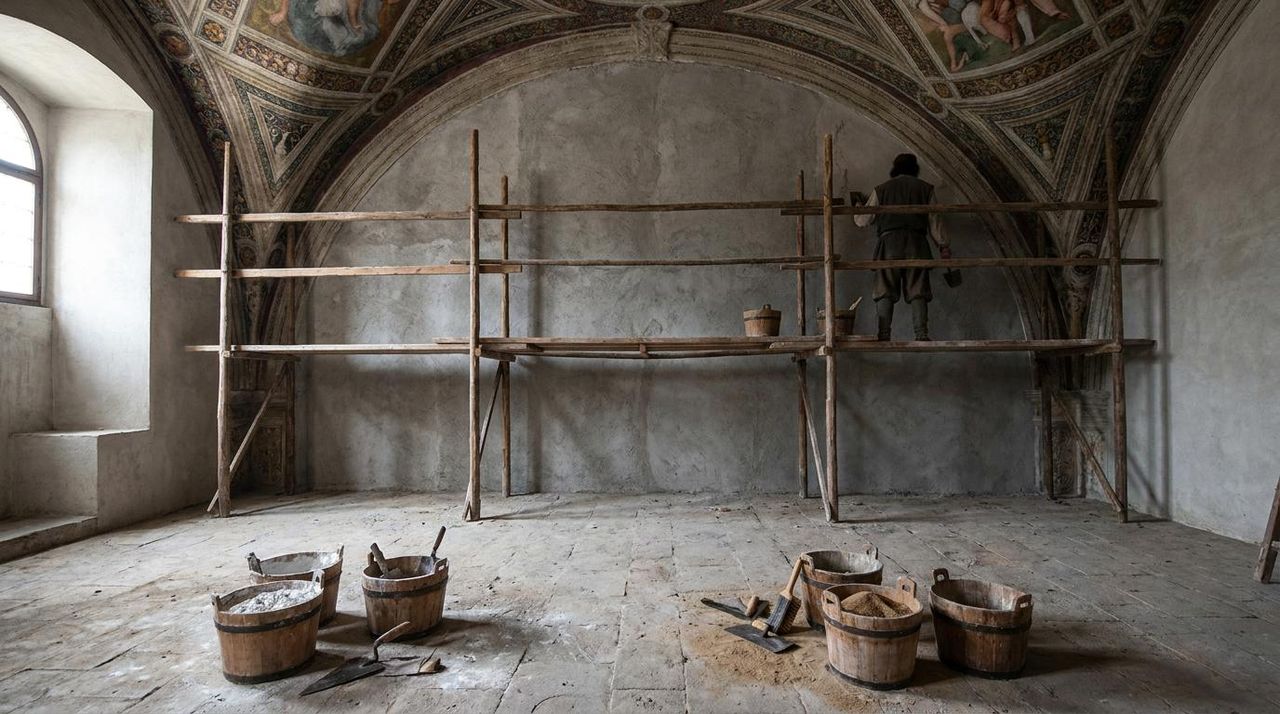
AI-generated reconstruction: a high vaulted room with a painted vault, wooden scaffolding against a bare plastered lunette, buckets of lime and trowels.
AI-generatedThe room in 1509: a painted vault above, a bare lunette waiting below.

The room is Julius II's library and study, now called the Stanza della Segnatura. Sodoma seems to have begun the vault, and you probably painted its four roundels first.

A theologian devised the programme. Your four walls stand for the faculties of a library: the Disputa and this wall for supernatural and rational truth, the Virtues and Law for the good, and Parnassus for beauty. Above this wall, a roundel of Philosophy presides.

Decide these before you draw

The subject
Philosophy, facing theology across the room. The title School of Athens came later; the Ambrosiana prefers La Filosofia.
The setting
A vast vaulted hall in perspective. The Vatican says it echoes Bramante's plan for the new St Peter's; Vasari says Bramante designed it for you. Scholars still debate that.
The cast
Plato and Aristotle at the centre, philosophers and mathematicians around them. Many later identifications are traditions, not facts: Plato as Leonardo, Euclid as Bramante.
How it reads
Clearly enough for some, not for all: Vasari described theologians and Evangelists, and a 1550 engraving labelled it Saint Paul preaching at Athens.

Think in drawings

EvidenceSurviving sheets at the Albertina in Vienna, the Ashmolean in Oxford and the Städel in Frankfurt.

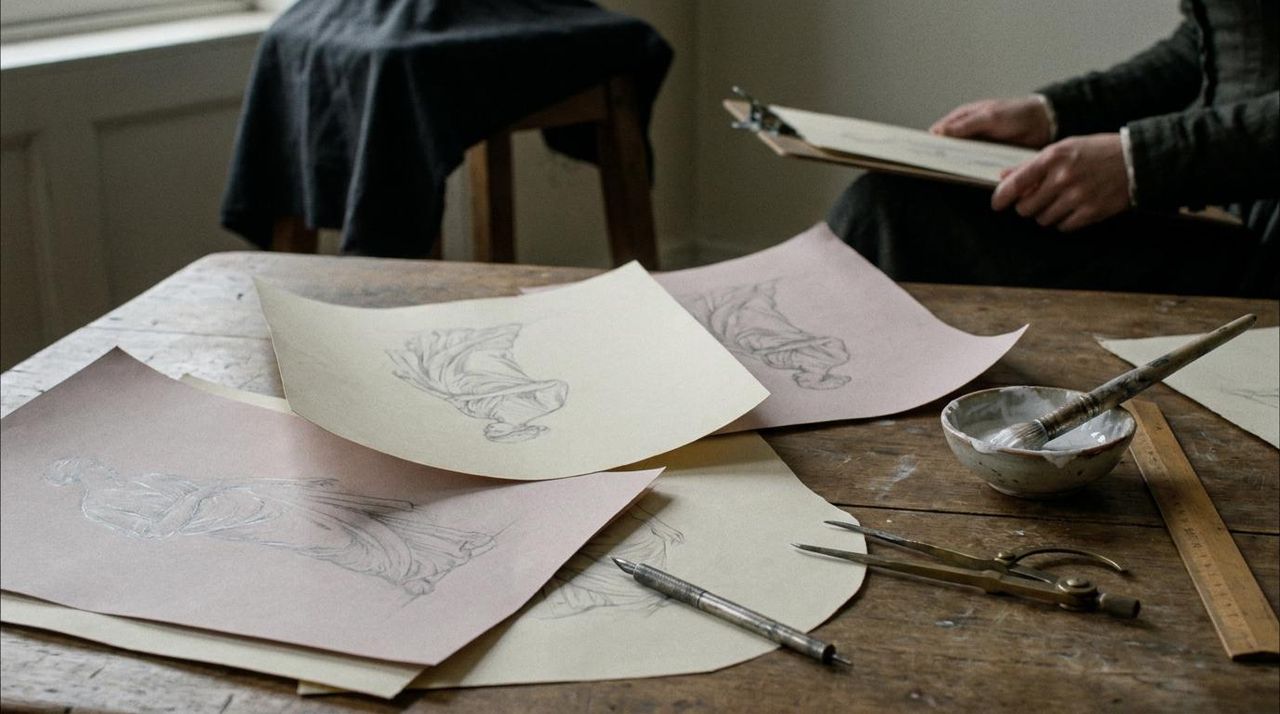
AI-generated reconstruction: metalpoint figure drawings on pink and grey paper, a stylus, a dish of white lead, dividers and a ruler on a table.
AI-generatedMetalpoint on coloured paper, white lead for the lights, ruler and dividers.

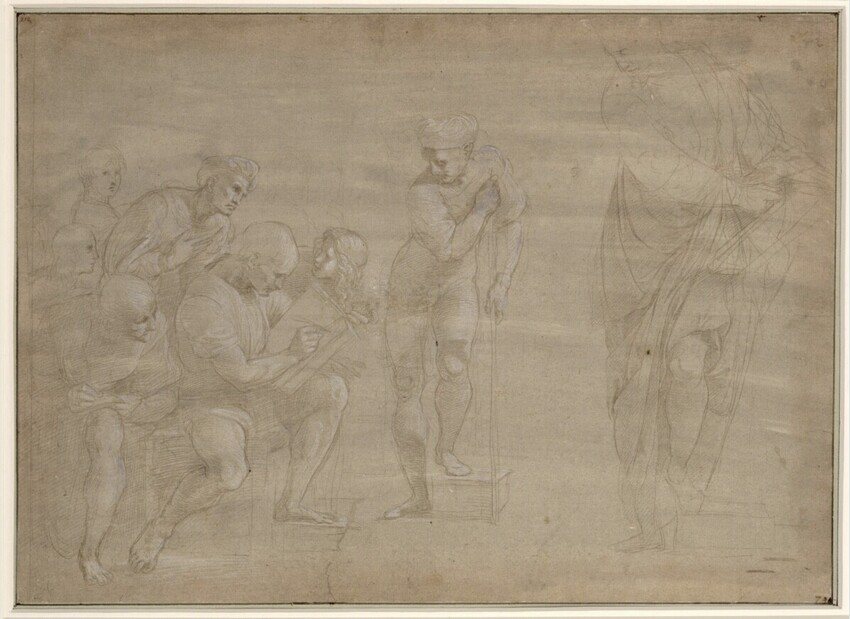
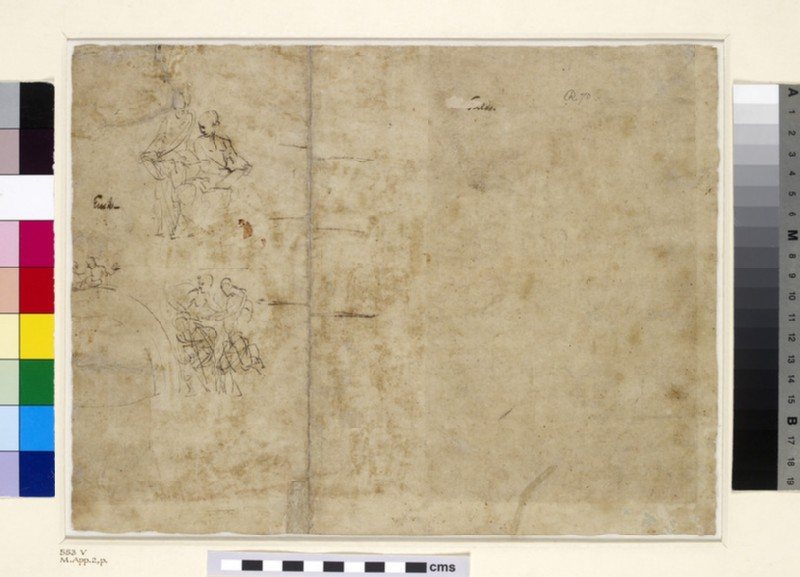
You design in drawings. You pose studio models, often assistants, and draw them in metalpoint on paper you have tinted pink or grey, adding the lights in white lead. Groups are worked out as wholes, single figures from life, statues and their niches with ruler and compass. These five sheets survive.

Metalpoint study of Pythagoras writing, surrounded by figures leaning in.
Pythagoras and his pupils c. 1508–10 · Metalpoint heightened with white on grey ground · Albertina, Vienna The left foreground group, worked out as a whole. Public domain · Albertina 4883 · Wikimedia Commons
Metalpoint study of a man bending over a slate with compasses, with pupils around him.
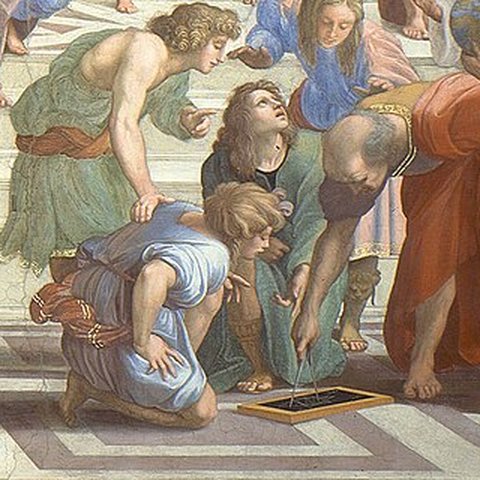
Euclid instructing his pupils c. 1509 · Metalpoint · Ashmolean Museum, Oxford The right foreground group, close to its final form. Public domain · Ashmolean WA1846.194 · Wikimedia Commons
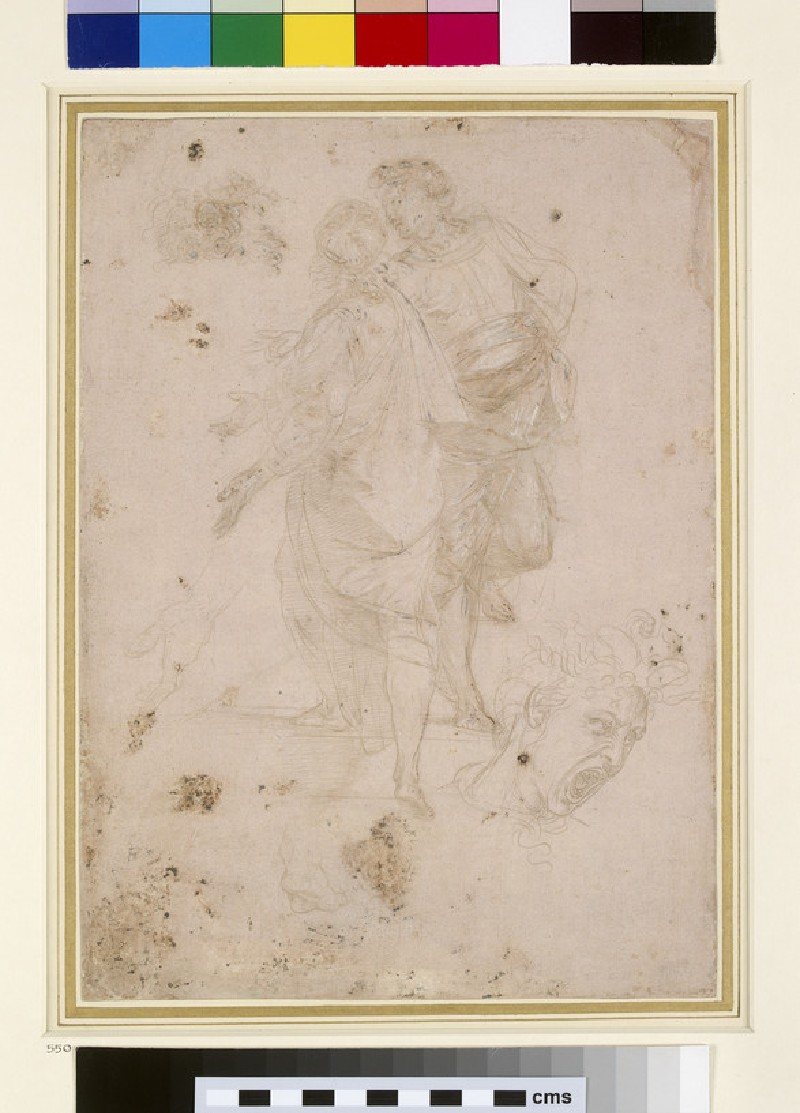
Metalpoint study of two men talking on a flight of steps, with a shouting head.
Two men on a flight of steps c. 1508–10 · Metalpoint and white on pink ground · Ashmolean Museum, Oxford The pair on the stairs at right; the climber leads with his right foot, as Vitruvius advised. The shouting head became the Medusa on Minerva's shield. Public domain · Ashmolean WA1846.191 · Wikimedia Commons
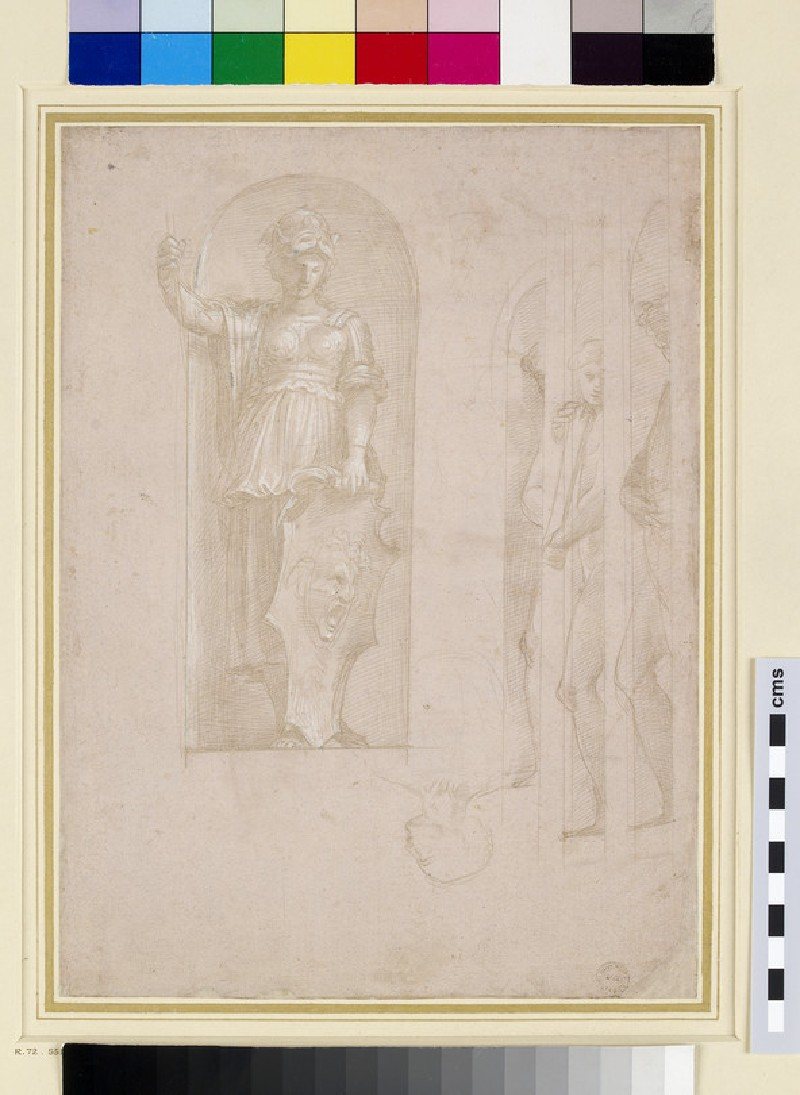
Metalpoint study of a statue of Minerva in a niche, with other statues.
Minerva and other statues c. 1508–10 · Metalpoint and white on pink ground · Ashmolean Museum, Oxford The niche is drawn with ruler and compass; the arm is revised. Public domain · Ashmolean WA1846.192 · Wikimedia Commons
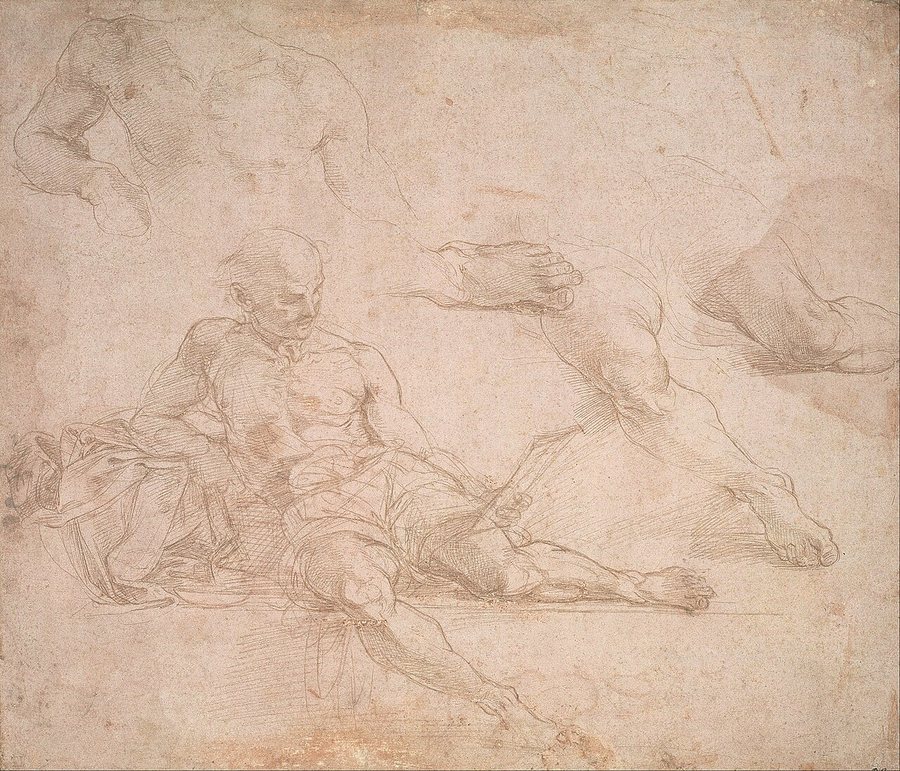
Silverpoint study of a reclining figure with repeated studies of limbs.
Study for Diogenes c. 1508–10 · Silverpoint on prepared paper · Städel Museum, Frankfurt A life study, probably from a studio assistant, with separate studies of anatomy. Public domain · Städel 380 · Wikimedia Commons

One giant drawing

EvidenceThe Ambrosiana's 2014–19 restoration of the cartoon, by Maurizio Michelozzi with Alberto Rocca, and the Lombardy catalogue record.

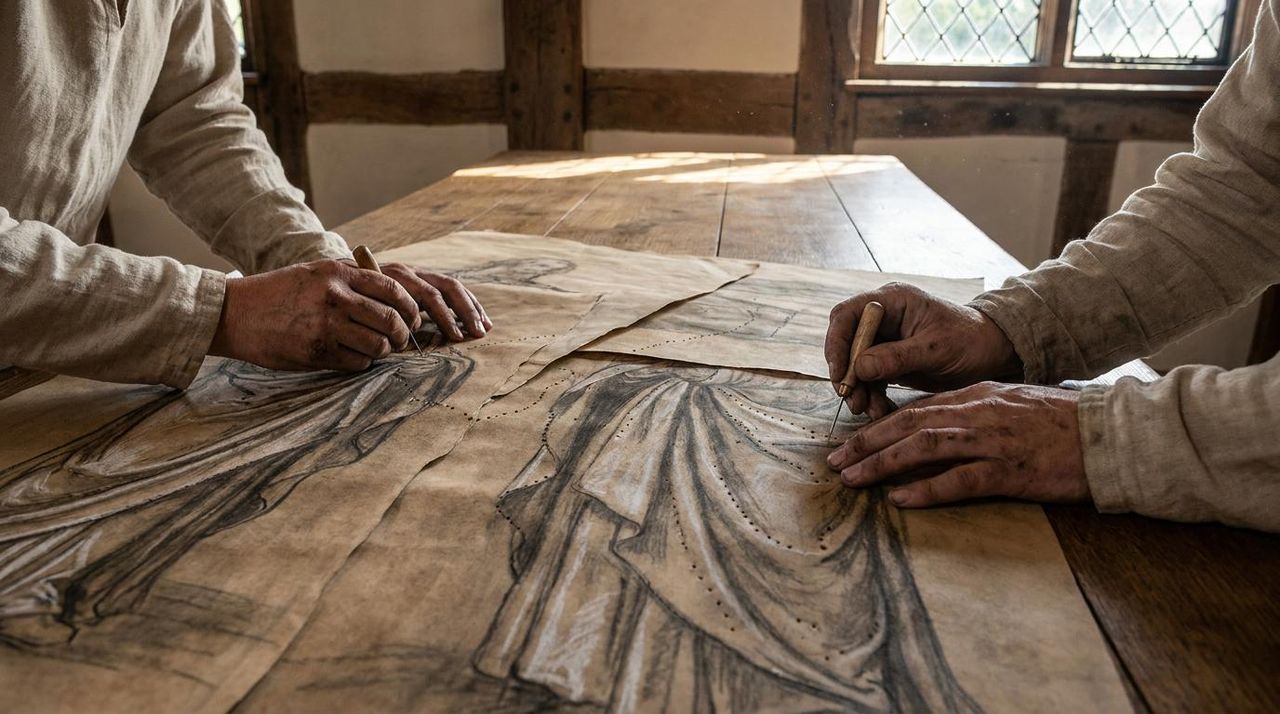
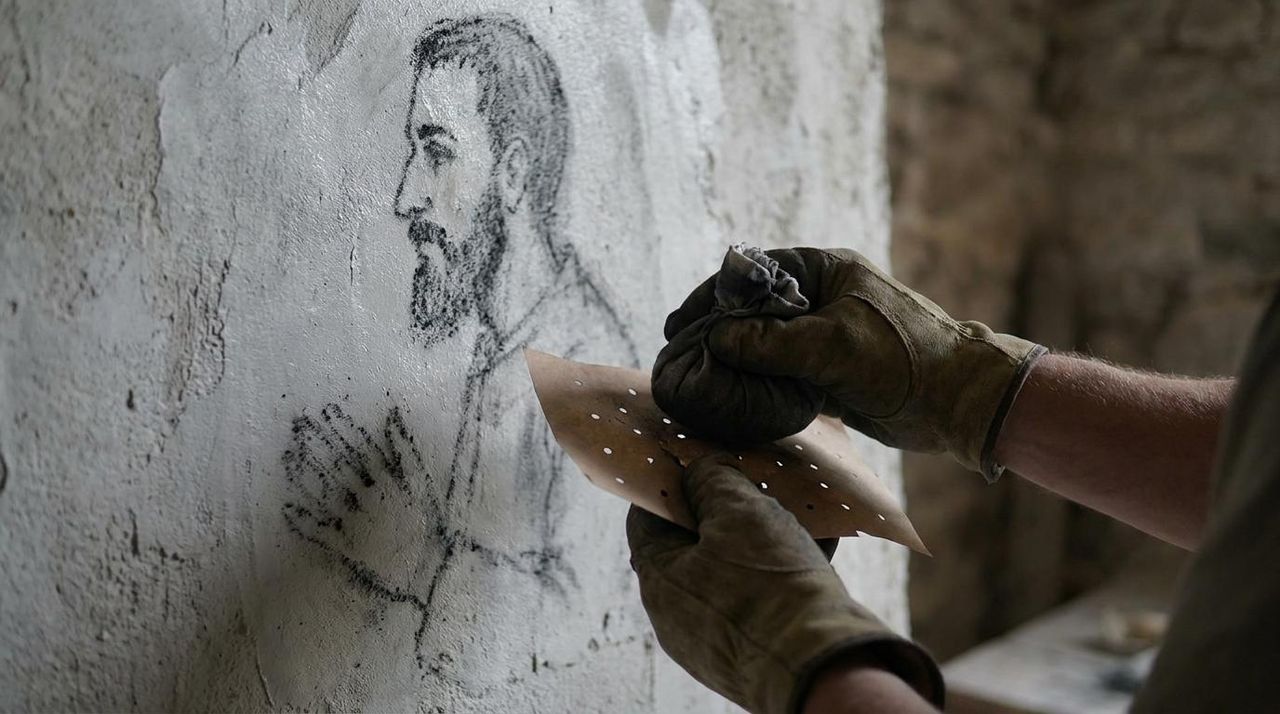
AI-generated reconstruction: hands pricking holes along the outlines of a huge charcoal drawing of robed figures laid over a second sheet.
AI-generatedPricking the outlines through onto a second, blank sheet. The holes in the cartoon still carry their paper burrs.
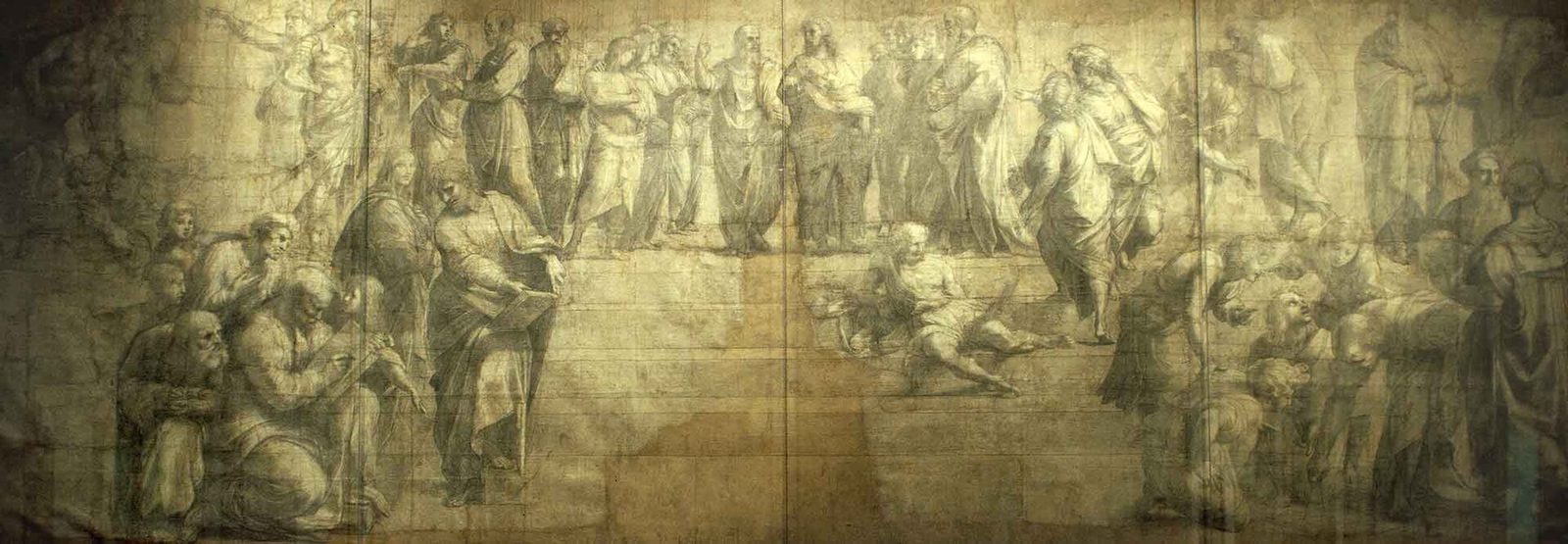
The full-size cartoon: groups of figures drawn in charcoal and white on toned paper, with no architecture behind them.
The cartoon for The School of Athens c. 1509 · Charcoal and white lead on 210 sheets of paper, 285 × 804 cm · Pinacoteca Ambrosiana, Milan The whole figure design at full size. There is no architecture, no statues, no Heraclitus and no tablet for Pythagoras. Public domain · Pinacoteca Ambrosiana, inv. 126 · Wikimedia Commons

Before the wall, you make the whole design at full size. The cartoon is 285 by 804 centimetres, built from 210 half-sheets of paper glued in seven strips. The paper was toned with charcoal and ochre in glue, and it carries notes for the architecture in red chalk.

You enlarged the design from a squared drawing, sketching with charcoal on a long cane. Shadows were laid by dabbing charcoal dust and then hatched; the lights are white lead.

The cartoon was pricked along every contour, but it never touched the wall. The holes still have their burrs of paper on the back. It was pricked through onto a second sheet underneath, and that copy was cut up day by day, used on the wet plaster and lost. The original, wholly yours, was kept.

Onto wet plaster

EvidenceMostly inferred from fresco practice; infrared of the Heraclitus figure; Luitpold De Vecchi's count of 47 day-patches (1966).

AI-generated reconstruction: charcoal dust pounced through a pricked paper pattern onto wet plaster, leaving dotted outlines of a head and a hand.
AI-generatedSpolvero: charcoal dust pounced through the pricked holes leaves dotted outlines on the wet plaster.
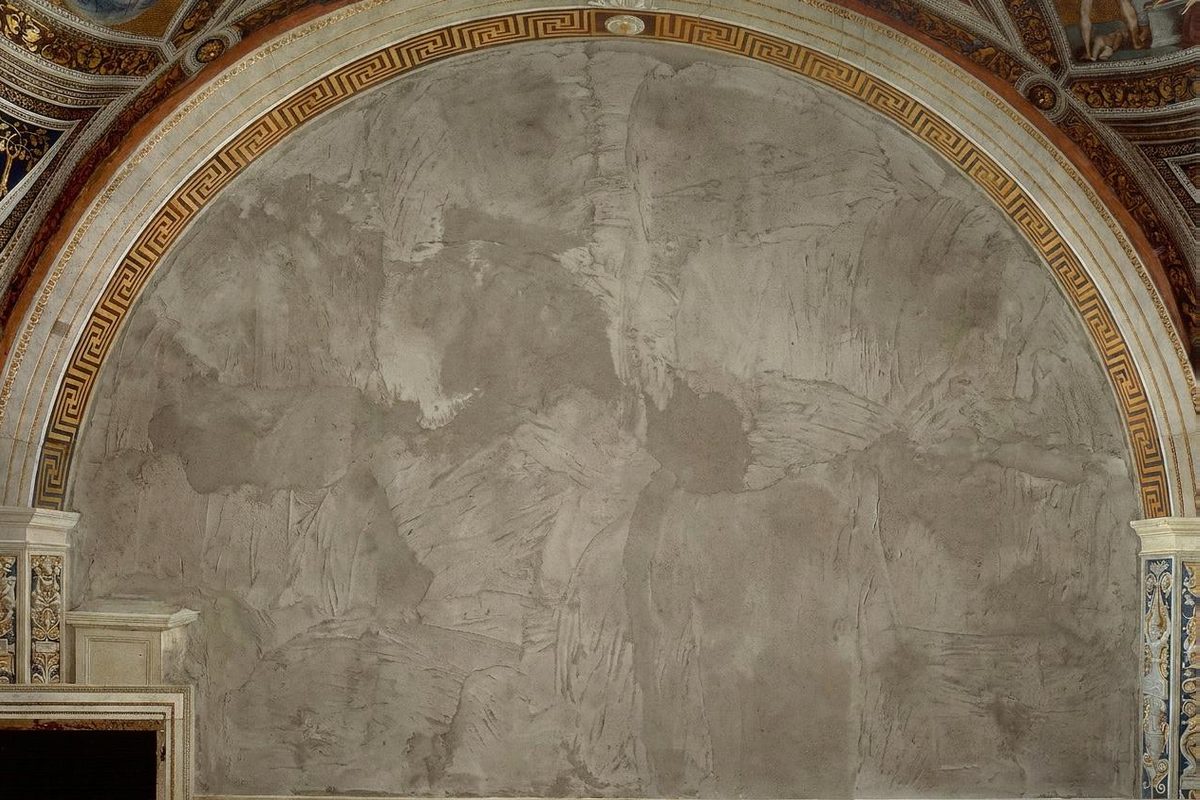
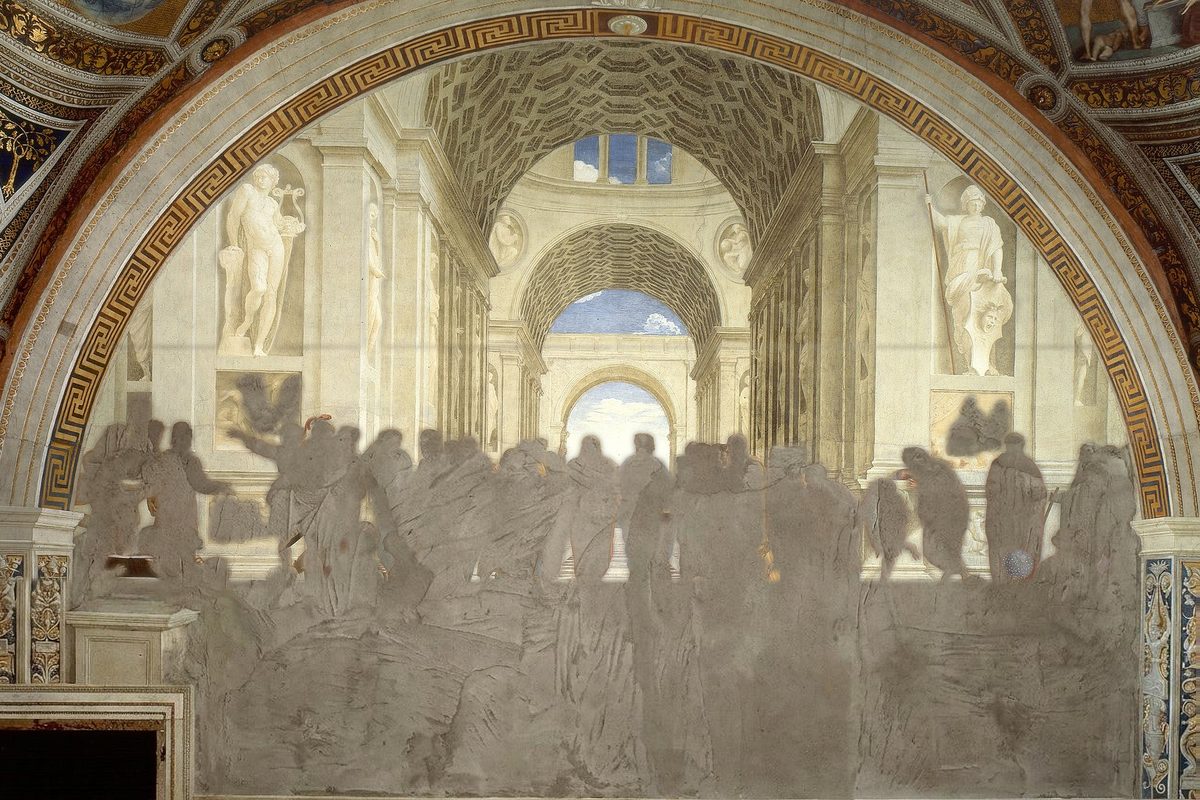
AI reconstruction: The lunette as a rough plastered wall.
Bare wallRough arriccio over the masonry. AI-generated
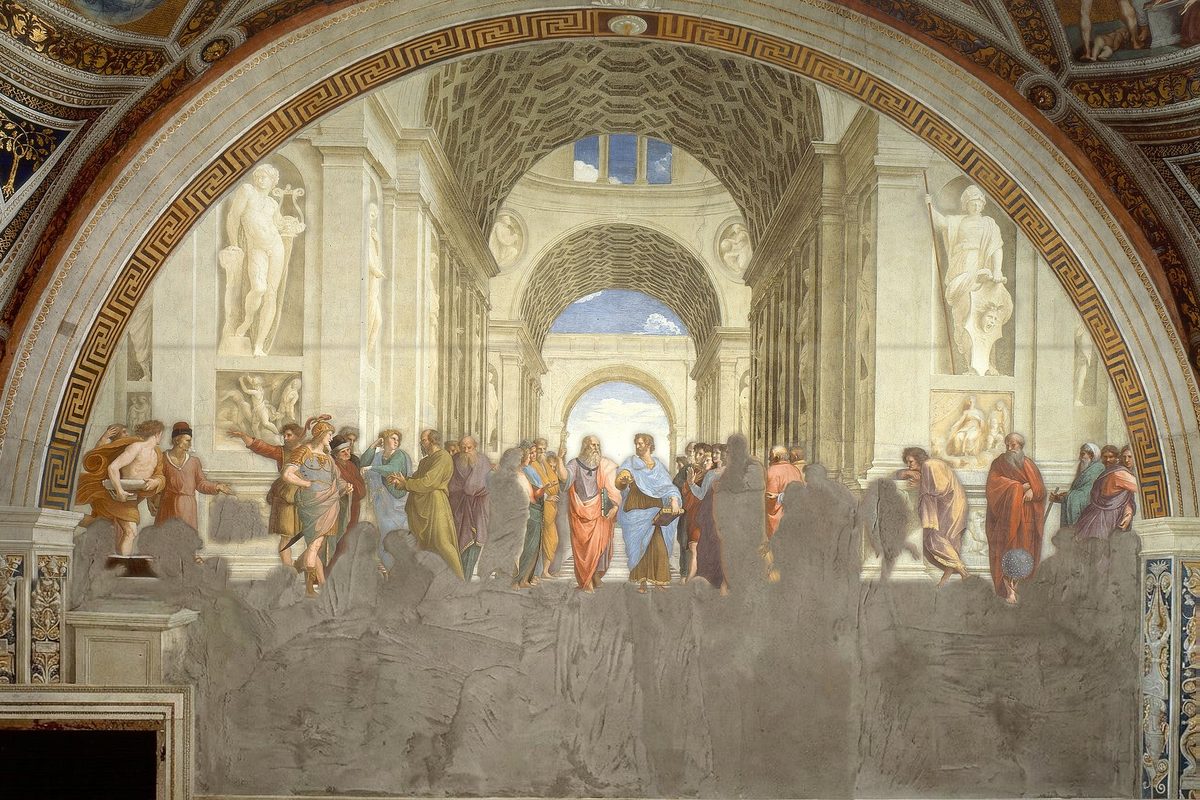
AI reconstruction: The painted vaults and sky above bare plaster.
First daysThe vaults and sky, from the top. AI-generated
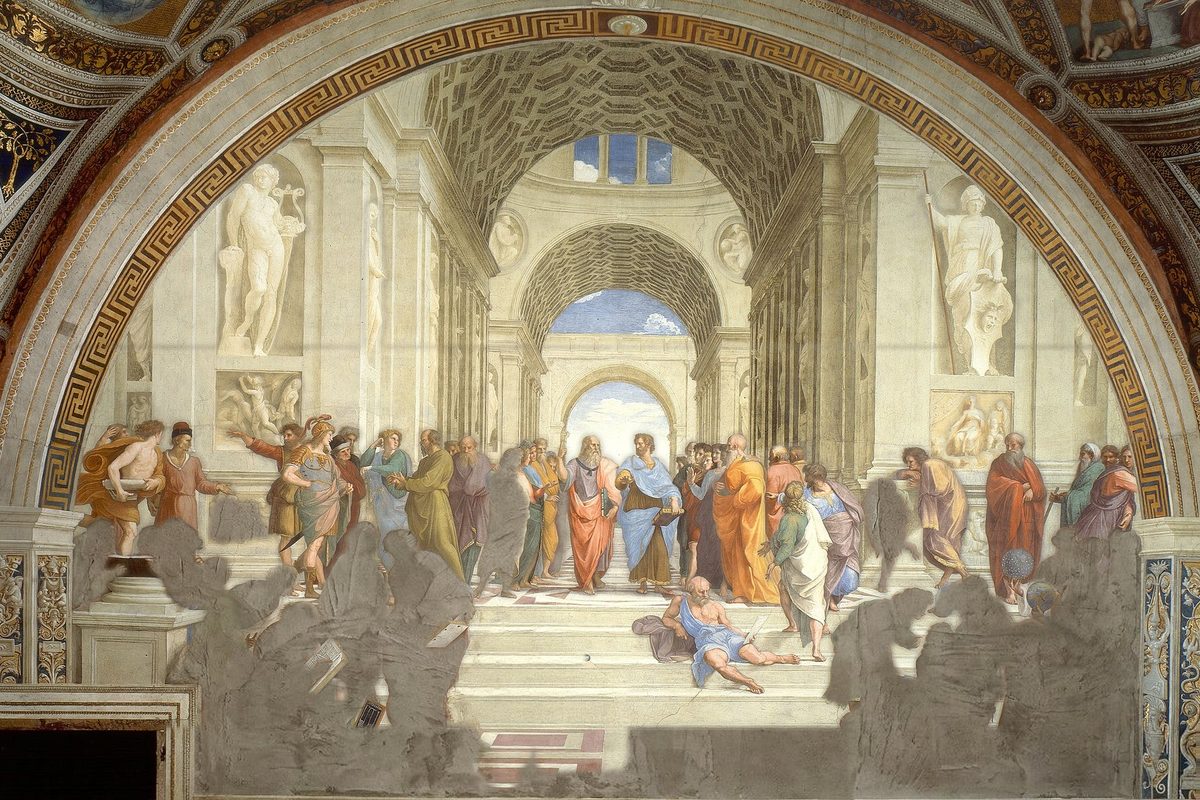
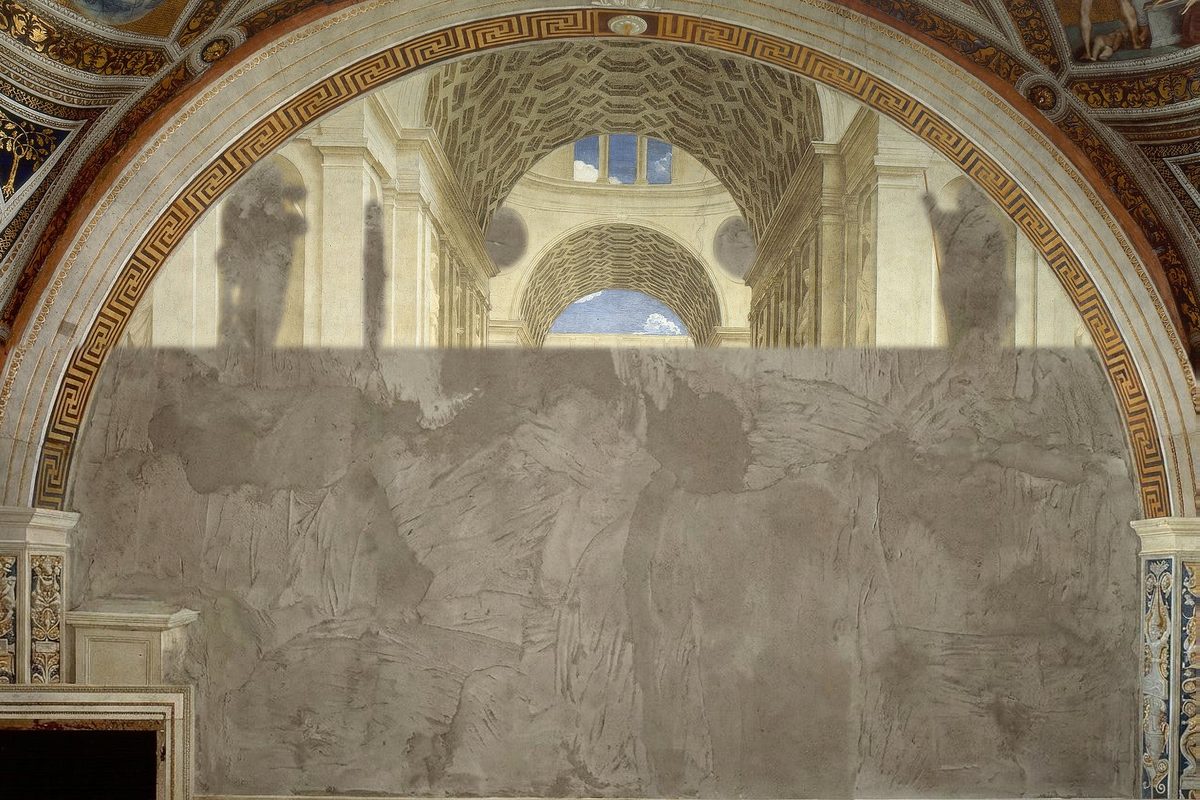
AI reconstruction: Painted architecture with figure-shaped gaps of bare plaster.
ArchitectureGaps left for the figures. AI-generated
Generated with Prodia from a photograph of the wall, so the composition stays in register. They show plausible stages, not a map of the real day-patches.
  1. A rough coat

    The masonry gets a rough layer of lime and sand, the arriccio. No underdrawing on it has been reported.

  2. One day's plaster

    Each morning a patch of fine plaster, the intonaco, is laid for only what you can paint before it dries. That day's patch is a giornata; its edges usually follow contours.

  3. Transfer

    The piece of the copied cartoon for that patch is held to the wet plaster and dabbed with a bag of charcoal dust. Lines for the architecture were probably scored into the plaster, as on the Parnassus.

  4. Count the days

    An old study counts 47 patches on this wall, so about 47 painting days spread over 1509–11. No modern map of them has been published.

Paint downward

EvidenceThe order is inferred from fresco practice; the figures follow the cartoon; analogies from the Parnassus wall. No pigment analysis of this wall has been published.

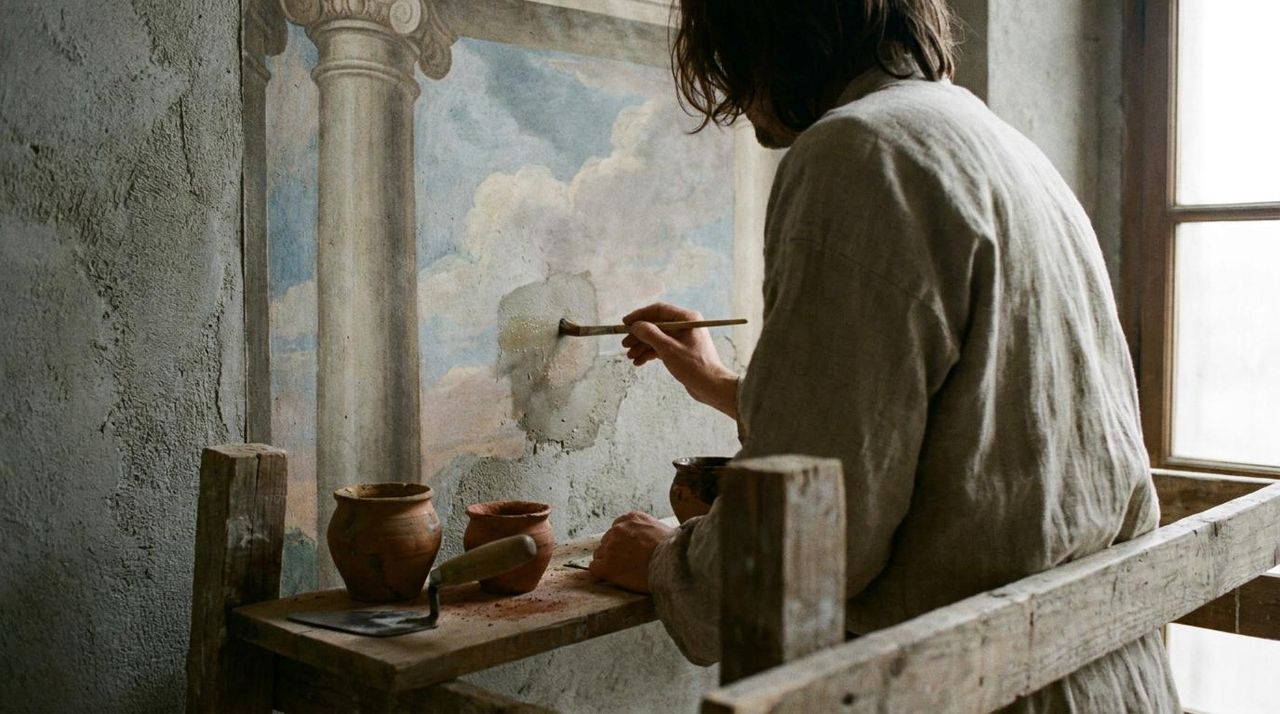
AI-generated reconstruction: a painter seen from behind on a scaffold, painting a patch of fresh plaster beside bare wall, with pigment pots on the boards.
AI-generatedOne patch a day, painted while the plaster is wet, from the top of the wall down.

You paint each patch while it is wet, so the colour, ground in water, binds into the lime as it sets. Work from the top down. Blues are another matter: on the Parnassus, the sky was finished with lapis lazuli painted on dry over a fresco base, and blues on this wall were noted as largely lost by 1846. Expect lime-proof earths, lime white, black and green earth, with the blues added last.

Vaults and sky

AI reconstruction after step 1: The highest patches first, so drips fall on wall not yet painted. The order of every stage after this is inferred.
After step 1 AI-generated
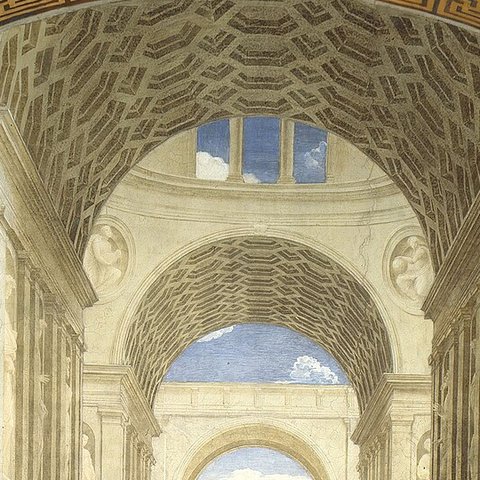
Close-up of the painted coffered barrel vault opening onto blue sky.
The coffered vault: architecture drawn in perspective.

Start at the top, where the plaster is highest, so that drips and splashes fall on wall you have not painted yet. The coffered barrel vaults and the patches of sky come first.

The cartoon has no architecture at all, only perspective lines and a plan sketch, so a separate architectural cartoon was probably used. It is lost.
Architecture and statues

AI reconstruction after step 2: Pilasters, cornices, and Apollo and Minerva in their niches. Figure-shaped gaps wait for their own days.
After step 2 AI-generated
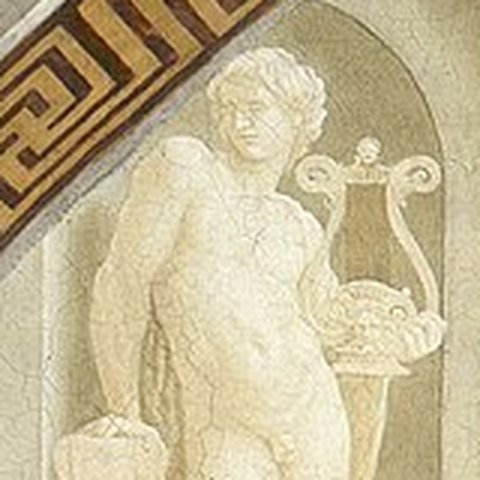
Close-up of the marble statue of Apollo with his lyre in a niche.
Apollo in his niche, drawn from studies of statues.

Next come the pilasters, cornices and the two great statues: Apollo at left and Minerva at right. Your study sheet for Minerva shows the niche drawn with ruler and compass.

A day's patch of plaster usually ends along a contour, so the figures in front of the architecture can wait for days of their own.

The upper figures

AI reconstruction after step 3: Plato and Aristotle at the centre, with the groups on the top step.
After step 3 AI-generated
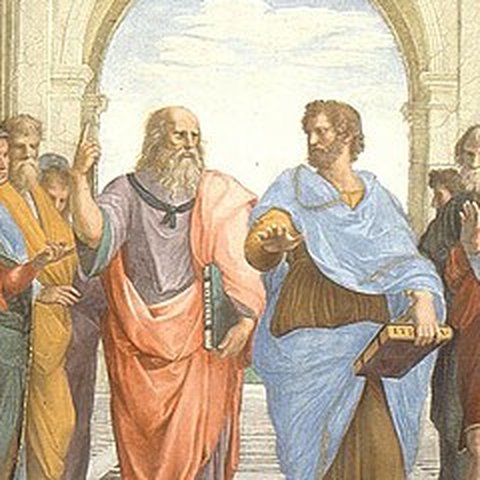
Close-up of Plato, pointing upward, beside Aristotle, gesturing outward, at the centre.
Plato and Aristotle, the centre of the design.

Paint the figures on the top step, with Plato and Aristotle framed by the furthest arch. Their poses follow the cartoon closely.

Faces are painted quickly and finely while the plaster is wet. On the Parnassus wall next door, assistants seem to have worked mainly on drapery.

The steps

AI reconstruction after step 4: The steps, with Diogenes sprawled across them and the two men climbing at right.
After step 4 AI-generated

Then the broad marble steps, with Diogenes sprawled across them and the two men climbing at right, whose poses you worked out in a drawing now in Oxford.

Where Heraclitus sits today, the steps are empty. The cartoon has no one there.

Left foreground

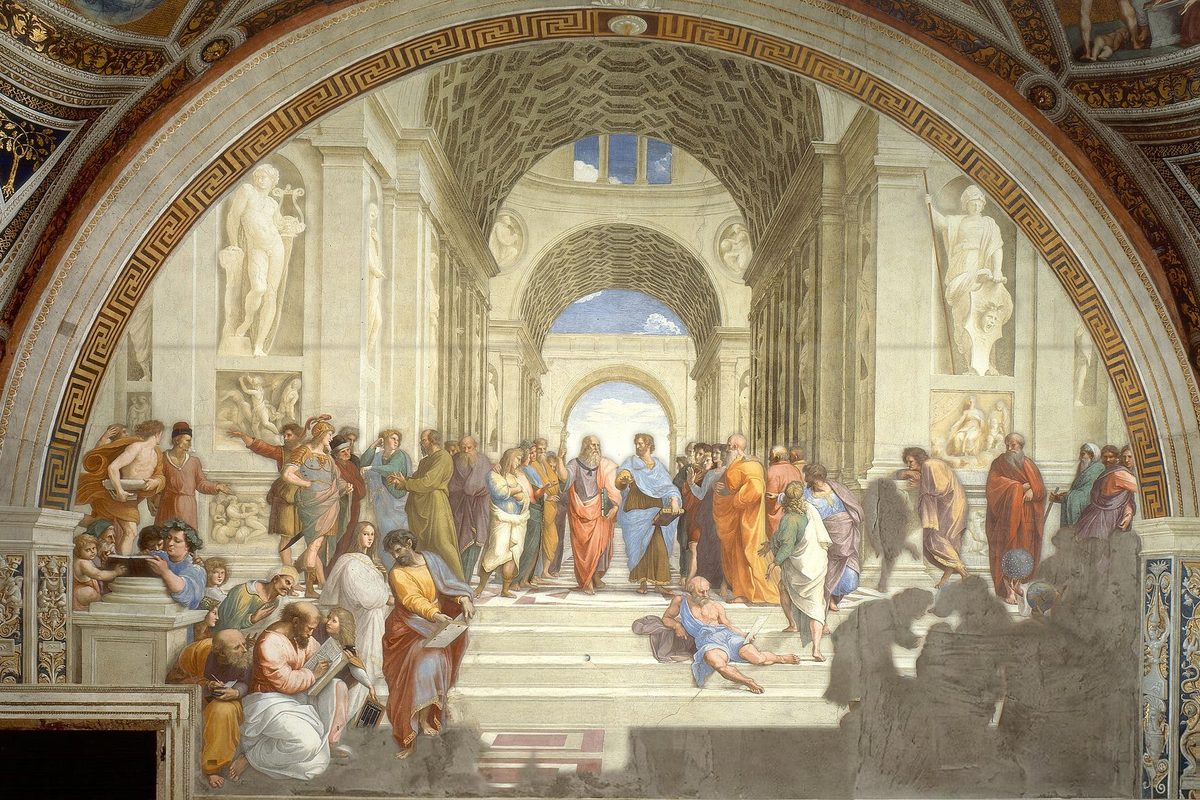
AI reconstruction after step 5: Pythagoras and his group. In front of them the steps are still empty.
After step 5 AI-generated
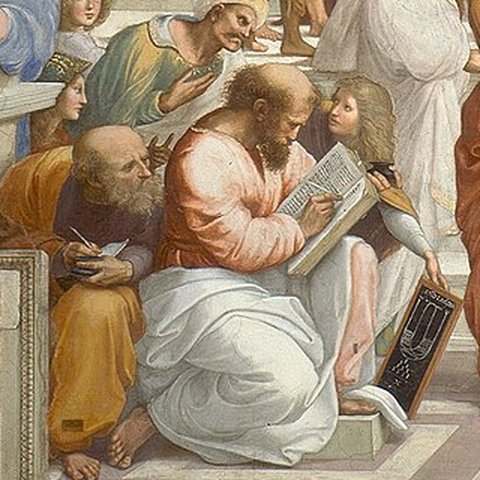
Close-up of Pythagoras writing in a book, surrounded by onlookers.
Pythagoras and his group, as in the Vienna drawing.

Pythagoras writes in his book while the figures round him lean in, much as in your metalpoint study in Vienna. The tablet he is shown is not in the cartoon either.

The floor

AI reconstruction after step 7: The patterned floor, the lowest band. Here the cartoon's design is complete.
After step 7 AI-generated

Last, the lowest band: the patterned floor, laid out in perspective toward the same vanishing point as the vaults. With it, the design of the cartoon is complete.

The afterthought

EvidenceThe cartoon, the plaster join and infrared of the figure. Who he portrays is contested.

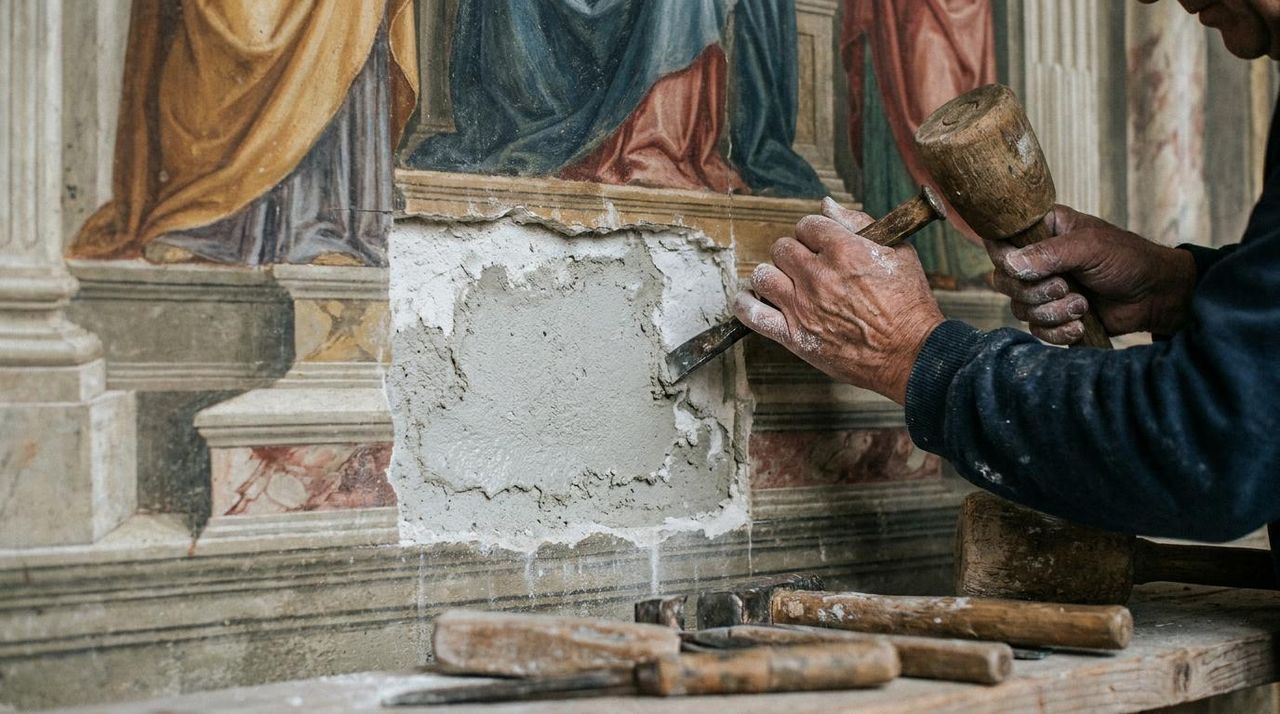
AI-generated reconstruction: a chisel cutting a rectangular patch out of a finished fresco so that fresh plaster can be laid for a new figure.
AI-generatedCutting into the finished wall to lay fresh plaster for one more figure.

When the wall seems finished, you add a man. Heraclitus, brooding on the front step with his head on his hand and writing on a marble block, is not in the cartoon. He sits on his own patch of plaster, set into the dried surface around him.

In infrared, pounce dots run over the whole figure, so you made a separate cartoon for him. He was probably painted after August 1511, when the first half of Michelangelo's Sistine ceiling was unveiled; his heavy, sculptural body recalls its prophets.

Since 1941 he has often been called a portrait of Michelangelo himself. That reading dates from Redig de Campos in 1941, and the art historian Maria Loh calls it an invention; the Ambrosiana says critics now prefer to call the figure il penseroso, the thinker.

What time has changed

EvidenceKeck (1984), citing Bellori; the Vatican Museums; press coverage of the 1995–96 cleaning.

  • In the Sack of Rome in 1527, imperial troops scratched graffiti into this fresco and the Disputa.
  • The wooden panelling below was probably lost then; Perino del Vaga painted the dado under Pope Paul III, between 1534 and 1549.
  • A crust of dust built up over the 17th century. Carlo Maratta began cleaning it in 1702, despite opposition.
  • A cleaning led by Arnold Nesselrath was finished in the spring of 1996. Its findings have not been published online.
  • The cartoon travelled to Paris and back, and was restored in Milan in 2014–19 with new linings and a sprung aluminium frame.

How Raphael thought

  • Draw everything first. Groups, single figures, statues and niches, each worked out on paper before the wall.
  • Design the whole at full size. The cartoon fixes every figure; the wall only carries it out.
  • Plan by the day. Fresco forgives nothing, so each day's patch is planned around what can be finished wet.
  • Change your mind openly. Heraclitus went in after the wall was done, on new plaster.
  • Learn from rivals. Michelangelo's ceiling, a few rooms away, shows in that late figure.

Sources